

Ecological Biochemistry of Corals
321
Il
III
20 fl
I
I
0
.ff!
10f! .7
fl
,f
I
~ 10
/
"
/
C.ll
-t::::: l.f
k
/1
~ 2f!
f
25
/
/
Jf!
/
/
J5 r:!
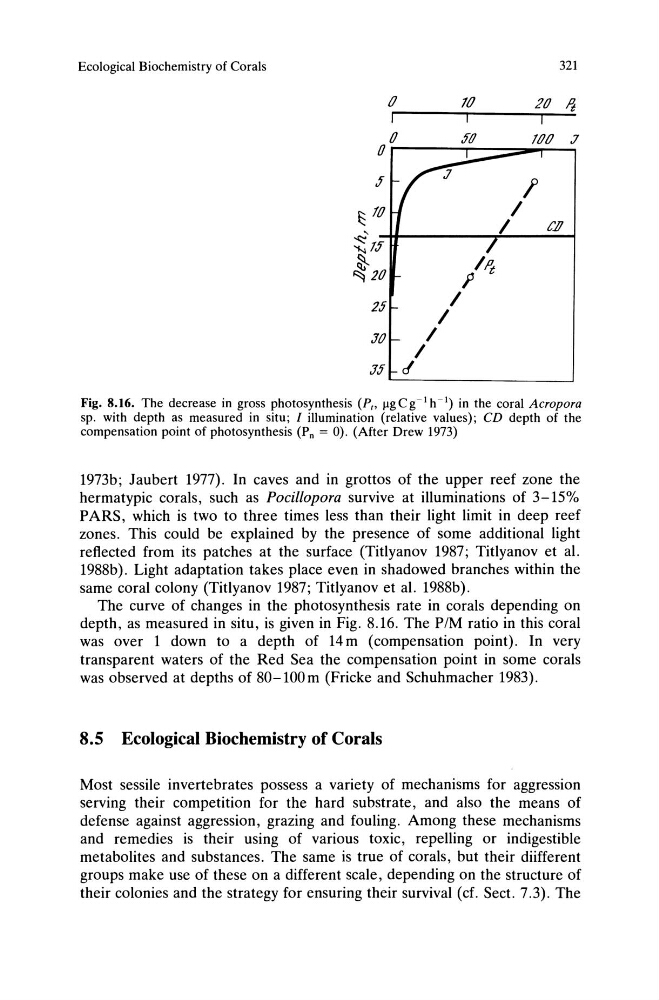
Fig. 8.16. The decrease in gross photosynthesis (Pt , IlgCg-1h-1) in the coral Acropora
sp. with depth as measured in situ; I illumination (relative values); CD depth of the
compensation point of photosynthesis (Pn = 0). (After Drew 1973)
1973b; Jaubert 1977). In caves and in grottos of the upper reef zone the
hermatypic corals, such as Pocillopora survive at illuminations of 3-15%
PARS, which is two to three times less than their light limit in deep reef
zones. This could be explained by the presence of some additional light
reflected from its patches at the surface (Titlyanov 1987; Titlyanov et al.
1988b). Light adaptation takes place even in shadowed branches within the
same coral colony (Titlyanov 1987; Titlyanov et al. 1988b).
The curve of changes in the photosynthesis rate in corals depending on
depth, as measured in situ, is given in Fig. 8.16. The P/M ratio in this coral
was over 1 down to a depth of 14 m (compensation point). In very
transparent waters of the Red Sea the compensation point in some corals
was observed at depths of 80-100m (Fricke and Schuhmacher 1983).
8.5 Ecological Biochemistry of Corals
Most sessile invertebrates possess a variety of mechanisms for aggression
serving their competition for the hard substrate, and also the means of
defense against aggression, grazing and fouling. Among these mechanisms
and remedies is their using of various toxic, repelling or indigestible
metabolites and substances. The same is true of corals, but their diifferent
groups make use of these on a different scale, depending on the structure of
their colonies and the strategy for ensuring their survival (cf. Sect. 7.3). The
321
Il
III
20 fl
I
I
0
.ff!
10f! .7
fl
,f
I
~ 10
/
"
/
C.ll
-t::::: l.f
k
/1
~ 2f!
f
25
/
/
Jf!
/
/
J5 r:!
Fig. 8.16. The decrease in gross photosynthesis (Pt , IlgCg-1h-1) in the coral Acropora
sp. with depth as measured in situ; I illumination (relative values); CD depth of the
compensation point of photosynthesis (Pn = 0). (After Drew 1973)
1973b; Jaubert 1977). In caves and in grottos of the upper reef zone the
hermatypic corals, such as Pocillopora survive at illuminations of 3-15%
PARS, which is two to three times less than their light limit in deep reef
zones. This could be explained by the presence of some additional light
reflected from its patches at the surface (Titlyanov 1987; Titlyanov et al.
1988b). Light adaptation takes place even in shadowed branches within the
same coral colony (Titlyanov 1987; Titlyanov et al. 1988b).
The curve of changes in the photosynthesis rate in corals depending on
depth, as measured in situ, is given in Fig. 8.16. The P/M ratio in this coral
was over 1 down to a depth of 14 m (compensation point). In very
transparent waters of the Red Sea the compensation point in some corals
was observed at depths of 80-100m (Fricke and Schuhmacher 1983).
8.5 Ecological Biochemistry of Corals
Most sessile invertebrates possess a variety of mechanisms for aggression
serving their competition for the hard substrate, and also the means of
defense against aggression, grazing and fouling. Among these mechanisms
and remedies is their using of various toxic, repelling or indigestible
metabolites and substances. The same is true of corals, but their diifferent
groups make use of these on a different scale, depending on the structure of
their colonies and the strategy for ensuring their survival (cf. Sect. 7.3). The