

Ecological Physiology of Photosynthesis in Corals
319
light-adapted corals may use the incoming light energy with an extremely
high efficiency - up to 80% of PARS, with the quantum yield of
photosynthesis up to 16% instead of the 1-2% in normal, unadapted corals,
which in itself proves the perfection of the photosynthesis apparatus in their
zooxanthellae.
Features of light adaptation were found also in permanently selfshadowed branches of coral colonies living in well-illuminated sites of the
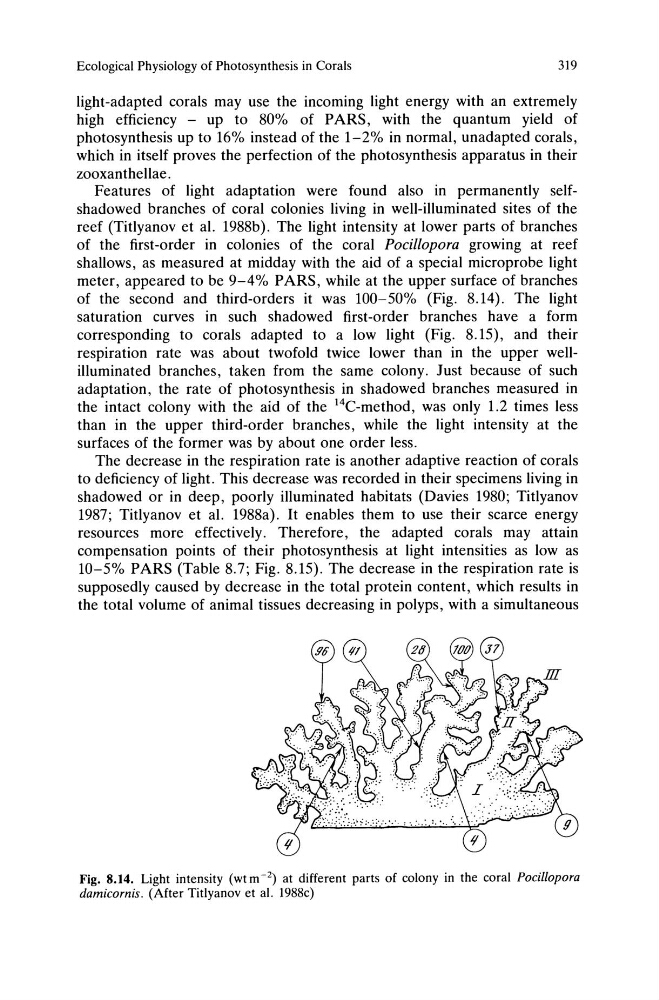
reef (Titlyanov et al. 1988b). The light intensity at lower parts of branches
of the first-order in colonies of the coral Pocillopora growing at reef
shallows, as measured at midday with the aid of a special microprobe light
meter, appeared to be 9-4% PARS, while at the upper surface of branches
of the second and third-orders it was 100-50% (Fig. 8.14). The light
saturation curves in such shadowed first-order branches have a form
corresponding to corals adapted to a low light (Fig. 8.15), and their
respiration rate was about twofold twice lower than in the upper wellilluminated branches, taken from the same colony. Just because of such
adaptation, the rate of photosynthesis in shadowed branches measured in
the intact colony with the aid of the 14C-method, was only 1.2 times less
than in the upper third-order branches, while the light intensity at the
surfaces of the former was by about one order less.
The decrease in the respiration rate is another adaptive reaction of corals
to deficiency of light. This decrease was recorded in their specimens living in
shadowed or in deep, poorly illuminated habitats (Davies 1980; Titlyanov
1987; Titlyanov et al. 1988a). It enables them to use their scarce energy
resources more effectively. Therefore, the adapted corals may attain
compensation points of their photosynthesis at light intensities as low as
10-5% PARS (Table 8.7; Fig. 8.15). The decrease in the respiration rate is
supposedly caused by decrease in the total protein content, which results in
the total volume of animal tissues decreasing in polyps, with a simultaneous
Fig. 8.14. Light intensity (wtm- 2 ) at different parts of colony in the coral Pocillopora
damicornis. (After Titlyanov et al. 1988c)
319
light-adapted corals may use the incoming light energy with an extremely
high efficiency - up to 80% of PARS, with the quantum yield of
photosynthesis up to 16% instead of the 1-2% in normal, unadapted corals,
which in itself proves the perfection of the photosynthesis apparatus in their
zooxanthellae.
Features of light adaptation were found also in permanently selfshadowed branches of coral colonies living in well-illuminated sites of the
reef (Titlyanov et al. 1988b). The light intensity at lower parts of branches
of the first-order in colonies of the coral Pocillopora growing at reef
shallows, as measured at midday with the aid of a special microprobe light
meter, appeared to be 9-4% PARS, while at the upper surface of branches
of the second and third-orders it was 100-50% (Fig. 8.14). The light
saturation curves in such shadowed first-order branches have a form
corresponding to corals adapted to a low light (Fig. 8.15), and their
respiration rate was about twofold twice lower than in the upper wellilluminated branches, taken from the same colony. Just because of such
adaptation, the rate of photosynthesis in shadowed branches measured in
the intact colony with the aid of the 14C-method, was only 1.2 times less
than in the upper third-order branches, while the light intensity at the
surfaces of the former was by about one order less.
The decrease in the respiration rate is another adaptive reaction of corals
to deficiency of light. This decrease was recorded in their specimens living in
shadowed or in deep, poorly illuminated habitats (Davies 1980; Titlyanov
1987; Titlyanov et al. 1988a). It enables them to use their scarce energy
resources more effectively. Therefore, the adapted corals may attain
compensation points of their photosynthesis at light intensities as low as
10-5% PARS (Table 8.7; Fig. 8.15). The decrease in the respiration rate is
supposedly caused by decrease in the total protein content, which results in
the total volume of animal tissues decreasing in polyps, with a simultaneous
Fig. 8.14. Light intensity (wtm- 2 ) at different parts of colony in the coral Pocillopora
damicornis. (After Titlyanov et al. 1988c)