

Feeding of Reef Fish
229
6.3 Feeding of Reef Fish
The study of feeding of reef fish had led to a separation within their
communities of trophic guilds in order to simplify the analysis of their
trophic structure (Hiatt and Strasburg 1960; Randall 1967; Colette and
Talbot 1972; Colette and Earle 1972; Vivien 1973; Davis and Birdsong 1973;
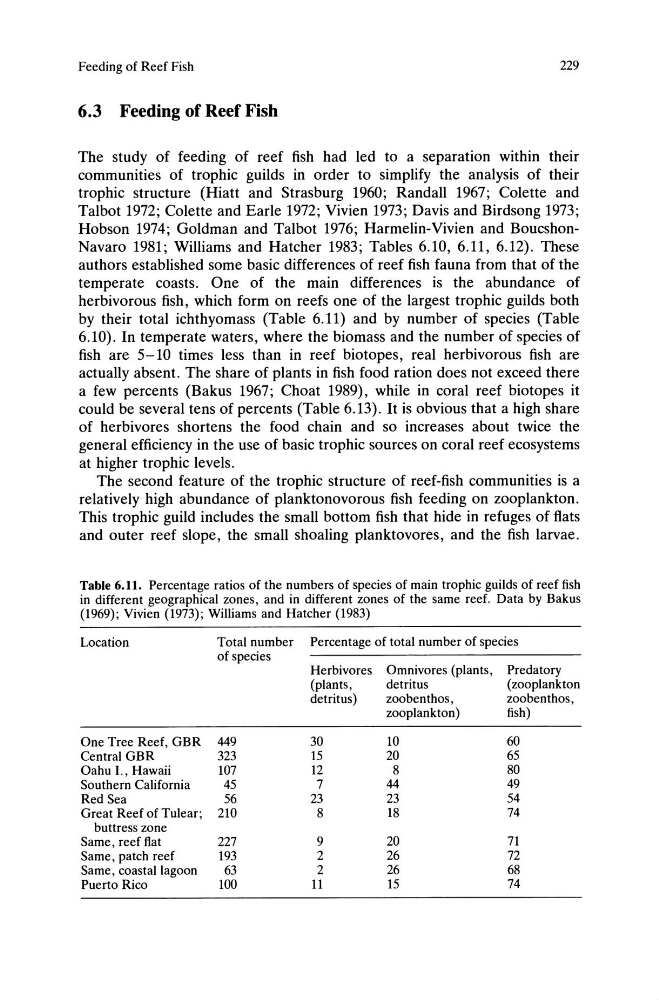
Hobson 1974; Goldman and Talbot 1976; Harmelin-Vivien and BoucshonNavaro 1981; Williams and Hatcher 1983; Tables 6.10, 6.11, 6.12). These
authors established some basic differences of reef fish fauna from that of the
temperate coasts. One of the main differences is the abundance of
herbivorous fish, which form on reefs one of the largest trophic guilds both
by their total ichthyomass (Table 6.11) and by number of species (Table
6.10). In temperate waters, where the biomass and the number of species of
fish are 5-10 times less than in reef biotopes, real herbivorous fish are
actually absent. The share of plants in fish food ration does not exceed there
a few percents (Bakus 1967; Choat 1989), while in coral reef biotopes it
could be several tens of percents (Table 6.13). It is obvious that a high share
of herbivores shortens the food chain and so increases about twice the
general efficiency in the use of basic trophic sources on coral reef ecosystems
at higher trophic levels.
The second feature of the trophic structure of reef-fish communities is a
relatively high abundance of planktonovorous fish feeding on zooplankton.
This trophic guild includes the small bottom fish that hide in refuges of flats
and outer reef slope, the small shoaling planktovores, and the fish larvae.
Table 6.11. Percentage ratios of the numbers of species of main trophic guilds of reef fish
in different geographical zones, and in different zones of the same reef. Data by Bakus
(1969); Vivien (1973); Williams and Hatcher (1983)
Location
Total number Percentage of total number of species
of species
Herbivores Omnivores (plants, Predatory
(plants,
detritus
(zooplankton
detritus)
zoo benthos,
zoobenthos,
zooplankton)
fish)
One Tree Reef, GBR 449
30
10
60
Central GBR
323
15
20
65
Oahu I., Hawaii
107
12
8
80
Southern California
45
7
44
49
Red Sea
56
23
23
54
Great Reef of Tulear; 210
8
18
74
buttress zone
Same, reef fiat
227
9
20
71
Same, patch reef
193
2
26
72
Same, coastal lagoon
63
2
26
68
Puerto Rico
100
11
15
74
229
6.3 Feeding of Reef Fish
The study of feeding of reef fish had led to a separation within their
communities of trophic guilds in order to simplify the analysis of their
trophic structure (Hiatt and Strasburg 1960; Randall 1967; Colette and
Talbot 1972; Colette and Earle 1972; Vivien 1973; Davis and Birdsong 1973;
Hobson 1974; Goldman and Talbot 1976; Harmelin-Vivien and BoucshonNavaro 1981; Williams and Hatcher 1983; Tables 6.10, 6.11, 6.12). These
authors established some basic differences of reef fish fauna from that of the
temperate coasts. One of the main differences is the abundance of
herbivorous fish, which form on reefs one of the largest trophic guilds both
by their total ichthyomass (Table 6.11) and by number of species (Table
6.10). In temperate waters, where the biomass and the number of species of
fish are 5-10 times less than in reef biotopes, real herbivorous fish are
actually absent. The share of plants in fish food ration does not exceed there
a few percents (Bakus 1967; Choat 1989), while in coral reef biotopes it
could be several tens of percents (Table 6.13). It is obvious that a high share
of herbivores shortens the food chain and so increases about twice the
general efficiency in the use of basic trophic sources on coral reef ecosystems
at higher trophic levels.
The second feature of the trophic structure of reef-fish communities is a
relatively high abundance of planktonovorous fish feeding on zooplankton.
This trophic guild includes the small bottom fish that hide in refuges of flats
and outer reef slope, the small shoaling planktovores, and the fish larvae.
Table 6.11. Percentage ratios of the numbers of species of main trophic guilds of reef fish
in different geographical zones, and in different zones of the same reef. Data by Bakus
(1969); Vivien (1973); Williams and Hatcher (1983)
Location
Total number Percentage of total number of species
of species
Herbivores Omnivores (plants, Predatory
(plants,
detritus
(zooplankton
detritus)
zoo benthos,
zoobenthos,
zooplankton)
fish)
One Tree Reef, GBR 449
30
10
60
Central GBR
323
15
20
65
Oahu I., Hawaii
107
12
8
80
Southern California
45
7
44
49
Red Sea
56
23
23
54
Great Reef of Tulear; 210
8
18
74
buttress zone
Same, reef fiat
227
9
20
71
Same, patch reef
193
2
26
72
Same, coastal lagoon
63
2
26
68
Puerto Rico
100
11
15
74