

Zooplankton
N, ~.
700
{fO
107
A
8
r-==:=t ~ _
~
~7~2
3 ~ 'I
1:·:·:1.,. 1IlIIIIII51+ + +17
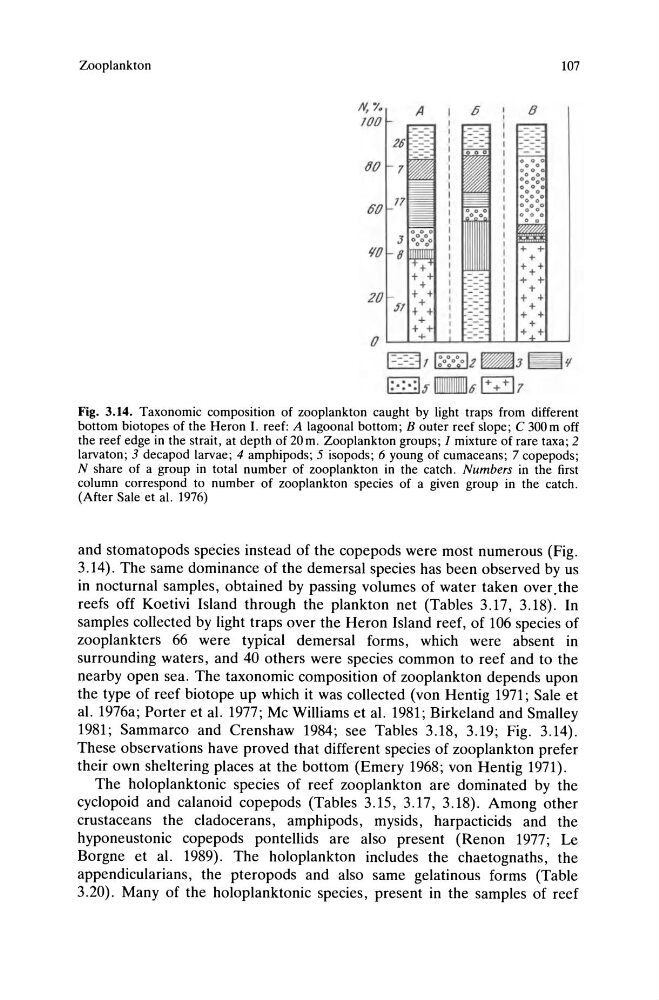
Fig. 3.14. Taxonomic composition of zooplankton caught by light traps from different
bottom biotopes of the Heron I. reef: A lagoonal bottom; B outer reef slope; C 300m off
the reef edge in the strait, at depth of 20 m. Zooplankton groups ; 1 mixture of rare taxa; 2
larvaton; 3 decapod larvae; 4 amphipods; 5 isopods; 6 young of cumaceans; 7 copepods;
N share of a group in total number of zooplankton in the catch. Numbers in the first
column correspond to number of zooplankton species of a given group in the catch .
(After Sale et al. 1976)
and stomatopods species instead of the copepods were most numerous (Fig.
3.14) . The same dominance of the demersal species has been observed by us
in nocturnal samples, obtained by passing volumes of water taken over.the
reefs off Koetivi Island through the plankton net (Tables 3.17, 3.18). In
samples collected by light traps over the Heron Island reef, of 106 species of
zooplankters 66 were typical demersal forms, which were absent in
surrounding waters, and 40 others were species common to reef and to the
nearby open sea. The taxonomic composition of zooplankton depends upon
the type of reef biotope up which it was collected (von Hentig 1971; Sale et
al. 1976a; Porter et al. 1977; Mc Williams et al. 1981; Birkeland and Smalley
1981; Sammarco and Crenshaw 1984; see Tables 3.18, 3.19; Fig. 3.14).
These observations have proved that different species of zooplankton prefer
their own sheltering places at the bottom (Emery 1968; von Hentig 1971).
The holoplanktonic species of reef zooplankton are dominated by the
cyclopoid and calanoid copepods (Tables 3.15, 3.17, 3.18). Among other
crustaceans the cladocerans, amphipods, mysids, harpacticids and the
hyponeustonic copepods pontellids are also present (Renon 1977; Le
Borgne et al. 1989). The holoplankton includes the chaetognaths, the
appendicularians, the pteropods and also same gelatinous forms (Table
3.20) . Many of the holoplanktonic species, present in the samples of reef
N, ~.
700
{fO
107
A
8
r-==:=t ~ _
~
~7~2
3 ~ 'I
1:·:·:1.,. 1IlIIIIII51+ + +17
Fig. 3.14. Taxonomic composition of zooplankton caught by light traps from different
bottom biotopes of the Heron I. reef: A lagoonal bottom; B outer reef slope; C 300m off
the reef edge in the strait, at depth of 20 m. Zooplankton groups ; 1 mixture of rare taxa; 2
larvaton; 3 decapod larvae; 4 amphipods; 5 isopods; 6 young of cumaceans; 7 copepods;
N share of a group in total number of zooplankton in the catch. Numbers in the first
column correspond to number of zooplankton species of a given group in the catch .
(After Sale et al. 1976)
and stomatopods species instead of the copepods were most numerous (Fig.
3.14) . The same dominance of the demersal species has been observed by us
in nocturnal samples, obtained by passing volumes of water taken over.the
reefs off Koetivi Island through the plankton net (Tables 3.17, 3.18). In
samples collected by light traps over the Heron Island reef, of 106 species of
zooplankters 66 were typical demersal forms, which were absent in
surrounding waters, and 40 others were species common to reef and to the
nearby open sea. The taxonomic composition of zooplankton depends upon
the type of reef biotope up which it was collected (von Hentig 1971; Sale et
al. 1976a; Porter et al. 1977; Mc Williams et al. 1981; Birkeland and Smalley
1981; Sammarco and Crenshaw 1984; see Tables 3.18, 3.19; Fig. 3.14).
These observations have proved that different species of zooplankton prefer
their own sheltering places at the bottom (Emery 1968; von Hentig 1971).
The holoplanktonic species of reef zooplankton are dominated by the
cyclopoid and calanoid copepods (Tables 3.15, 3.17, 3.18). Among other
crustaceans the cladocerans, amphipods, mysids, harpacticids and the
hyponeustonic copepods pontellids are also present (Renon 1977; Le
Borgne et al. 1989). The holoplankton includes the chaetognaths, the
appendicularians, the pteropods and also same gelatinous forms (Table
3.20) . Many of the holoplanktonic species, present in the samples of reef