

100
P
oil
.f"1l
JI!
21l
If!
Plankton in Coral-Reef Waters
J. Nt/nut/p
Clle Bay
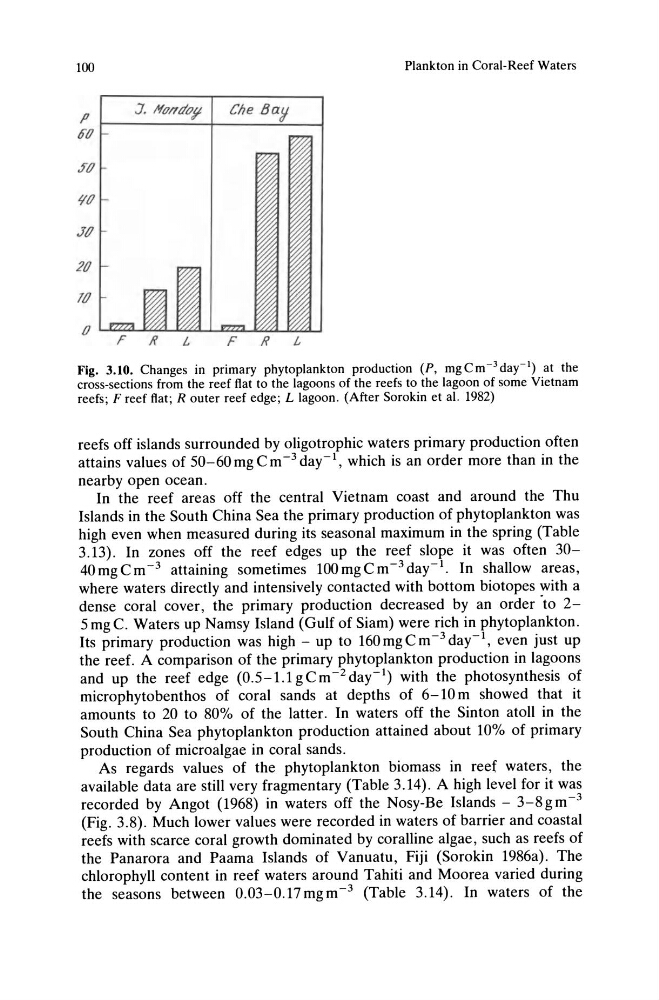
Fig. 3.10. Changes in primary phytoplankton production (P, mgCm- 3 day-l) at the
cross-sections from the reef flat to the lagoons of the reefs to the lagoon of some Vietnam
reefs; F reef flat; R outer reef edge; L lagoon. (After Sorokin et al. 1982)
reefs off islands surrounded by oligotrophic waters primary production often
attains values of SO-60mgCm- 3 day-l, which is an order more than in the
nearby open ocean.
In the reef areas off the central Vietnam coast and around the Thu
Islands in the South China Sea the primary production of phytoplankton was
high even when measured during its seasonal maximum in the spring (Table
3.13). In zones off the reef edges up the reef slope it was often 3040 mg C m -3 attaining sometimes 100 mg C m -3 day-I. In shallow areas,
where waters directly and intensively contacted with bottom biotopes with a
dense coral cover, the primary production decreased by an order -to 2S mg C. Waters up Namsy Island (Gulf of Siam) were rich in phytoplankton.
Its primary production was high - up to 160mgCm- 3 day-l, even just up
the reef. A comparison of the primary phytoplankton production in lagoons
and up the reef edge (0.S-1.1gCm- 2 day-l) with the photosynthesis of
microphytobenthos of coral sands at depths of 6-10 m showed that it
amounts to 20 to 80% of the latter. In waters off the Sinton atoll in the
South China Sea phytoplankton production attained about 10% of primary
production of microalgae in coral sands.
As regards values of the phytoplankton biomass in reef waters, the
available data are still very fragmentary (Table 3.14). A high level for it was
recorded by Angot (1968) in waters off the Nosy-Be Islands - 3-8gm- 3
(Fig. 3.8). Much lower values were recorded in waters of barrier and coastal
reefs with scarce coral growth dominated by coralline algae, such as reefs of
the Panarora and Paama Islands of Vanuatu, Fiji (Sorokin 1986a). The
chlorophyll content in reef waters around Tahiti and Moorea varied during
the seasons between 0.03-0.17mgm- 3 (Table 3.14) . In waters of the
P
oil
.f"1l
JI!
21l
If!
Plankton in Coral-Reef Waters
J. Nt/nut/p
Clle Bay
Fig. 3.10. Changes in primary phytoplankton production (P, mgCm- 3 day-l) at the
cross-sections from the reef flat to the lagoons of the reefs to the lagoon of some Vietnam
reefs; F reef flat; R outer reef edge; L lagoon. (After Sorokin et al. 1982)
reefs off islands surrounded by oligotrophic waters primary production often
attains values of SO-60mgCm- 3 day-l, which is an order more than in the
nearby open ocean.
In the reef areas off the central Vietnam coast and around the Thu
Islands in the South China Sea the primary production of phytoplankton was
high even when measured during its seasonal maximum in the spring (Table
3.13). In zones off the reef edges up the reef slope it was often 3040 mg C m -3 attaining sometimes 100 mg C m -3 day-I. In shallow areas,
where waters directly and intensively contacted with bottom biotopes with a
dense coral cover, the primary production decreased by an order -to 2S mg C. Waters up Namsy Island (Gulf of Siam) were rich in phytoplankton.
Its primary production was high - up to 160mgCm- 3 day-l, even just up
the reef. A comparison of the primary phytoplankton production in lagoons
and up the reef edge (0.S-1.1gCm- 2 day-l) with the photosynthesis of
microphytobenthos of coral sands at depths of 6-10 m showed that it
amounts to 20 to 80% of the latter. In waters off the Sinton atoll in the
South China Sea phytoplankton production attained about 10% of primary
production of microalgae in coral sands.
As regards values of the phytoplankton biomass in reef waters, the
available data are still very fragmentary (Table 3.14). A high level for it was
recorded by Angot (1968) in waters off the Nosy-Be Islands - 3-8gm- 3
(Fig. 3.8). Much lower values were recorded in waters of barrier and coastal
reefs with scarce coral growth dominated by coralline algae, such as reefs of
the Panarora and Paama Islands of Vanuatu, Fiji (Sorokin 1986a). The
chlorophyll content in reef waters around Tahiti and Moorea varied during
the seasons between 0.03-0.17mgm- 3 (Table 3.14) . In waters of the