

Phytoplankton
101
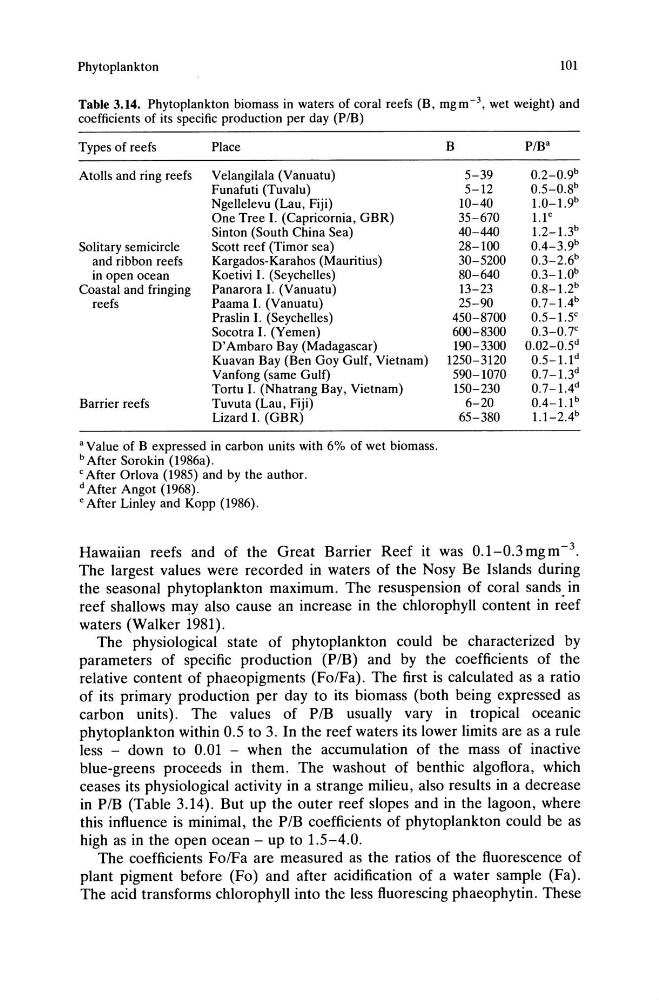
Table 3.14. Phytoplankton biomass in waters of coral reefs (B, mgm- 3 , wet weight) and
coefficients of its specific production per day (P/B)
Types of reefs
Atolls and ring reefs
Solitary semicircle
and ribbon reefs
in open ocean
Coastal and fringing
reefs
Barrier reefs
Place
Velangilala (Vanuatu)
Funafuti (Tuvalu)
Ngellelevu (Lau, Fiji)
One Tree I. (Capricornia, GBR)
Sinton (South China Sea)
Scott reef (Timor sea)
Kargados-Karahos (Mauritius)
Koetivi I. (Seychelles)
Panarora I. (Vanuatu)
Paama I. (Vanuatu)
Praslin I. (Seychelles)
Socotra I. (Yemen)
D'Ambaro Bay (Madagascar)
Kuavan Bay (Ben Goy Gulf, Vietnam)
Vanfong (same Gulf)
Tortu I. (Nhatrang Bay, Vietnam)
Tuvuta (Lau, Fiji)
Lizard I. (GBR)
a Value of B expressed in carbon units with 6% of wet biomass.
b After Sorokin (1986a).
c After Orlova (1985) and by the author.
dAfter Angot (1968).
e After Linley and Kopp (1986).
B
5-39
5-12
10-40
35-670
40-440
28-100
30-5200
80-640
13-23
25-90
450-8700
600-8300
190-3300
1250-3120
590-1070
150-230
6-20
65-380
P/B a
0.2-0.9 b
0.5-0.8 b
1.0-1.9 b
1.1 e
1.2-1.3 b
0.4-3.9 b
0.3-2.6 b
0.3-1.0 b
0.8-1.2b
0.7-1.4b
0.5-1S
0.3-0.7 c
0.02-0.5 d
0.5-1.1 d
0.7-1.3 d
0.7-1.4d
0.4-1.1 b
1.1-2.4 b
Hawaiian reefs and of the Great Barrier Reef it was 0.1-0.3 mg m -3.
The largest values were recorded in waters of the Nosy Be Islands during
the seasonal phytoplankton maximum. The resuspension of coral sands in
reef shallows may also cause an increase in the chlorophyll content in reef
waters (Walker 1981).
The physiological state of phytoplankton could be characterized by
parameters of specific production (P/B) and by the coefficients of the
relative content of phaeopigments (Fo/Fa). The first is calculated as a ratio
of its primary production per day to its biomass (both being expressed as
carbon units). The values of PIB usually vary in tropical oceanic
phytoplankton within 0.5 to 3. In the reef waters its lower limits are as a rule
less - down to 0.01 - when the accumulation of the mass of inactive
blue-greens proceeds in them. The washout of benthic algoflora, which
ceases its physiological activity in a strange milieu, also results in a decrease
in P/B (Table 3.14). But up the outer reef slopes and in the lagoon, where
this influence is minimal, the P/B coefficients of phytoplankton could be as
high as in the open ocean - up to 1.5-4.0.
The coefficients FolFa are measured as the ratios of the fluorescence of
plant pigment before (Fo) and after acidification of a water sample (Fa).
The acid transforms chlorophyll into the less fluorescing phaeophytin. These
101
Table 3.14. Phytoplankton biomass in waters of coral reefs (B, mgm- 3 , wet weight) and
coefficients of its specific production per day (P/B)
Types of reefs
Atolls and ring reefs
Solitary semicircle
and ribbon reefs
in open ocean
Coastal and fringing
reefs
Barrier reefs
Place
Velangilala (Vanuatu)
Funafuti (Tuvalu)
Ngellelevu (Lau, Fiji)
One Tree I. (Capricornia, GBR)
Sinton (South China Sea)
Scott reef (Timor sea)
Kargados-Karahos (Mauritius)
Koetivi I. (Seychelles)
Panarora I. (Vanuatu)
Paama I. (Vanuatu)
Praslin I. (Seychelles)
Socotra I. (Yemen)
D'Ambaro Bay (Madagascar)
Kuavan Bay (Ben Goy Gulf, Vietnam)
Vanfong (same Gulf)
Tortu I. (Nhatrang Bay, Vietnam)
Tuvuta (Lau, Fiji)
Lizard I. (GBR)
a Value of B expressed in carbon units with 6% of wet biomass.
b After Sorokin (1986a).
c After Orlova (1985) and by the author.
dAfter Angot (1968).
e After Linley and Kopp (1986).
B
5-39
5-12
10-40
35-670
40-440
28-100
30-5200
80-640
13-23
25-90
450-8700
600-8300
190-3300
1250-3120
590-1070
150-230
6-20
65-380
P/B a
0.2-0.9 b
0.5-0.8 b
1.0-1.9 b
1.1 e
1.2-1.3 b
0.4-3.9 b
0.3-2.6 b
0.3-1.0 b
0.8-1.2b
0.7-1.4b
0.5-1S
0.3-0.7 c
0.02-0.5 d
0.5-1.1 d
0.7-1.3 d
0.7-1.4d
0.4-1.1 b
1.1-2.4 b
Hawaiian reefs and of the Great Barrier Reef it was 0.1-0.3 mg m -3.
The largest values were recorded in waters of the Nosy Be Islands during
the seasonal phytoplankton maximum. The resuspension of coral sands in
reef shallows may also cause an increase in the chlorophyll content in reef
waters (Walker 1981).
The physiological state of phytoplankton could be characterized by
parameters of specific production (P/B) and by the coefficients of the
relative content of phaeopigments (Fo/Fa). The first is calculated as a ratio
of its primary production per day to its biomass (both being expressed as
carbon units). The values of PIB usually vary in tropical oceanic
phytoplankton within 0.5 to 3. In the reef waters its lower limits are as a rule
less - down to 0.01 - when the accumulation of the mass of inactive
blue-greens proceeds in them. The washout of benthic algoflora, which
ceases its physiological activity in a strange milieu, also results in a decrease
in P/B (Table 3.14). But up the outer reef slopes and in the lagoon, where
this influence is minimal, the P/B coefficients of phytoplankton could be as
high as in the open ocean - up to 1.5-4.0.
The coefficients FolFa are measured as the ratios of the fluorescence of
plant pigment before (Fo) and after acidification of a water sample (Fa).
The acid transforms chlorophyll into the less fluorescing phaeophytin. These