

Phytoplankton
99
semiclosed lagoon of the Fanning atoll during the development of the
dinoflagellates and the Nostoc-type blue-greens in its waters (Gordon et al.
1971). Thus, in lagoons of some ring reefs abundant communities of
phytoplankton are developing periodically. The chlorophyll content in
waters of ring reefs is also usually 5-10 times more than in surrounding
oceanic waters, being 0.2-1 mg m -3 (Kollentz-Mishke and Fortus 1980).
Seasonal observation in the lagoon of the Takapoto atoll showed its
fluctuations to be within 0.22 to 0.77mgm- 3 (Sournia and Ricard 1976a) .
In waters of barrier and coastal fringing reefs primary production values
were very variable in their different zones. The lowest primary production
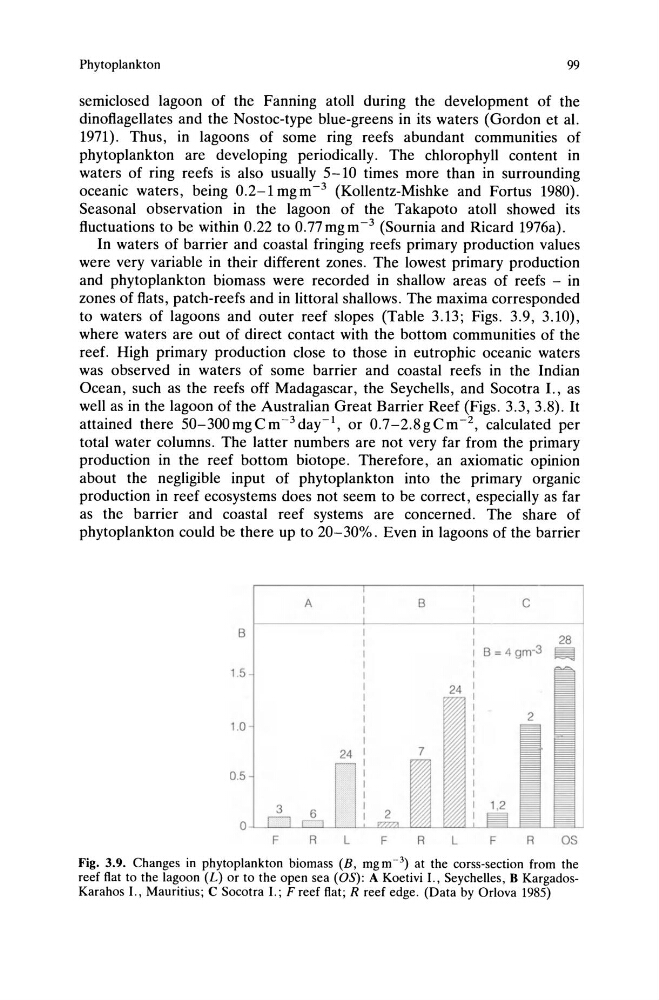
and phytoplankton biomass were recorded in shallow areas of reefs - in
zones of flats , patch-reefs and in littoral shallows. The maxima corresponded
to waters of lagoons and outer reef slopes (Table 3.13; Figs. 3.9, 3.10),
where waters are out of direct contact with the bottom communities of the
reef. High primary production close to those in eutrophic oceanic waters
was observed in waters of some barrier and coastal reefs in the Indian
Ocean, such as the reefs off Madagascar, the Seychells, and Socotra I., as
well as in the lagoon of the Australian Great Barrier Reef (Figs. 3.3, 3.8) . It
attained there 50-300mgCm- 3 day-l, or 0.7-2.8gCm- 2 , calculated per
total water columns. The latter numbers are not very far from the primary
production in the reef bottom biotope. Therefore, an axiomatic opinion
about the negligible input of phytoplankton into the primary organic
production in reef ecosystems does not seem to be correct, especially as far
as the barrier and coastal reef systems are concerned. The share of
phytoplankton could be there up to 20-30%. Even in lagoons of the barrier
A
B
C
B
28
B = 4 gm-3 ~
1.5
1.0
0.5
0
F
R
L
F
R
L
F
R
OS
Fig. 3.9. Changes in phytoplankton biomass (B, mg m- 3 ) at the corss-section from the
reef fiat to the lagoon (L) or to the open sea (OS): A Koetivi I., Seychelles, B KargadosKarahos I., Mauritius; C Socotra I.; F reef fiat; R reef edge. (Data by Orlova 1985)
99
semiclosed lagoon of the Fanning atoll during the development of the
dinoflagellates and the Nostoc-type blue-greens in its waters (Gordon et al.
1971). Thus, in lagoons of some ring reefs abundant communities of
phytoplankton are developing periodically. The chlorophyll content in
waters of ring reefs is also usually 5-10 times more than in surrounding
oceanic waters, being 0.2-1 mg m -3 (Kollentz-Mishke and Fortus 1980).
Seasonal observation in the lagoon of the Takapoto atoll showed its
fluctuations to be within 0.22 to 0.77mgm- 3 (Sournia and Ricard 1976a) .
In waters of barrier and coastal fringing reefs primary production values
were very variable in their different zones. The lowest primary production
and phytoplankton biomass were recorded in shallow areas of reefs - in
zones of flats , patch-reefs and in littoral shallows. The maxima corresponded
to waters of lagoons and outer reef slopes (Table 3.13; Figs. 3.9, 3.10),
where waters are out of direct contact with the bottom communities of the
reef. High primary production close to those in eutrophic oceanic waters
was observed in waters of some barrier and coastal reefs in the Indian
Ocean, such as the reefs off Madagascar, the Seychells, and Socotra I., as
well as in the lagoon of the Australian Great Barrier Reef (Figs. 3.3, 3.8) . It
attained there 50-300mgCm- 3 day-l, or 0.7-2.8gCm- 2 , calculated per
total water columns. The latter numbers are not very far from the primary
production in the reef bottom biotope. Therefore, an axiomatic opinion
about the negligible input of phytoplankton into the primary organic
production in reef ecosystems does not seem to be correct, especially as far
as the barrier and coastal reef systems are concerned. The share of
phytoplankton could be there up to 20-30%. Even in lagoons of the barrier
A
B
C
B
28
B = 4 gm-3 ~
1.5
1.0
0.5
0
F
R
L
F
R
L
F
R
OS
Fig. 3.9. Changes in phytoplankton biomass (B, mg m- 3 ) at the corss-section from the
reef fiat to the lagoon (L) or to the open sea (OS): A Koetivi I., Seychelles, B KargadosKarahos I., Mauritius; C Socotra I.; F reef fiat; R reef edge. (Data by Orlova 1985)