

ocean-wave influenced; and located at the river end, the
processes are river-current influenced, estuarine-wave
dominated, and less tide influenced.
The shape of an estuary and its relationship to its marine
entrance and its relationship to prevailing wind and windwave trains also influence the hydrodynamic factors of
beaches that affect their shape and sedimentology and the
extent that beaches are backed by beach ridges or dunes.
The processes of waves and tides result in different
slopes and heights to beaches. Commonly, a beach within
an estuary, as a sloping sandy surface, may involve the
whole tidal zone of a shore, or only the mid-tidal to
high-tidal part of the shore, with the low-tidal part being
a low-tidal sand flat, low-tidal muddy sand flat, or
low-tidal mud flat. With stronger wave action, beaches
within an estuary may have a slope from low- to high-tidal
level. Slopes of beaches vary from relatively steep, to
moderately sloping, and to low-gradient slopes, and spatially, beaches vary from narrow to wide. Where beaches
are exposed to onshore wind, during low tide
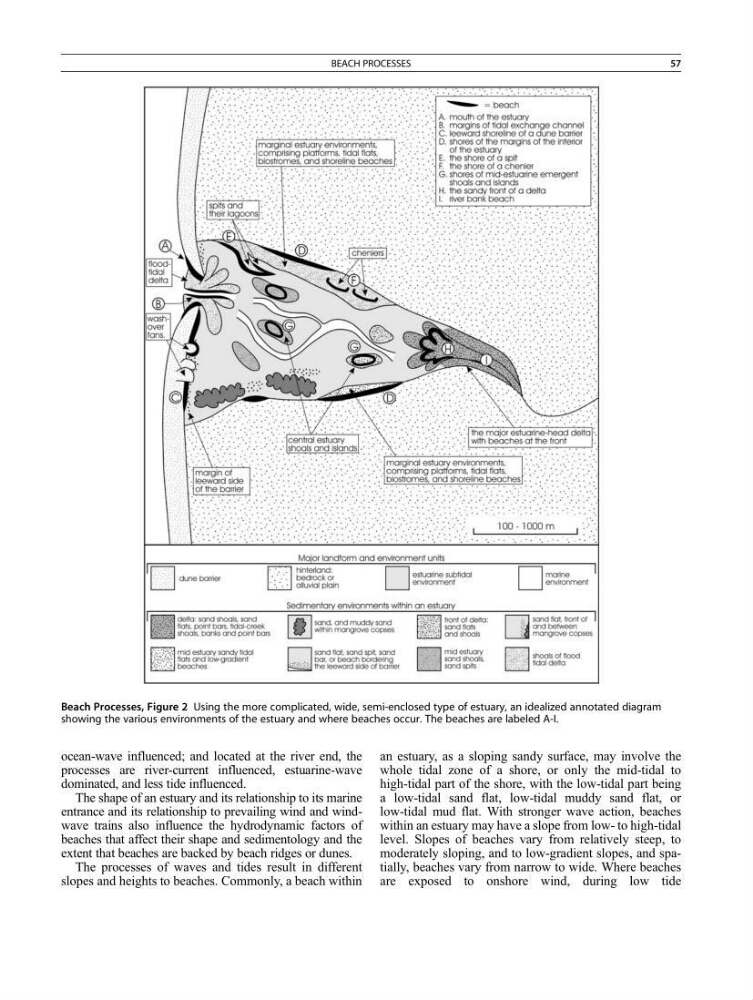
Beach Processes, Figure 2 Using the more complicated, wide, semi-enclosed type of estuary, an idealized annotated diagram
showing the various environments of the estuary and where beaches occur. The beaches are labeled A-I.
BEACH PROCESSES
57
processes are river-current influenced, estuarine-wave
dominated, and less tide influenced.
The shape of an estuary and its relationship to its marine
entrance and its relationship to prevailing wind and windwave trains also influence the hydrodynamic factors of
beaches that affect their shape and sedimentology and the
extent that beaches are backed by beach ridges or dunes.
The processes of waves and tides result in different
slopes and heights to beaches. Commonly, a beach within
an estuary, as a sloping sandy surface, may involve the
whole tidal zone of a shore, or only the mid-tidal to
high-tidal part of the shore, with the low-tidal part being
a low-tidal sand flat, low-tidal muddy sand flat, or
low-tidal mud flat. With stronger wave action, beaches
within an estuary may have a slope from low- to high-tidal
level. Slopes of beaches vary from relatively steep, to
moderately sloping, and to low-gradient slopes, and spatially, beaches vary from narrow to wide. Where beaches
are exposed to onshore wind, during low tide
Beach Processes, Figure 2 Using the more complicated, wide, semi-enclosed type of estuary, an idealized annotated diagram
showing the various environments of the estuary and where beaches occur. The beaches are labeled A-I.
BEACH PROCESSES
57