

action and storms, the type of sediment that comprises the
uplands, the amount of sediment that is delivered to the
shore from the estuary or from erosion of the uplands,
and the tidal range. A brief description of estuarine
beaches in terms of setting, environmental processes,
and substrate types is provided later. A selection of
beaches in estuaries is shown in Figures 3 and 4.
From seaward to the river along the length of an estuary,
the different parts of an estuary vary in relation to the
prevailing hydrodynamic conditions. Beaches, for example, are subject to varying oceanic waves, intra-estuarine
waves, tides, river currents, floods, and wind, depending
on their location. This concept, expressed sedimentologically in facies and stratigraphy along the marine-to-river
transition in an estuary, is described by Dalrymple
et al. (1992) and is, in principle, also applicable to categorizing and comparing processes and products of estuarine
beaches in their locations along, and within, an estuary.
Located at the seaward end of an estuary, the hydrodynamic
processes are more tide and ocean-wave dominated;
located in the central parts of the estuary, the processes
are tide influenced, estuarine-wave dominated, and less
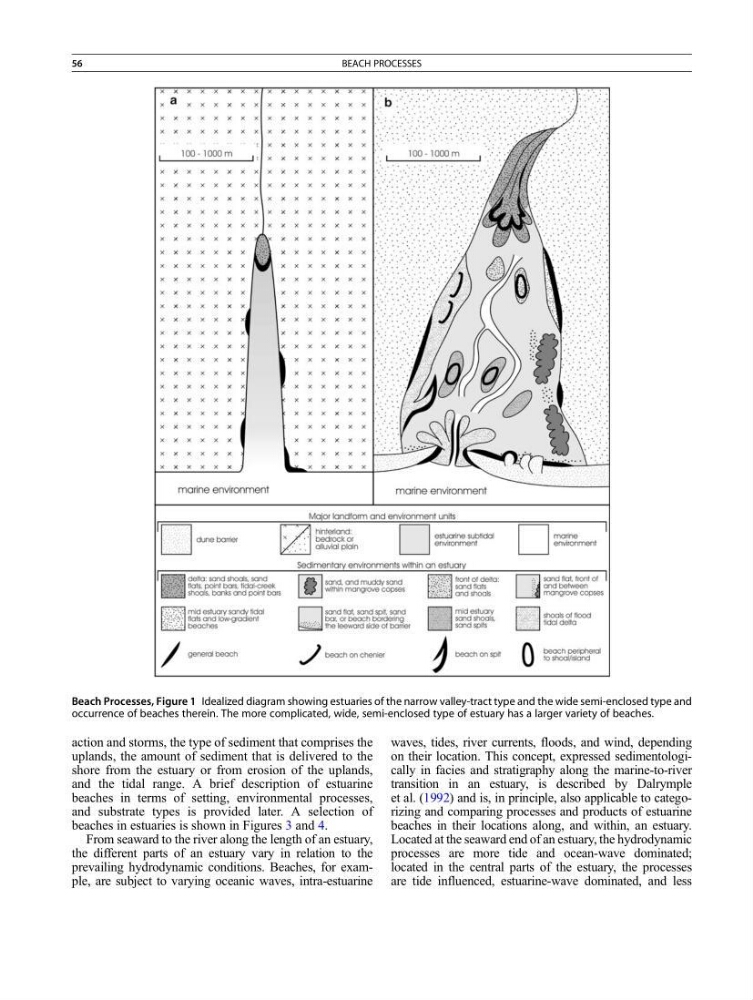
Beach Processes, Figure 1 Idealized diagram showing estuaries of the narrow valley-tract type and the wide semi-enclosed type and
occurrence of beaches therein. The more complicated, wide, semi-enclosed type of estuary has a larger variety of beaches.
56
BEACH PROCESSES
uplands, the amount of sediment that is delivered to the
shore from the estuary or from erosion of the uplands,
and the tidal range. A brief description of estuarine
beaches in terms of setting, environmental processes,
and substrate types is provided later. A selection of
beaches in estuaries is shown in Figures 3 and 4.
From seaward to the river along the length of an estuary,
the different parts of an estuary vary in relation to the
prevailing hydrodynamic conditions. Beaches, for example, are subject to varying oceanic waves, intra-estuarine
waves, tides, river currents, floods, and wind, depending
on their location. This concept, expressed sedimentologically in facies and stratigraphy along the marine-to-river
transition in an estuary, is described by Dalrymple
et al. (1992) and is, in principle, also applicable to categorizing and comparing processes and products of estuarine
beaches in their locations along, and within, an estuary.
Located at the seaward end of an estuary, the hydrodynamic
processes are more tide and ocean-wave dominated;
located in the central parts of the estuary, the processes
are tide influenced, estuarine-wave dominated, and less
Beach Processes, Figure 1 Idealized diagram showing estuaries of the narrow valley-tract type and the wide semi-enclosed type and
occurrence of beaches therein. The more complicated, wide, semi-enclosed type of estuary has a larger variety of beaches.
56
BEACH PROCESSES