

(and particularly during low spring tide), aeolian transport
sweeps up fine and medium sand from the dry part of the
beach to construct a landward low beach ridge above the
storm water level. With accretion, the beach ridges may
become low dunes. As such, some beaches in estuarine
environments are backed by beach ridges and/or dunes.
Some profiles of beaches from different estuaries, and
ranging from those concavely sloping from high tide to
low tide and relatively steep (Botany Bay entrance) to
those bordered by a low-tidal flat (Sans Souci, Botany
Bay), those bordered by beach ridges/dunes (Deep River
Delta, Nornalup Inlet), and those fronting a barrier that
shelters a peat-filled lagoon (bar-and-lagoon complex,
Nornalup Inlet), are shown in Figure 5.
Wave fields, whether deriving from the open ocean and
propagating through the estuary entrance or as wind
waves generated within the estuary, in crossing an estuary
and impinging on its shores can transport, rework, and
winnow sediment to leave a sandy to gravelly deposit, as
well as recurringly sorting sediment granulometrically to
leave stratigraphically distinctive layers and packages.
Storm waves, similarly deriving from open ocean areas
or generated within the estuary can transport, rework,
and winnow sediment and, additionally, can emplace sediments above the level of the highest tide, often leaving
a distinctive stratigraphic, lithologic, and granulometric
signature. Combined with wind and wind-induced currents, storms deriving from the ocean can deliver floating
debris such as marine algae, seagrass, and shells, as well as
chunks of wood, branches, leaves, logs, and the mollusks
Spirula and cuttlefish skeletons that accumulate on the
beach to form a distinctive sedimentary deposit at the
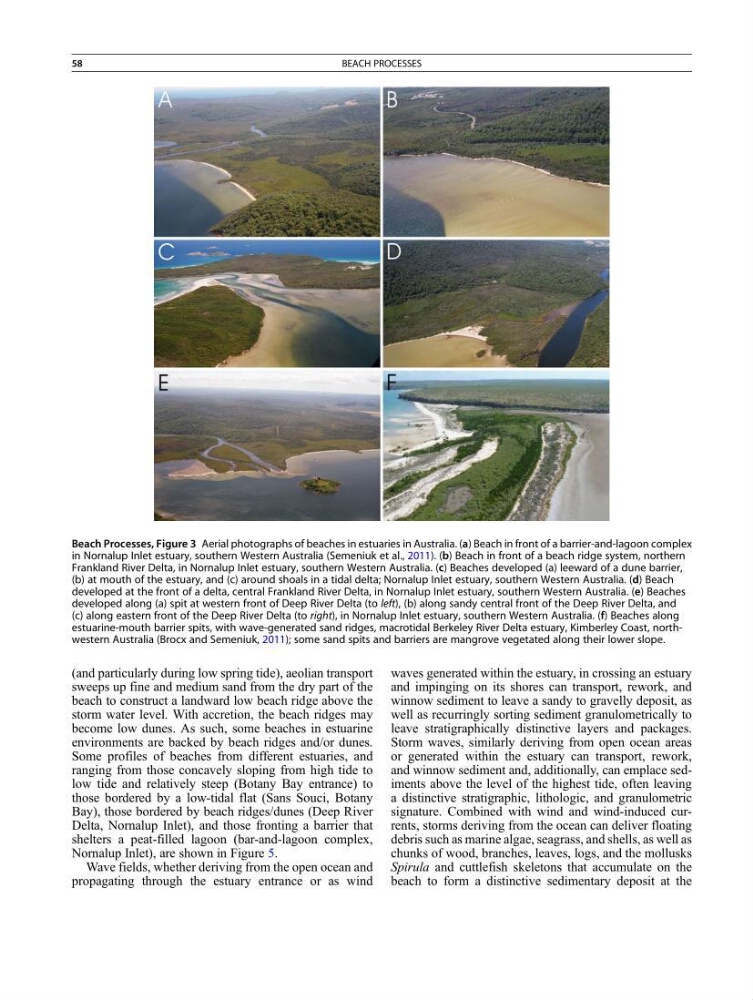
Beach Processes, Figure 3 Aerial photographs of beaches in estuaries in Australia. (a) Beach in front of a barrier-and-lagoon complex
in Nornalup Inlet estuary, southern Western Australia (Semeniuk et al., 2011). (b) Beach in front of a beach ridge system, northern
Frankland River Delta, in Nornalup Inlet estuary, southern Western Australia. (c) Beaches developed (a) leeward of a dune barrier,
(b) at mouth of the estuary, and (c) around shoals in a tidal delta; Nornalup Inlet estuary, southern Western Australia. (d) Beach
developed at the front of a delta, central Frankland River Delta, in Nornalup Inlet estuary, southern Western Australia. (e) Beaches
developed along (a) spit at western front of Deep River Delta (to left), (b) along sandy central front of the Deep River Delta, and
(c) along eastern front of the Deep River Delta (to right), in Nornalup Inlet estuary, southern Western Australia. (f) Beaches along
estuarine-mouth barrier spits, with wave-generated sand ridges, macrotidal Berkeley River Delta estuary, Kimberley Coast, northwestern Australia (Brocx and Semeniuk, 2011); some sand spits and barriers are mangrove vegetated along their lower slope.
58
BEACH PROCESSES
sweeps up fine and medium sand from the dry part of the
beach to construct a landward low beach ridge above the
storm water level. With accretion, the beach ridges may
become low dunes. As such, some beaches in estuarine
environments are backed by beach ridges and/or dunes.
Some profiles of beaches from different estuaries, and
ranging from those concavely sloping from high tide to
low tide and relatively steep (Botany Bay entrance) to
those bordered by a low-tidal flat (Sans Souci, Botany
Bay), those bordered by beach ridges/dunes (Deep River
Delta, Nornalup Inlet), and those fronting a barrier that
shelters a peat-filled lagoon (bar-and-lagoon complex,
Nornalup Inlet), are shown in Figure 5.
Wave fields, whether deriving from the open ocean and
propagating through the estuary entrance or as wind
waves generated within the estuary, in crossing an estuary
and impinging on its shores can transport, rework, and
winnow sediment to leave a sandy to gravelly deposit, as
well as recurringly sorting sediment granulometrically to
leave stratigraphically distinctive layers and packages.
Storm waves, similarly deriving from open ocean areas
or generated within the estuary can transport, rework,
and winnow sediment and, additionally, can emplace sediments above the level of the highest tide, often leaving
a distinctive stratigraphic, lithologic, and granulometric
signature. Combined with wind and wind-induced currents, storms deriving from the ocean can deliver floating
debris such as marine algae, seagrass, and shells, as well as
chunks of wood, branches, leaves, logs, and the mollusks
Spirula and cuttlefish skeletons that accumulate on the
beach to form a distinctive sedimentary deposit at the
Beach Processes, Figure 3 Aerial photographs of beaches in estuaries in Australia. (a) Beach in front of a barrier-and-lagoon complex
in Nornalup Inlet estuary, southern Western Australia (Semeniuk et al., 2011). (b) Beach in front of a beach ridge system, northern
Frankland River Delta, in Nornalup Inlet estuary, southern Western Australia. (c) Beaches developed (a) leeward of a dune barrier,
(b) at mouth of the estuary, and (c) around shoals in a tidal delta; Nornalup Inlet estuary, southern Western Australia. (d) Beach
developed at the front of a delta, central Frankland River Delta, in Nornalup Inlet estuary, southern Western Australia. (e) Beaches
developed along (a) spit at western front of Deep River Delta (to left), (b) along sandy central front of the Deep River Delta, and
(c) along eastern front of the Deep River Delta (to right), in Nornalup Inlet estuary, southern Western Australia. (f) Beaches along
estuarine-mouth barrier spits, with wave-generated sand ridges, macrotidal Berkeley River Delta estuary, Kimberley Coast, northwestern Australia (Brocx and Semeniuk, 2011); some sand spits and barriers are mangrove vegetated along their lower slope.
58
BEACH PROCESSES