

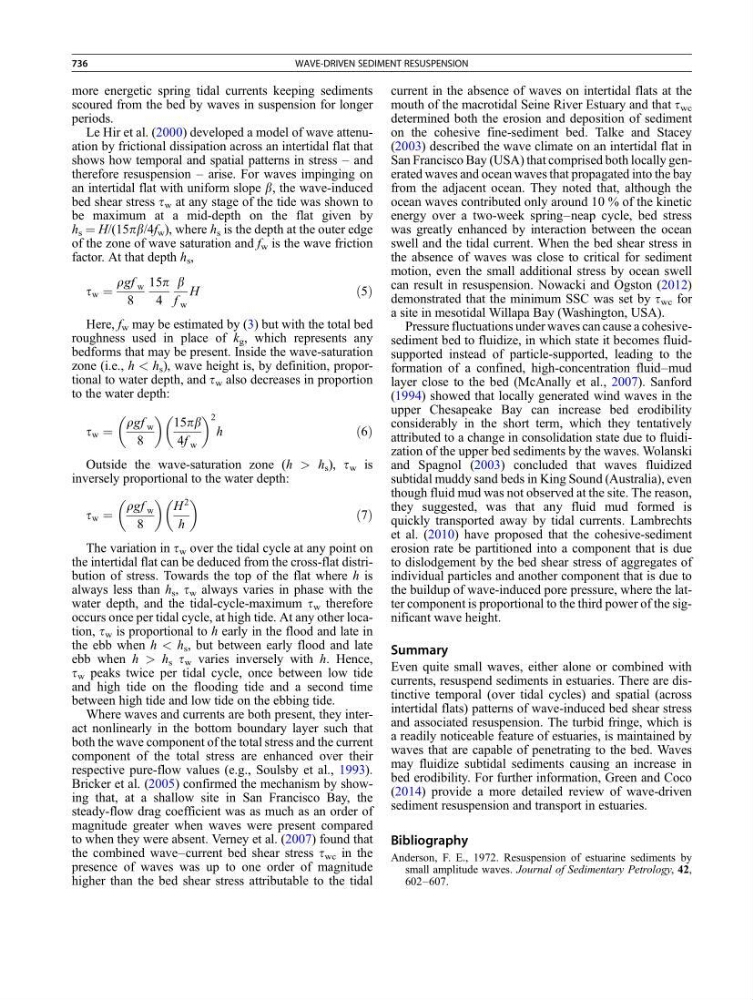
more energetic spring tidal currents keeping sediments
scoured from the bed by waves in suspension for longer
periods.
Le Hir et al. (2000) developed a model of wave attenuation by frictional dissipation across an intertidal flat that
shows how temporal and spatial patterns in stress – and
therefore resuspension – arise. For waves impinging on
an intertidal flat with uniform slope b, the wave-induced
bed shear stress t w at any stage of the tide was shown to
be maximum at a mid-depth on the flat given by
h s ¼ H/(15pb/4f w ), where h s is the depth at the outer edge
of the zone of wave saturation and f w is the wave friction
factor. At that depth h s ,
t w ¼
rgf w
8
15p
4
b
f w
H
ð5Þ
Here, f w may be estimated by (3) but with the total bed
roughness used in place of k g , which represents any
bedforms that may be present. Inside the wave-saturation
zone (i.e., h < h s ), wave height is, by definition, proportional to water depth, and t w also decreases in proportion
to the water depth:
t w ¼
rgf w
8
15pb
4f w
2
h
ð6Þ
Outside the wave-saturation zone (h > h s ), t w is
inversely proportional to the water depth:
t w ¼
rgf w
8
H
2
h
ð7Þ
The variation in t w over the tidal cycle at any point on
the intertidal flat can be deduced from the cross-flat distribution of stress. Towards the top of the flat where h is
always less than h s , t w always varies in phase with the
water depth, and the tidal-cycle-maximum t w therefore
occurs once per tidal cycle, at high tide. At any other location, t w is proportional to h early in the flood and late in
the ebb when h < h s , but between early flood and late
ebb when h > h s t w varies inversely with h. Hence,
t w peaks twice per tidal cycle, once between low tide
and high tide on the flooding tide and a second time
between high tide and low tide on the ebbing tide.
Where waves and currents are both present, they interact nonlinearly in the bottom boundary layer such that
both the wave component of the total stress and the current
component of the total stress are enhanced over their
respective pure-flow values (e.g., Soulsby et al., 1993).
Bricker et al. (2005) confirmed the mechanism by showing that, at a shallow site in San Francisco Bay, the
steady-flow drag coefficient was as much as an order of
magnitude greater when waves were present compared
to when they were absent. Verney et al. (2007) found that
the combined wave–current bed shear stress t wc in the
presence of waves was up to one order of magnitude
higher than the bed shear stress attributable to the tidal
current in the absence of waves on intertidal flats at the
mouth of the macrotidal Seine River Estuary and that t wc
determined both the erosion and deposition of sediment
on the cohesive fine-sediment bed. Talke and Stacey
(2003) described the wave climate on an intertidal flat in
San Francisco Bay (USA) that comprised both locally generated waves and ocean waves that propagated into the bay
from the adjacent ocean. They noted that, although the
ocean waves contributed only around 10 % of the kinetic
energy over a two-week spring–neap cycle, bed stress
was greatly enhanced by interaction between the ocean
swell and the tidal current. When the bed shear stress in
the absence of waves was close to critical for sediment
motion, even the small additional stress by ocean swell
can result in resuspension. Nowacki and Ogston (2012)
demonstrated that the minimum SSC was set by t wc for
a site in mesotidal Willapa Bay (Washington, USA).
Pressure fluctuations under waves can cause a cohesivesediment bed to fluidize, in which state it becomes fluidsupported instead of particle-supported, leading to the
formation of a confined, high-concentration fluid–mud
layer close to the bed (McAnally et al., 2007). Sanford
(1994) showed that locally generated wind waves in the
upper Chesapeake Bay can increase bed erodibility
considerably in the short term, which they tentatively
attributed to a change in consolidation state due to fluidization of the upper bed sediments by the waves. Wolanski
and Spagnol (2003) concluded that waves fluidized
subtidal muddy sand beds in King Sound (Australia), even
though fluid mud was not observed at the site. The reason,
they suggested, was that any fluid mud formed is
quickly transported away by tidal currents. Lambrechts
et al. (2010) have proposed that the cohesive-sediment
erosion rate be partitioned into a component that is due
to dislodgement by the bed shear stress of aggregates of
individual particles and another component that is due to
the buildup of wave-induced pore pressure, where the latter component is proportional to the third power of the significant wave height.
Summary
Even quite small waves, either alone or combined with
currents, resuspend sediments in estuaries. There are distinctive temporal (over tidal cycles) and spatial (across
intertidal flats) patterns of wave-induced bed shear stress
and associated resuspension. The turbid fringe, which is
a readily noticeable feature of estuaries, is maintained by
waves that are capable of penetrating to the bed. Waves
may fluidize subtidal sediments causing an increase in
bed erodibility. For further information, Green and Coco
(2014) provide a more detailed review of wave-driven
sediment resuspension and transport in estuaries.
Bibliography
Anderson, F. E., 1972. Resuspension of estuarine sediments by
small amplitude waves. Journal of Sedimentary Petrology, 42,
602–607.
736
WAVE-DRIVEN SEDIMENT RESUSPENSION