

boundary layer is thinner, the wave-induced bed shear
stress is correspondingly larger, and the wave is therefore
more effective at resuspending bed sediments. Experimental observations confirm this. For example,
Schoellhamer (1995) showed that waves generating bottom orbital speeds of 15–20 cm/s dominated sediment
resuspension at two depths in Old Tampa Bay, Florida,
even though mean currents also attained speeds of
15 cm/s. In addition, de Jonge and van Beusekom (1995)
found that, in the Ems-Dollard Estuary (northwest
Europe), a doubling of wind speed caused a much greater
increase in SSC than a doubling in tidal-current speed,
leading them to conclude that the “effect of wind on the
suspended matter concentration appears to be predominant.” Christiansen et al. (2006) showed that SSC was
controlled more by the wave-induced bed shear stress than
by the current-induced stress on a microtidal intertidal flat
in the Danish Wadden Sea.
Statistical models have been developed to explain
and predict wave resuspension, and many of these have
used various formulations of the wind speed as the
independent variable in regression models. For example,
de Jonge and van Beusekom (1995) expressed SSC as a
linear function of the “effective wind speed,” which they
defined as the wind speed averaged over three high-water
periods preceding sampling, and Dyer et al. (2000) found
a good correlation between SSC and wind speed above
a certain threshold. Such models are not readily applicable to sites other than the site for which they were developed. Other researchers have used wave parameters in
regression models, which make them more generally
applicable. For example, both Anderson (1980) and
Janssen-Stelder (2000) explained SSC in terms of wave
height, and Schoellhamer (1995) correlated SSC against
wave height, wave-orbital speed at the seabed and
wave-induced bed shear stress. Christiansen et al. (2006)
developed regressions of SSC on the wave-induced bed
shear stress. Green and MacDonald (2001) showed that
the onset of resuspension of fine-grained noncohesive
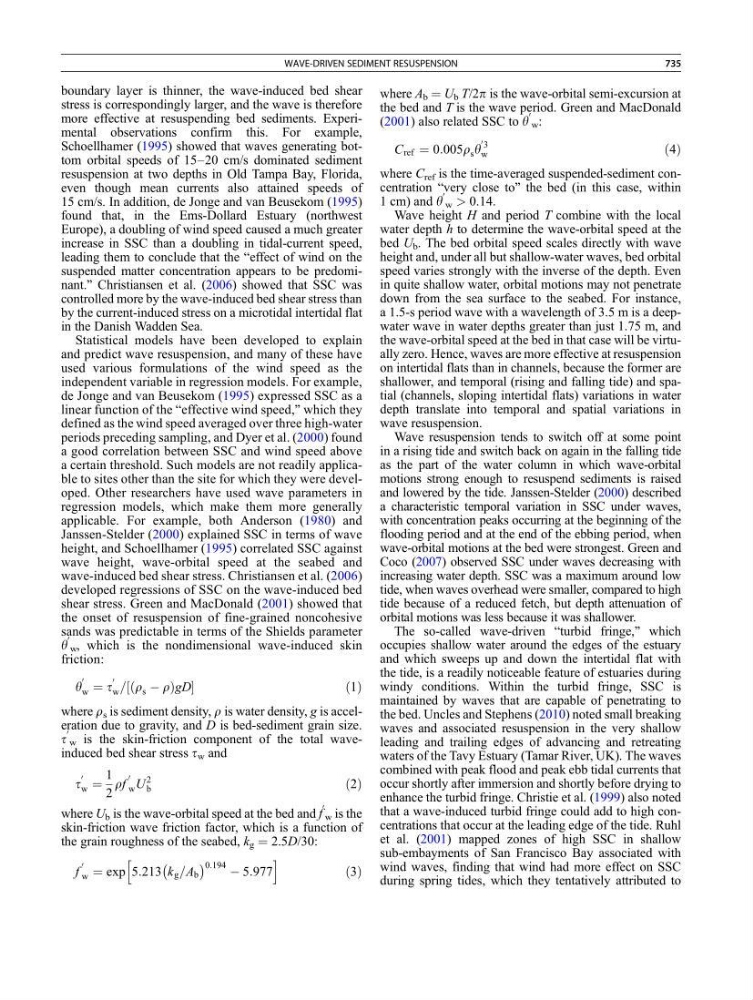
sands was predictable in terms of the Shields parameter
y
0
w , which is the nondimensional wave-induced skin
friction:
y
0
w ¼ t
0
w = r s À r
ð
ÞgD
½
ð 1Þ
where r s is sediment density, r is water density, g is acceleration due to gravity, and D is bed-sediment grain size.
t
0
w is the skin-friction component of the total waveinduced bed shear stress t w and
t
0
w ¼
1
2
rf
0
w U
2
b
ð2Þ
where U b is the wave-orbital speed at the bed and f
0
w is the
skin-friction wave friction factor, which is a function of
the grain roughness of the seabed, k g ¼ 2.5D/30:
f
0
w ¼ exp 5:213 k g =A b
À
Á 0:194 À 5:977
h
i
ð3Þ
where A b ¼ U b T/2p is the wave-orbital semi-excursion at
the bed and T is the wave period. Green and MacDonald
(2001) also related SSC to y
0
w :
C ref ¼ 0:005r s y
0 3
w
ð4Þ
where C ref is the time-averaged suspended-sediment concentration “very close to” the bed (in this case, within
1 cm) and y
0
w > 0.14.
Wave height H and period T combine with the local
water depth h to determine the wave-orbital speed at the
bed U b . The bed orbital speed scales directly with wave
height and, under all but shallow-water waves, bed orbital
speed varies strongly with the inverse of the depth. Even
in quite shallow water, orbital motions may not penetrate
down from the sea surface to the seabed. For instance,
a 1.5-s period wave with a wavelength of 3.5 m is a deepwater wave in water depths greater than just 1.75 m, and
the wave-orbital speed at the bed in that case will be virtually zero. Hence, waves are more effective at resuspension
on intertidal flats than in channels, because the former are
shallower, and temporal (rising and falling tide) and spatial (channels, sloping intertidal flats) variations in water
depth translate into temporal and spatial variations in
wave resuspension.
Wave resuspension tends to switch off at some point
in a rising tide and switch back on again in the falling tide
as the part of the water column in which wave-orbital
motions strong enough to resuspend sediments is raised
and lowered by the tide. Janssen-Stelder (2000) described
a characteristic temporal variation in SSC under waves,
with concentration peaks occurring at the beginning of the
flooding period and at the end of the ebbing period, when
wave-orbital motions at the bed were strongest. Green and
Coco (2007) observed SSC under waves decreasing with
increasing water depth. SSC was a maximum around low
tide, when waves overhead were smaller, compared to high
tide because of a reduced fetch, but depth attenuation of
orbital motions was less because it was shallower.
The so-called wave-driven “turbid fringe,” which
occupies shallow water around the edges of the estuary
and which sweeps up and down the intertidal flat with
the tide, is a readily noticeable feature of estuaries during
windy conditions. Within the turbid fringe, SSC is
maintained by waves that are capable of penetrating to
the bed. Uncles and Stephens (2010) noted small breaking
waves and associated resuspension in the very shallow
leading and trailing edges of advancing and retreating
waters of the Tavy Estuary (Tamar River, UK). The waves
combined with peak flood and peak ebb tidal currents that
occur shortly after immersion and shortly before drying to
enhance the turbid fringe. Christie et al. (1999) also noted
that a wave-induced turbid fringe could add to high concentrations that occur at the leading edge of the tide. Ruhl
et al. (2001) mapped zones of high SSC in shallow
sub-embayments of San Francisco Bay associated with
wind waves, finding that wind had more effect on SSC
during spring tides, which they tentatively attributed to
WAVE-DRIVEN SEDIMENT RESUSPENSION
735