

This involves least-squares fitting of the tidal constituents
to water level measurements at that site. To predict the
tides into the future, the estimated amplitudes and phases
of each constituent can be substituted into (4) and then
the terms summed.
Dynamic tidal theory
The equilibrium theory helps to describe several features
of tides and serves as a reference system for harmonic
analysis. However, the tide observed in reality bears no
resemblance to the equilibrium tide, because none of the
Spring tides
Neap tides
0
5
10
15
−1
−0.5
0
0.5
1
1.5
2
2.5
3
Days
Level (m)
Lunar Tide (M 2 )
Solar Tide (S 2 )
Combined Tide (M 2 + S 2 )
Springs
Neaps
c
b
a
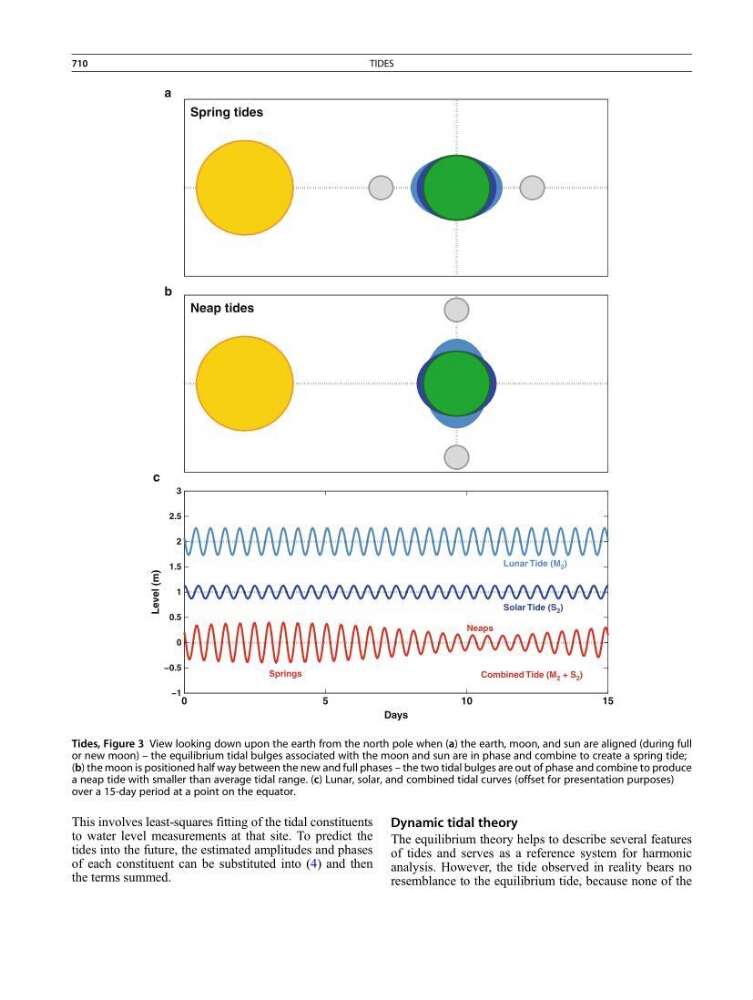
Tides, Figure 3 View looking down upon the earth from the north pole when (a) the earth, moon, and sun are aligned (during full
or new moon) – the equilibrium tidal bulges associated with the moon and sun are in phase and combine to create a spring tide;
(b) the moon is positioned half way between the new and full phases – the two tidal bulges are out of phase and combine to produce
a neap tide with smaller than average tidal range. (c) Lunar, solar, and combined tidal curves (offset for presentation purposes)
over a 15-day period at a point on the equator.
710
TIDES