

principle assumptions of the theory are valid (Brown et al.,
1989), including the following: (1) the presence of land
prevents tidal bulges from directly circumnavigating the
globe; (2) the rotation of the earth on its polar axis is too
rapid for the inertia of the water masses to overcome in
sufficient time to establish an immediate equilibrium tide;
and (3) water movements induced by tide-generating
forces are subject to friction and the Coriolis force.
The combination of all of these factors results in the
development of so-called amphidromic systems. The
global ocean is essentially broken into separate basins separated by shallow continental shelves and landmasses
(Masselink et al., 2003). In these enclosed basins, the tidal
wave travels from east to west, elevating sea levels against
the western margin of the basin. The resulting slope in the
ocean surface produces a pressure gradient that causes
water to flow eastward. In the Northern Hemisphere, the
eastward flow is deflected to the right by Coriolis force,
which causes elevated sea levels against the southern
margin. The pressure gradient force subsequently drives
the water northward which is then deflected to the west
and so on. Thus, the wave crest rotates around the ocean
basin in an anticlockwise direction, which is referred to
as a Kelvin wave. Amphidromic systems are set up on
continental shelves and large bays, but these systems are
scaled down and are less symmetrical as the wave speeds
decrease in shallow water where there are significant
energy losses due to bottom friction (Pugh, 2004).
In the open ocean, tides are generated directly by the
tide-generating forces. These waves then spread onto the
surrounding shallow shelf seas where their characteristics
are altered through standing wave generation and local
resonances (Pugh, 2004). As the tidal wave progresses
from the deep ocean onto the shallow continental shelf,
the wave slows down. The wavelength is reduced and
the amplitude increases because the wave energy becomes
concentrated in a smaller area. As the wave approaches
even shallower water near the coast, it encounters the
irregular topography of the coastline and moves into estuaries and bays where it undergoes even larger distortions.
As the tide travels into a narrowing bay or estuary, the tidal
range increases again, because the same energy is being
forced through a smaller opening (Parker, 2005). In
extreme cases, this can result in the formation of a tidal
bore. In very shallow water, the wave crest will travel
faster than the trough, resulting in tidal asymmetry. Eventually, the tidal amplitude will be reduced by bottom friction as the wave progresses into very shallow water.
Tidal characteristics and types
At a particular location, tides are typically classified by
their range (see Tidal Ranges) and form. The form of the
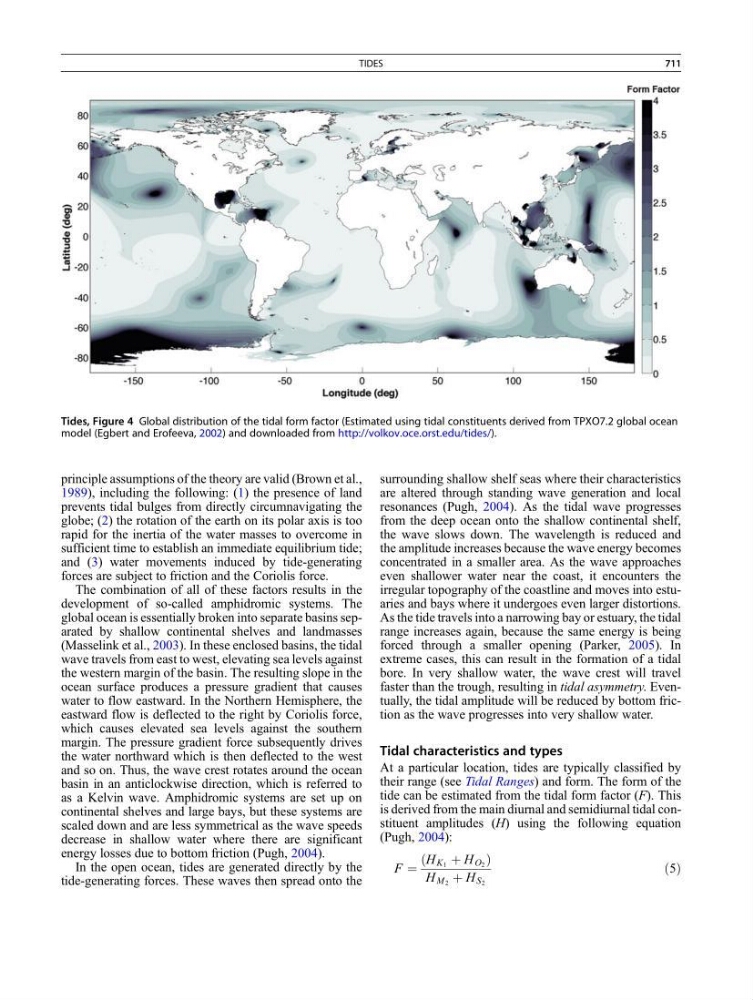
tide can be estimated from the tidal form factor (F). This
is derived from the main diurnal and semidiurnal tidal constituent amplitudes (H) using the following equation
(Pugh, 2004):
F ¼
H K 1 þ H O 2
ð
Þ
H M 2 þ H S 2
ð5Þ
Tides, Figure 4 Global distribution of the tidal form factor (Estimated using tidal constituents derived from TPXO7.2 global ocean
model (Egbert and Erofeeva, 2002) and downloaded from http://volkov.oce.orst.edu/tides/).
TIDES
711