

water to the phase of the moon (Pugh, 1987), through to the
more sophisticated harmonic (Doodson, 1921; Foreman,
1977) and response analysis methods (Munk and Cartwright,
1966). Harmonic analysis is the most widely used tidal prediction method. The underlying principle of this method is
the assumption that no matter how complex they appear,
tidal variations at any location can be represented by the
sum of a finite number of harmonic terms (tidal constituents),
each expressed in the form of (4).
The frequency of each of the tidal constituents can be
expressed as a linear superposition of six fundamental
astronomical forcing harmonics, from which the positions
of the sun or moon, and hence the tide-generating forces,
can be calculated for any time. Therefore, it is possible
to relate each individual tidal harmonic to real astronomical behavior (Pugh, 2004). More than 400 tidal constituents have been identified (Cartwright and Tayler, 1971),
but the tide can be predicted to a useful level of accuracy
using only a small subset of these.
In order to predict tides at a given location, we need to
know the frequencies, amplitudes, and phases of the tidal
constituents. The frequencies are fixed, but the amplitudes
and phases of the different constituents vary with location
and the aim of the harmonic analysis is to determine them.
1
2
3
a
b
c
d
1
2
3
0
0.5
1
1.5
2
2.5
3
−0.5
0
0.5
1
1.5
2
2.5
Days
Level (m)
1
2
3
0
0.5
1
1.5
2
2.5
3
Days
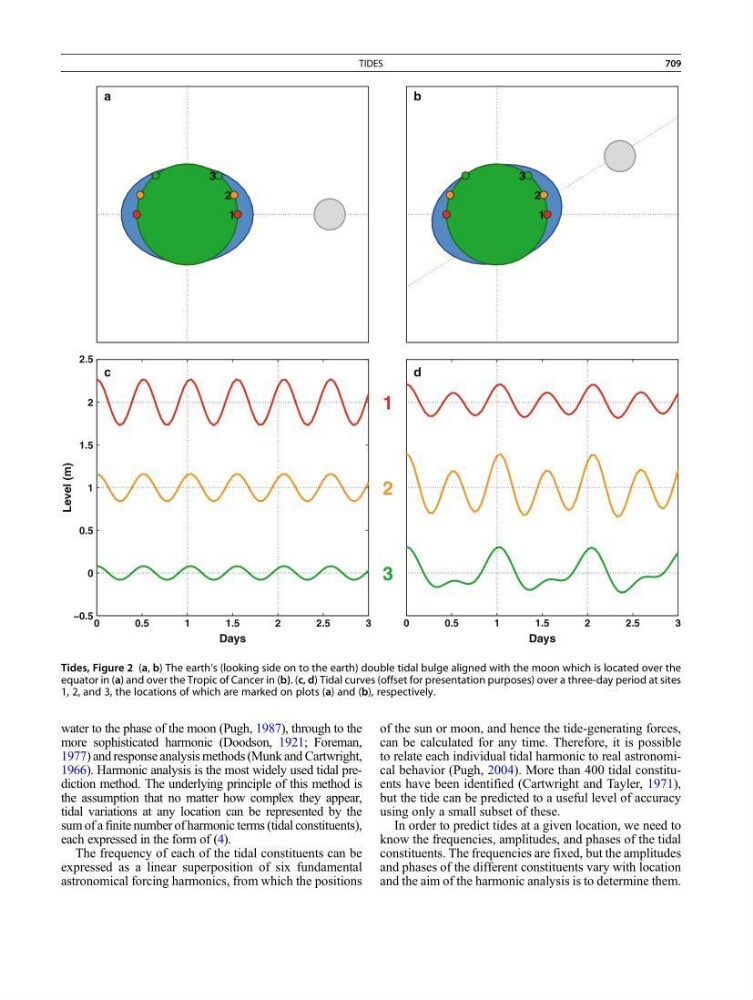
Tides, Figure 2 (a, b) The earth’s (looking side on to the earth) double tidal bulge aligned with the moon which is located over the
equator in (a) and over the Tropic of Cancer in (b). (c, d) Tidal curves (offset for presentation purposes) over a three-day period at sites
1, 2, and 3, the locations of which are marked on plots (a) and (b), respectively.
TIDES
709