

reduction in N 2 (due to M 2 ) will be greater than the reduction in M 2 (due to N 2 ), because M 2 is much greater than
N 2 . However, M 2 will be reduced by the combined
interactions of all the other tidal constituents. There is
a 27.6-day modulation of this energy loss from M 2 and
N 2 , and this produces two new compound tidal constituents
called 2MN 2 and 2NM 2 . (Similarly, the above asymmetric
mechanisms also cause interactions between constituents,
producing higher frequency constituents such as MN 4 from
M 2 and N 2 .) More compound tides and overtides and their
origin are explained by Parker (2007).
In shallow waterways with large tidal ranges, the
nonlinear effects can produce dozens of compound tides
and overtides of significant enough size that they must
be included in harmonically based tide predictions. For
example, for tide predictions at Anchorage, Alaska, at
the northern end of Cook Inlet, 114 tidal constituents
(most of them shallow-water constituents) must be used
to predict the 30-ft tides there (as compared with typically
26 or less constituents in other waterways).
Nonlinear tidal interaction with river flow
In a tidal river, water flow is due to both the tidal current
and the river current itself (i.e., the freshwater flowing
downhill). The result of the combined tidal current and
river current is a faster and longer-lasting ebb current
phase and a slower and shorter flood current phase. Far
enough up a river, where the river flow is faster than the
strongest tidal current, the flow of water will always be
downstream. In this case, the speed of flow will oscillate,
flowing the fastest downstream at the time when maximum ebb occurs farther down the river and flowing the
slowest downstream at the time when maximum flood
occurs farther down the river. This is a simple linear addition of the river current to the tidal current.
However, because of the shallow water, the river flow
also interacts with the tide nonlinearly and distorts it,
mainly due to the effect of bottom friction. Energy loss
due to friction is proportional to the square of the total
current speed. During ebb, the tidal current is in the same
direction as the river current, and the result is a larger
combined ebb current, with increased energy loss. During flood, the tidal current is in the opposite direction
as the river current and the result is a smaller combined
current, with reduced energy loss. This has an asymmetric effect that distorts the tide (causing a faster rise to
high water, delaying the time of low water, and increasing the size of M 4 ). It also wears down the entire wave
further because the increased energy loss during ebb is
larger than the decreased energy loss during flood. In
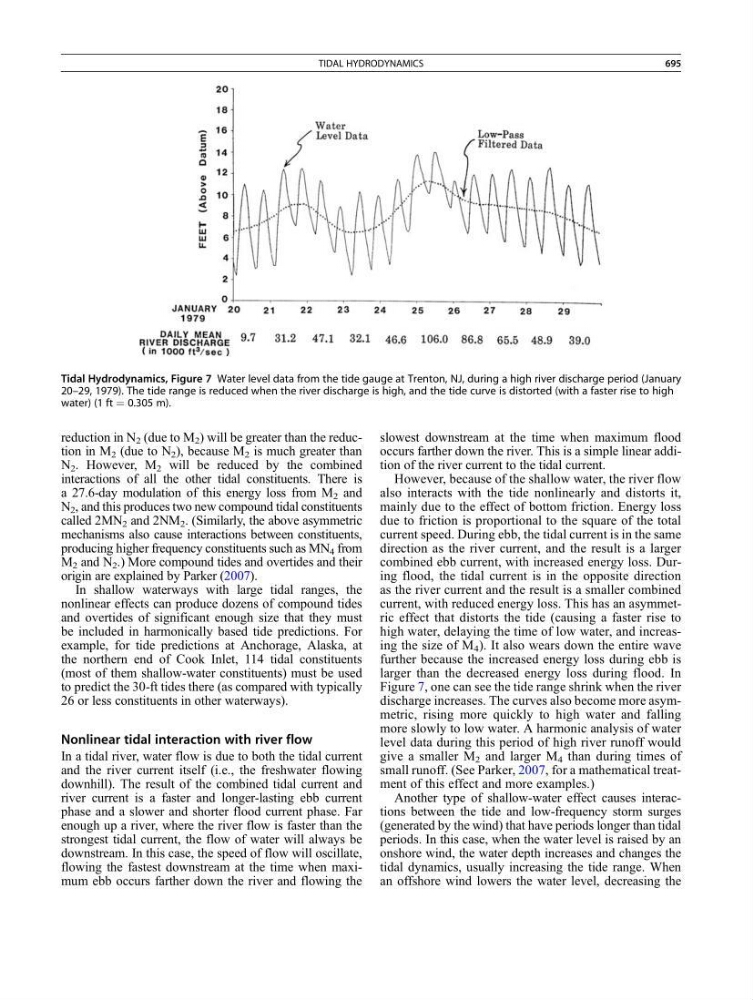
Figure 7, one can see the tide range shrink when the river
discharge increases. The curves also become more asymmetric, rising more quickly to high water and falling
more slowly to low water. A harmonic analysis of water
level data during this period of high river runoff would
give a smaller M 2 and larger M 4 than during times of
small runoff. (See Parker, 2007, for a mathematical treatment of this effect and more examples.)
Another type of shallow-water effect causes interactions between the tide and low-frequency storm surges
(generated by the wind) that have periods longer than tidal
periods. In this case, when the water level is raised by an
onshore wind, the water depth increases and changes the
tidal dynamics, usually increasing the tide range. When
an offshore wind lowers the water level, decreasing the
Tidal Hydrodynamics, Figure 7 Water level data from the tide gauge at Trenton, NJ, during a high river discharge period (January
20–29, 1979). The tide range is reduced when the river discharge is high, and the tide curve is distorted (with a faster rise to high
water) (1 ft ¼ 0.305 m).
TIDAL HYDRODYNAMICS
695