

Another shallow-water distorting mechanism is caused
by bottom friction, which can have both asymmetric and
symmetric effects. The asymmetric effect (similar to that
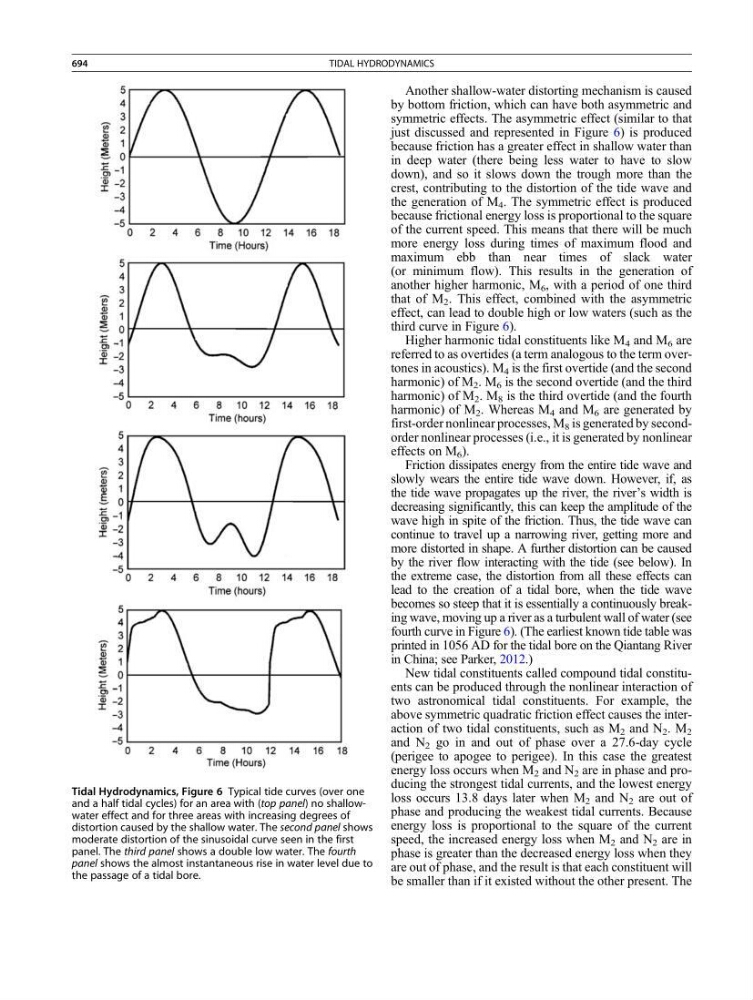
just discussed and represented in Figure 6) is produced
because friction has a greater effect in shallow water than
in deep water (there being less water to have to slow
down), and so it slows down the trough more than the
crest, contributing to the distortion of the tide wave and
the generation of M 4 . The symmetric effect is produced
because frictional energy loss is proportional to the square
of the current speed. This means that there will be much
more energy loss during times of maximum flood and
maximum ebb than near times of slack water
(or minimum flow). This results in the generation of
another higher harmonic, M 6 , with a period of one third
that of M 2 . This effect, combined with the asymmetric
effect, can lead to double high or low waters (such as the
third curve in Figure 6).
Higher harmonic tidal constituents like M 4 and M 6 are
referred to as overtides (a term analogous to the term overtones in acoustics). M 4 is the first overtide (and the second
harmonic) of M 2 . M 6 is the second overtide (and the third
harmonic) of M 2 . M 8 is the third overtide (and the fourth
harmonic) of M 2 . Whereas M 4 and M 6 are generated by
first-order nonlinear processes, M 8 is generated by secondorder nonlinear processes (i.e., it is generated by nonlinear
effects on M 6 ).
Friction dissipates energy from the entire tide wave and
slowly wears the entire tide wave down. However, if, as
the tide wave propagates up the river, the river’s width is
decreasing significantly, this can keep the amplitude of the
wave high in spite of the friction. Thus, the tide wave can
continue to travel up a narrowing river, getting more and
more distorted in shape. A further distortion can be caused
by the river flow interacting with the tide (see below). In
the extreme case, the distortion from all these effects can
lead to the creation of a tidal bore, when the tide wave
becomes so steep that it is essentially a continuously breaking wave, moving up a river as a turbulent wall of water (see
fourth curve in Figure 6). (The earliest known tide table was
printed in 1056 AD for the tidal bore on the Qiantang River
in China; see Parker, 2012.)
New tidal constituents called compound tidal constituents can be produced through the nonlinear interaction of
two astronomical tidal constituents. For example, the
above symmetric quadratic friction effect causes the interaction of two tidal constituents, such as M 2 and N 2 . M 2
and N 2 go in and out of phase over a 27.6-day cycle
(perigee to apogee to perigee). In this case the greatest
energy loss occurs when M 2 and N 2 are in phase and producing the strongest tidal currents, and the lowest energy
loss occurs 13.8 days later when M 2 and N 2 are out of
phase and producing the weakest tidal currents. Because
energy loss is proportional to the square of the current
speed, the increased energy loss when M 2 and N 2 are in
phase is greater than the decreased energy loss when they
are out of phase, and the result is that each constituent will
be smaller than if it existed without the other present. The
Tidal Hydrodynamics, Figure 6 Typical tide curves (over one
and a half tidal cycles) for an area with (top panel) no shallowwater effect and for three areas with increasing degrees of
distortion caused by the shallow water. The second panel shows
moderate distortion of the sinusoidal curve seen in the first
panel. The third panel shows a double low water. The fourth
panel shows the almost instantaneous rise in water level due to
the passage of a tidal bore.
694
TIDAL HYDRODYNAMICS