

However, the effects of these nonlinear terms can be
explained physically here without resorting to the math
of these nonlinear models. (For mathematical treatments
of the nonlinear terms, see Parker, 2007).
The speed, C, at which a long tide wave travels depends
on the depth of the water, D, approximately (ignoring friction) as the formula C ¼ (gD)
½ . When the depth of the
water is much greater than the tidal range, the speed of
the crest of a tide wave and the speed of the trough are virtually the same, since the tide wave itself has only a very
small effect on the total water depth. However, in the shallow water where the depth is not much greater than the tide
range, the total water depth under the crest is significantly
larger than the total water depth under the trough. In this
case, the crest of the wave (high water) travels faster than
the trough of the wave (low water). If the tide wave travels
far enough, the crest begins to catch up with the trough
ahead of it (which is falling behind the crest ahead of it).
Thus, high water arrives sooner than it would in deeper
water, and there is a faster rise to high water and
a slower fall to low water. The shape of the tide curve
could perhaps look like that shown in the second curve
in Figure 6. In terms of harmonic constituents, this distortion transfers energy from M 2 into the second harmonic,
a constituent called M 4 , with half the period of M 2 . Combining an M 2 tide curve and an M 4 tide curve, one can produce the distorted tide curves shown in Figure 6, with the
M 4 /M 2 ratio increasing as one goes from top curve to bottom curve in those figures. The third curve in Figure 6
shows a double low water, but with a different phase relationship between M 2 and M 4 , one could obtain a double
high water.
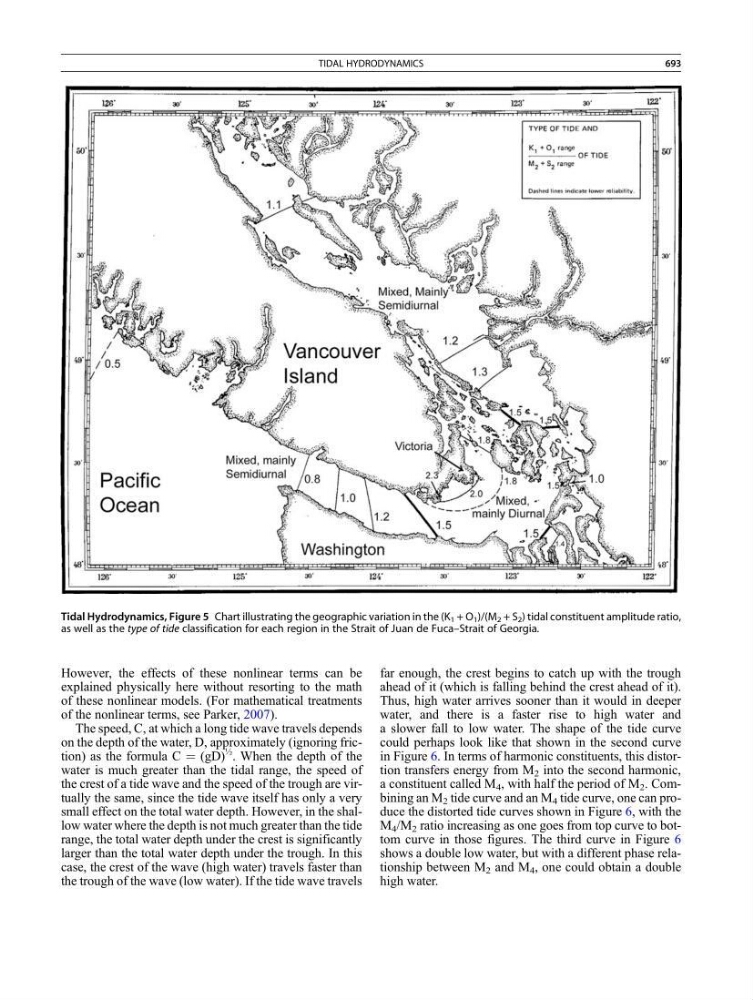
Tidal Hydrodynamics, Figure 5 Chart illustrating the geographic variation in the (K 1 + O 1 )/(M 2 + S 2 ) tidal constituent amplitude ratio,
as well as the type of tide classification for each region in the Strait of Juan de Fuca–Strait of Georgia.
TIDAL HYDRODYNAMICS
693