

(10 ft), respectively (near times of maximum southern
declination of the moon). In these locations, the tide
remains diurnal even when the moon is over the equator.
Nonlinear effects of shallow water
on tides: overtides and compound tides
Shallow water also has other effects on the tide. It can, for
example, distort the shape of the tide wave, that is, make it
very asymmetric, so that its rise and fall (and its flood and
ebb) are no longer equal (see the second curve in Figure 6).
The tide can then no longer be described by a simple sine
wave (such as the first curve in Figure 6). In some cases,
such distortion leads to double high waters or double
low waters (see the third curve in Figure 6). The extreme
case of distortion is a tidal bore (the fourth curve in
Figure 6), when the tide wave becomes so steep that it is
essentially a continuously breaking wave moving up
a river as a turbulent wall of water.
Shallow water distorts the tide through several mechanisms that are nonlinear – that is, in the equations of
motion (based on conservation of mass and momentum,
see Parker, 2007), each mechanism can be tied to
a specific term in which key parameters (such as water elevation or velocity) multiply each other, which leads to
energy transfer. (Linear terms contain only one key parameter and thus their separate effects simply add, with no
interaction.) Such nonlinearities can only be handled adequately in numerical hydrodynamic models (based on the
nonlinear equations of motion), rather than by simple
formulas from analytical models, such as those that we
used to described many of the linear tidal effects.
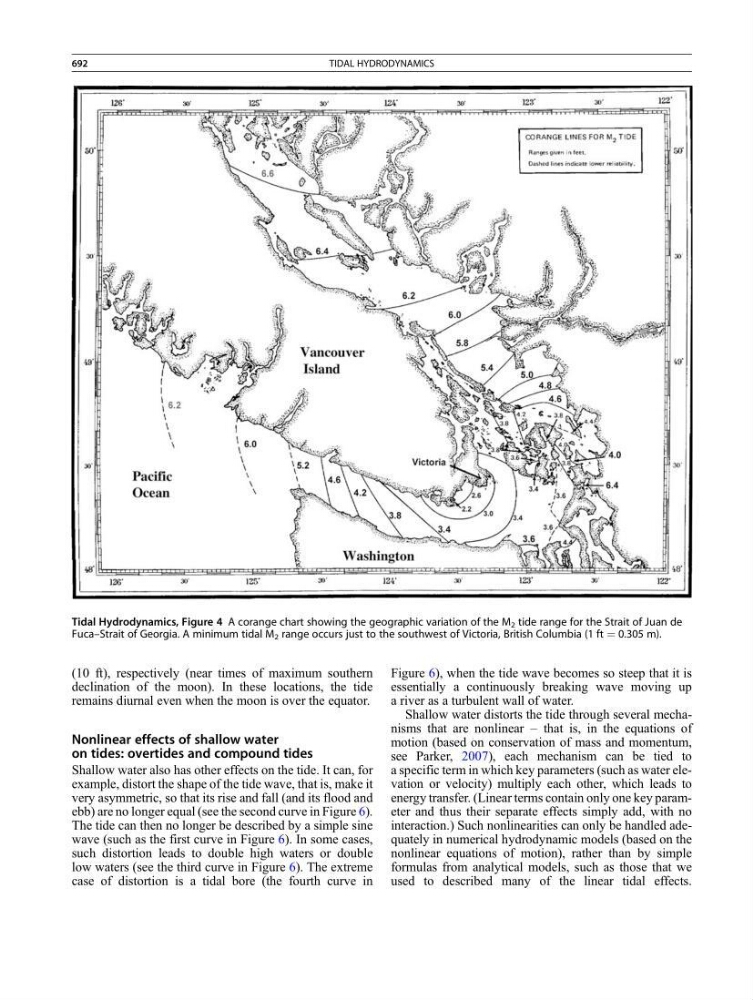
Tidal Hydrodynamics, Figure 4 A corange chart showing the geographic variation of the M 2 tide range for the Strait of Juan de
Fuca–Strait of Georgia. A minimum tidal M 2 range occurs just to the southwest of Victoria, British Columbia (1 ft ¼ 0.305 m).
692
TIDAL HYDRODYNAMICS