

locations in an estuary. This classification of tides is not
always as descriptively precise as one might wish, because
the relative strength of the diurnal signal to semidiurnal
signal varies throughout the month, with the diurnal signal
being strongest during maximum lunar declination (i.e.,
when the moon is farthest north or south of the equator).
Thus, a so-called mixed tide might have two high waters
a day when the moon is over the equator, but only one high
water a day when the moon is farthest north or south of the
equator (and thus being diurnal at those times).
The dimensions of a basin (and the dimensions of the
waterways leading to the basin) determine the size of the
diurnal tidal signal (primarily K 1 and O 1 ) compared with
the usually dominant semidiurnal tidal signal (primarily
M 2 , S 2 , and N 2 ). A particular bay could have a natural
period of oscillation that is closer to the diurnal tidal
period (approximately 24.84 h) than to the semidiurnal
period, thus amplifying the diurnal forcing at the entrance
to the bay more than the semidiurnal signal. Depending on
the size of the diurnal signal at the entrance, the result
could be a mixed tide or a diurnal tide. At such locations
(e.g., parts of the Gulf of Mexico), the tide will be diurnal
near times of maximum lunar declination, but will be
mixed near times when the moon is over the equator.
As mentioned earlier, the wavelength, l, of a tide wave
in a bay depends on the depth of the water, D, and on
the tidal period, T, according to l ¼ T(gD)
½ (if frictional
effects are ignored). The longer the tidal period, the longer
is the tidal wavelength. A diurnal tidal component has
a wavelength twice as long as a semidiurnal tidal component, since its period is twice as long. When a waterway is
shallow enough and long enough so that more than one
fourth of a semidiurnal (e.g., M 2 ) wavelength fits in the
waterway, there will be a nodal area with a very small
semidiurnal (M 2 ) tidal range. This will be an area where
the diurnal tide could dominate, since the diurnal tide
would still be large at the semidiurnal nodal area (the diurnal node being twice as far from the head of the bay).
Thus, near the head of the waterway the tide could be
semidiurnal, but near the semidiurnal nodal area, the tide
could be mixed or even diurnal. This is the case near
Victoria, British Columbia, at the southeastern end of Vancouver Island (see Figure 5). At that location along the
Strait of Georgia–Strait of Juan de Fuca waterway, the
M 2 and S 2 tidal constituents decrease to a minimum, but
the K 1 and O 1 constituents do not, and so the tide becomes
mixed mainly diurnal, while at the northern end of the
Strait of Georgia, the tide is mixed, mainly semidiurnal.
Whether due to a basin size conducive to amplifying
the diurnal signal or due to the existence of
a semidiurnal nodal area (leaving the diurnal signal as
the dominant one), there are numerous areas around the
world with strong diurnal tides – places like Norton Sound
in Alaska near the Bering Strait and various (but not all)
locations in the Philippines, New Guinea, and the islands
of Indonesia. In southern China, at Beihai, and at Do
Son, Vietnam, the diurnal signal is very dominant, with
diurnal tidal ranges that reach 4.6 m (15 ft) and 3.0 m
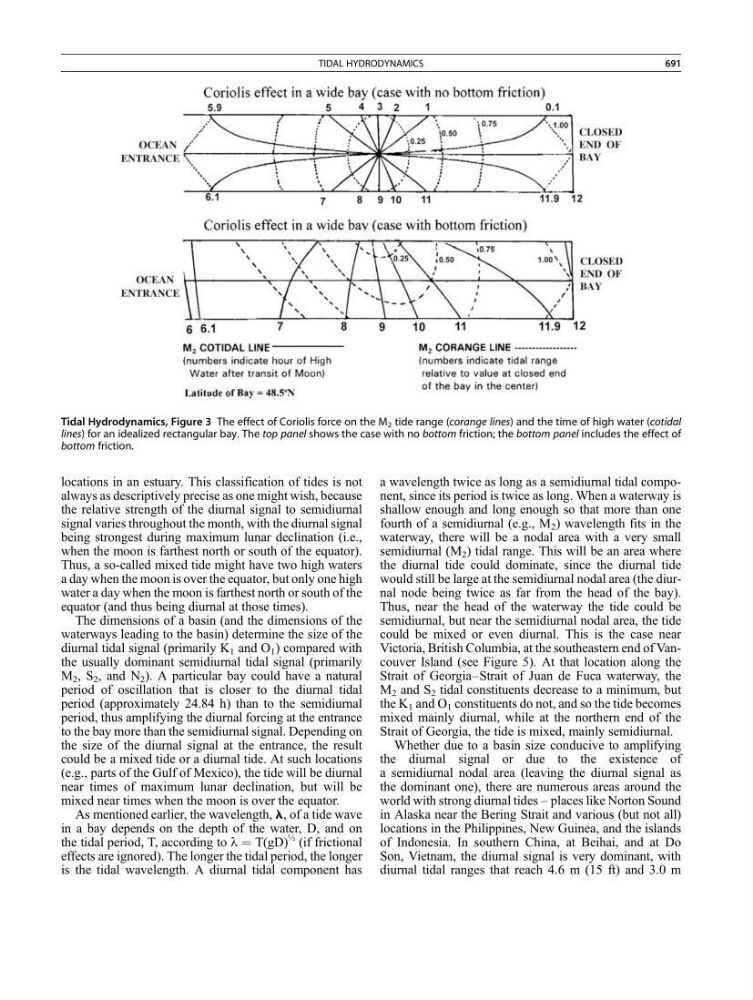
Tidal Hydrodynamics, Figure 3 The effect of Coriolis force on the M 2 tide range (corange lines) and the time of high water (cotidal
lines) for an idealized rectangular bay. The top panel shows the case with no bottom friction; the bottom panel includes the effect of
bottom friction.
TIDAL HYDRODYNAMICS
691