

reclamation has proven to be an effective way to relieve
some of the pressure on space. Land reclamation also
offers good opportunities for implementation of the
“building with nature” concept, meanwhile easily applying new safety considerations. Multifunctional use of
areas, e.g., giving a water storage function to nature areas,
may further assist in relieving the pressure on space.
Improving resilience of estuaries
Vulnerability of societies to future climate change (such as
flood risks, droughts, and salinity intrusion) should be
reduced, preferably by making societies more resilient.
Resilience can be improved by preparedness, coping
strategies, and adaptation to changing conditions. This
requires a combination of willingness to change, appropriate technology, and community participation. Increasing
the robustness of infrastructure is another promising way
to respond to the increase of vulnerability of estuarine
areas as well as the growing aversion of risk.
Secure fresh water supplies
Many estuaries in the world currently face water shortages
which may be worsened by climate change and pollution.
Adaptation to land and water use will be an important way
to respond to these shortages. This may include more efficient water use and/or changes in cropping pattern and fertilization in agriculture. Pollution reduction programs and
establishment of flow requirements for estuaries are
needed. Their implementation may benefit by involvement of river basin agencies.
Upgrade aging infrastructure
Many estuaries have irrigation and drainage systems as
well as flood protection works, roads, water supply, and
treatment facilities which require upgrading. Public and
private partnerships can provide solutions in those cases
where farmers, industries, and communities directly benefit from these infrastructure investments. However, for
protection schemes against floods and storm surges, other
options may be more appropriate, such as introducing
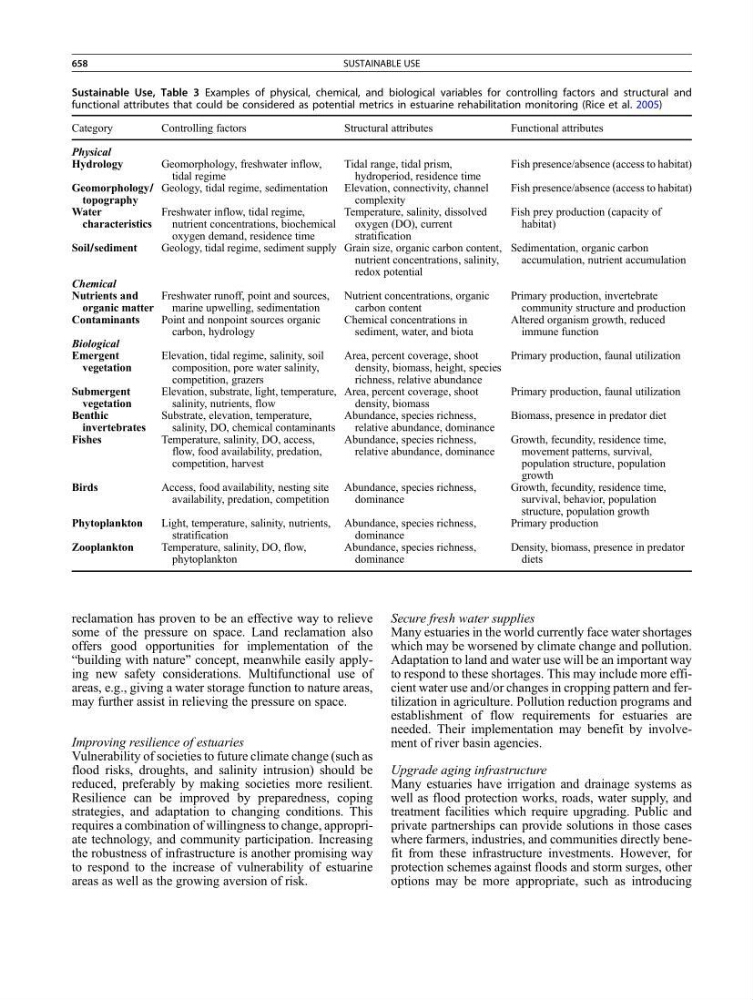
Sustainable Use, Table 3 Examples of physical, chemical, and biological variables for controlling factors and structural and
functional attributes that could be considered as potential metrics in estuarine rehabilitation monitoring (Rice et al. 2005)
Category
Controlling factors
Structural attributes
Functional attributes
Physical
Hydrology
Geomorphology, freshwater inflow,
tidal regime
Tidal range, tidal prism,
hydroperiod, residence time
Fish presence/absence (access to habitat)
Geomorphology/
topography
Geology, tidal regime, sedimentation Elevation, connectivity, channel
complexity
Fish presence/absence (access to habitat)
Water
characteristics
Freshwater inflow, tidal regime,
nutrient concentrations, biochemical
oxygen demand, residence time
Temperature, salinity, dissolved
oxygen (DO), current
stratification
Fish prey production (capacity of
habitat)
Soil/sediment
Geology, tidal regime, sediment supply Grain size, organic carbon content,
nutrient concentrations, salinity,
redox potential
Sedimentation, organic carbon
accumulation, nutrient accumulation
Chemical
Nutrients and
organic matter
Freshwater runoff, point and sources,
marine upwelling, sedimentation
Nutrient concentrations, organic
carbon content
Primary production, invertebrate
community structure and production
Contaminants
Point and nonpoint sources organic
carbon, hydrology
Chemical concentrations in
sediment, water, and biota
Altered organism growth, reduced
immune function
Biological
Emergent
vegetation
Elevation, tidal regime, salinity, soil
composition, pore water salinity,
competition, grazers
Area, percent coverage, shoot
density, biomass, height, species
richness, relative abundance
Primary production, faunal utilization
Submergent
vegetation
Elevation, substrate, light, temperature,
salinity, nutrients, flow
Area, percent coverage, shoot
density, biomass
Primary production, faunal utilization
Benthic
invertebrates
Substrate, elevation, temperature,
salinity, DO, chemical contaminants
Abundance, species richness,
relative abundance, dominance
Biomass, presence in predator diet
Fishes
Temperature, salinity, DO, access,
flow, food availability, predation,
competition, harvest
Abundance, species richness,
relative abundance, dominance
Growth, fecundity, residence time,
movement patterns, survival,
population structure, population
growth
Birds
Access, food availability, nesting site
availability, predation, competition
Abundance, species richness,
dominance
Growth, fecundity, residence time,
survival, behavior, population
structure, population growth
Phytoplankton
Light, temperature, salinity, nutrients,
stratification
Abundance, species richness,
dominance
Primary production
Zooplankton
Temperature, salinity, DO, flow,
phytoplankton
Abundance, species richness,
dominance
Density, biomass, presence in predator
diets
658
SUSTAINABLE USE