

(1996), monitoring should be considered as a fundamental
part of a restoration project aiming to: (1) assess the performance of the restoration project relative to the project
goals, (2) provide information that can be used to improve
the performance of the project, and (3) provide information to interested parties.
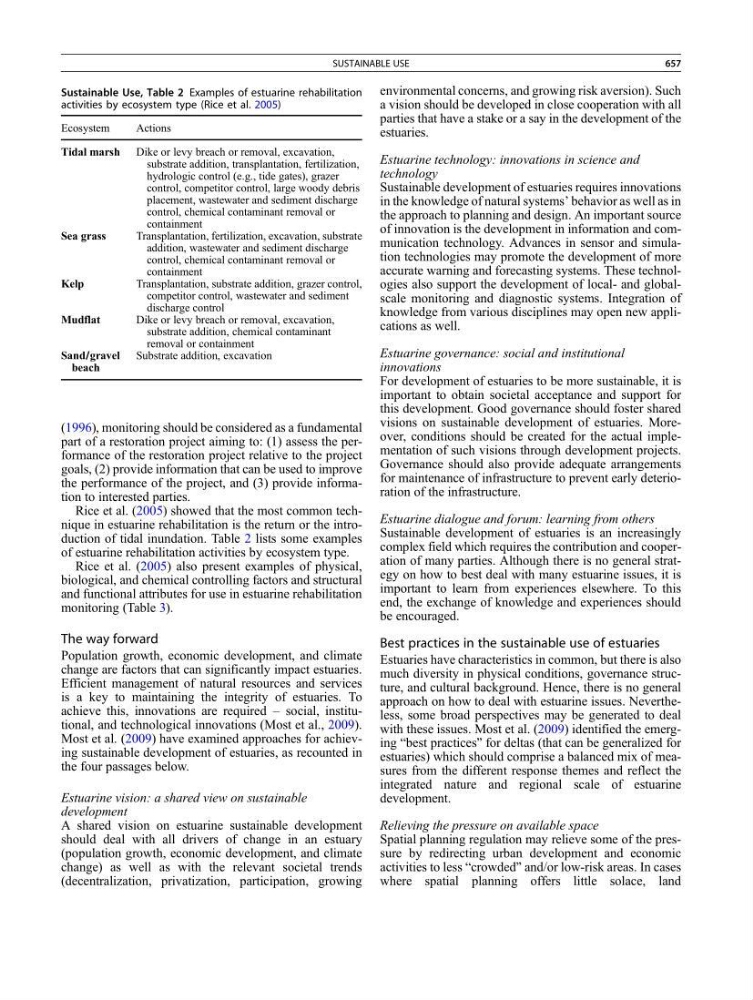
Rice et al. (2005) showed that the most common technique in estuarine rehabilitation is the return or the introduction of tidal inundation. Table 2 lists some examples
of estuarine rehabilitation activities by ecosystem type.
Rice et al. (2005) also present examples of physical,
biological, and chemical controlling factors and structural
and functional attributes for use in estuarine rehabilitation
monitoring (Table 3).
The way forward
Population growth, economic development, and climate
change are factors that can significantly impact estuaries.
Efficient management of natural resources and services
is a key to maintaining the integrity of estuaries. To
achieve this, innovations are required – social, institutional, and technological innovations (Most et al., 2009).
Most et al. (2009) have examined approaches for achieving sustainable development of estuaries, as recounted in
the four passages below.
Estuarine vision: a shared view on sustainable
development
A shared vision on estuarine sustainable development
should deal with all drivers of change in an estuary
(population growth, economic development, and climate
change) as well as with the relevant societal trends
(decentralization, privatization, participation, growing
environmental concerns, and growing risk aversion). Such
a vision should be developed in close cooperation with all
parties that have a stake or a say in the development of the
estuaries.
Estuarine technology: innovations in science and
technology
Sustainable development of estuaries requires innovations
in the knowledge of natural systems’ behavior as well as in
the approach to planning and design. An important source
of innovation is the development in information and communication technology. Advances in sensor and simulation technologies may promote the development of more
accurate warning and forecasting systems. These technologies also support the development of local- and globalscale monitoring and diagnostic systems. Integration of
knowledge from various disciplines may open new applications as well.
Estuarine governance: social and institutional
innovations
For development of estuaries to be more sustainable, it is
important to obtain societal acceptance and support for
this development. Good governance should foster shared
visions on sustainable development of estuaries. Moreover, conditions should be created for the actual implementation of such visions through development projects.
Governance should also provide adequate arrangements
for maintenance of infrastructure to prevent early deterioration of the infrastructure.
Estuarine dialogue and forum: learning from others
Sustainable development of estuaries is an increasingly
complex field which requires the contribution and cooperation of many parties. Although there is no general strategy on how to best deal with many estuarine issues, it is
important to learn from experiences elsewhere. To this
end, the exchange of knowledge and experiences should
be encouraged.
Best practices in the sustainable use of estuaries
Estuaries have characteristics in common, but there is also
much diversity in physical conditions, governance structure, and cultural background. Hence, there is no general
approach on how to deal with estuarine issues. Nevertheless, some broad perspectives may be generated to deal
with these issues. Most et al. (2009) identified the emerging “best practices” for deltas (that can be generalized for
estuaries) which should comprise a balanced mix of measures from the different response themes and reflect the
integrated nature and regional scale of estuarine
development.
Relieving the pressure on available space
Spatial planning regulation may relieve some of the pressure by redirecting urban development and economic
activities to less “crowded” and/or low-risk areas. In cases
where spatial planning offers little solace, land
Sustainable Use, Table 2 Examples of estuarine rehabilitation
activities by ecosystem type (Rice et al. 2005)
Ecosystem
Actions
Tidal marsh Dike or levy breach or removal, excavation,
substrate addition, transplantation, fertilization,
hydrologic control (e.g., tide gates), grazer
control, competitor control, large woody debris
placement, wastewater and sediment discharge
control, chemical contaminant removal or
containment
Sea grass
Transplantation, fertilization, excavation, substrate
addition, wastewater and sediment discharge
control, chemical contaminant removal or
containment
Kelp
Transplantation, substrate addition, grazer control,
competitor control, wastewater and sediment
discharge control
Mudflat
Dike or levy breach or removal, excavation,
substrate addition, chemical contaminant
removal or containment
Sand/gravel
beach
Substrate addition, excavation
SUSTAINABLE USE
657