

encouraged wherever appropriate and incorporated into
restoration plans. However, they should be designed to
minimize impacts on the ecological functioning of the site.
Use history as a guide, but recognize irreversible change
Historic templates often provide the framework for restoration goals, as well as a perspective on how ecosystems
have been incrementally degraded. Tidal, fluvial, geomorphic, and other naturally dynamic processes occur in
a landscape context. Understanding the historic landscape
structure is essential to comprehending how restoration
can be implemented strategically in the modern landscape
to promote the natural formation and maintenance of
important habitats. Reconstructing the historical river,
tidal floodplain, and estuarine structure does not necessarily guarantee restoration success but will decrease
uncertainty.
Establish performance criteria based on specific
objectives and monitor performance both individually and
comprehensively
Monitoring and adaptive management are essential components of restoration and habitat management. Objectives for restoration projects should be clearly stated, site
specific, measurable, and long-term, in many cases greater
than 20 years. Performance criteria should derive directly
from these goals and should include both functional and
structural elements and be linked to suitable, local reference (“target”) habitats. Scientific monitoring based on
the established performance criteria is essential to improve
restoration techniques and to achieve estuarine restoration
goals. All restoration designs should be monitored and,
based on the concept of adaptive management, altered if
necessary to achieve desired end points and to insure that
local projects are self-sustaining.
Use the best interdisciplinary science and technical
knowledge and use science review processes
All available scientific and technical expertise should be
brought to bear on the complex problems of estuarine habitat restoration. Restoration should be planned, designed,
implemented, and monitored by an interdisciplinary, not
just multidisciplinary, group of experts. Physical (e.g.,
hydrology, geomorphology, geophysics, sedimentology),
chemical (e.g., sediment geochemistry), mathematical
(e.g., biostatistics), and engineering sciences should be
represented in addition to the essential biological disciplines (e.g., estuarine and fish ecology, landscape ecology,
botany). An independent, peer-review panel should be
established to evaluate scientific assumptions and performance throughout the restoration process and to ensure
restoration goals are achieved.
These recommendations stress the importance of monitoring. Monitoring is essential for assessing whether the
action led to the hypothesized result and for providing
managers and researchers with increasing knowledge
about the feasibility and approaches to rehabilitation
(Rice et al., 2005). According to Thom and Wellman
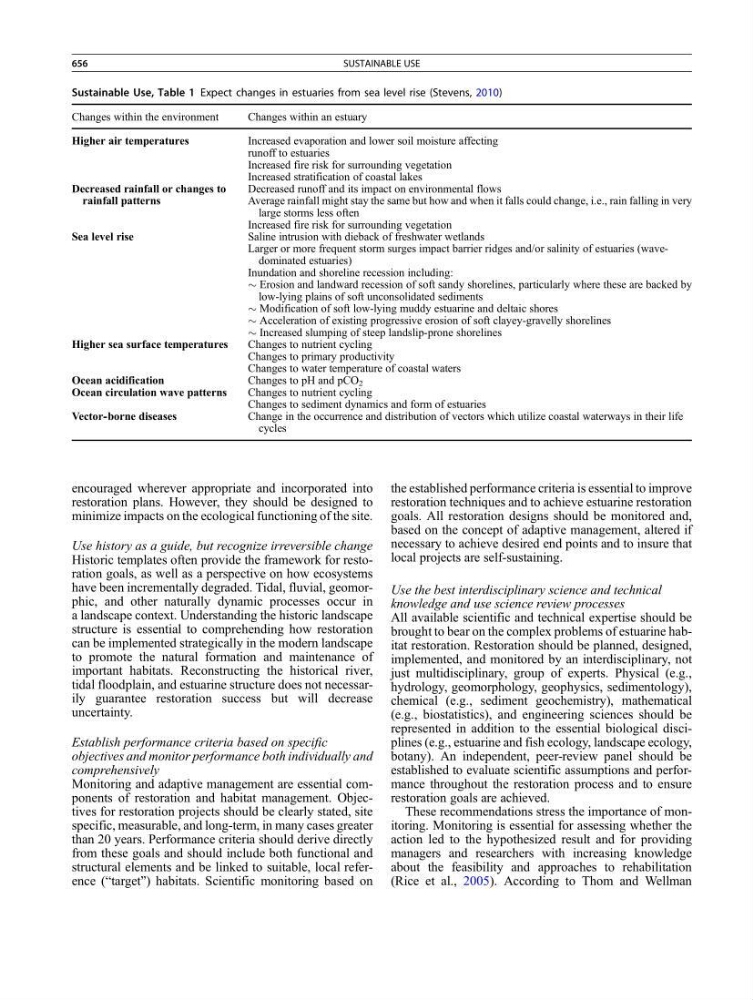
Sustainable Use, Table 1 Expect changes in estuaries from sea level rise (Stevens, 2010)
Changes within the environment
Changes within an estuary
Higher air temperatures
Increased evaporation and lower soil moisture affecting
runoff to estuaries
Increased fire risk for surrounding vegetation
Increased stratification of coastal lakes
Decreased rainfall or changes to
rainfall patterns
Decreased runoff and its impact on environmental flows
Average rainfall might stay the same but how and when it falls could change, i.e., rain falling in very
large storms less often
Increased fire risk for surrounding vegetation
Sea level rise
Saline intrusion with dieback of freshwater wetlands
Larger or more frequent storm surges impact barrier ridges and/or salinity of estuaries (wavedominated estuaries)
Inundation and shoreline recession including:
$ Erosion and landward recession of soft sandy shorelines, particularly where these are backed by
low-lying plains of soft unconsolidated sediments
$ Modification of soft low-lying muddy estuarine and deltaic shores
$ Acceleration of existing progressive erosion of soft clayey-gravelly shorelines
$ Increased slumping of steep landslip-prone shorelines
Higher sea surface temperatures
Changes to nutrient cycling
Changes to primary productivity
Changes to water temperature of coastal waters
Ocean acidification
Changes to pH and pCO 2
Ocean circulation wave patterns
Changes to nutrient cycling
Changes to sediment dynamics and form of estuaries
Vector-borne diseases
Change in the occurrence and distribution of vectors which utilize coastal waterways in their life
cycles
656
SUSTAINABLE USE