

the Columbia River system, can be generally applied to
a wide range of restoration activities.
Protect first, restore second
Protection of existing habitat is critical to the success of
estuarine restoration. To restore habitat in the absence of
any overlying conservation program is counterproductive.
All restoration sites should be explicitly incorporated into
a broad conservation framework that will ensure their
long-term protection. Estuaries and estuarine habitats can
be restored only through a long-term stewardship
approach with the necessary constituencies, policies, and
funding to support it.
Do no harm
To ensure no net loss of habitat functions and to protect
unimpeded natural processes, restoration actions should
achieve proposed benefits without degrading other ecological functions of natural habitats or broader
ecosystems.
Use natural processes to restore and maintain structure
Restorative measures should reestablish the dynamics of
estuarine hydrology, sedimentology, geomorphology,
and other habitat-forming processes that naturally create
and maintain habitat, rather than simply implanting habitat
structures at inappropriate or unsustainable locations. To
the extent possible, engineered structures should be
avoided in restoration designs.
Restore rather than enhance or create
Past experience demonstrates that, compared to restoration, enhancement (where designed to increase one or
more specific functions of a degraded habitat) or creation
of estuarine habitat is problematic and rarely leads to
self-sustaining ecosystems.
Develop a comprehensive restoration plan using
landscape ecology concepts to reestablish ecosystem
connectivity and complexity
Unplanned, opportunistic approaches to restoration will
not suffice. Strategic planning is necessary across hierarchical scales, from watershed to estuarine habitats, in
order to set a broad vision, articulate clear goals, and place
local restoration activities in an ecologically sound, ecosystem context. Both ecological and socioeconomic
aspects of the estuarine landscape must be considered
when selecting, designing, and locating restoration sites;
restoration and conservation can only be effective if
implemented within the human context. Restoration plans
should be designed to restore ecosystem complexity and
diversity. Public access to restoration sites should be
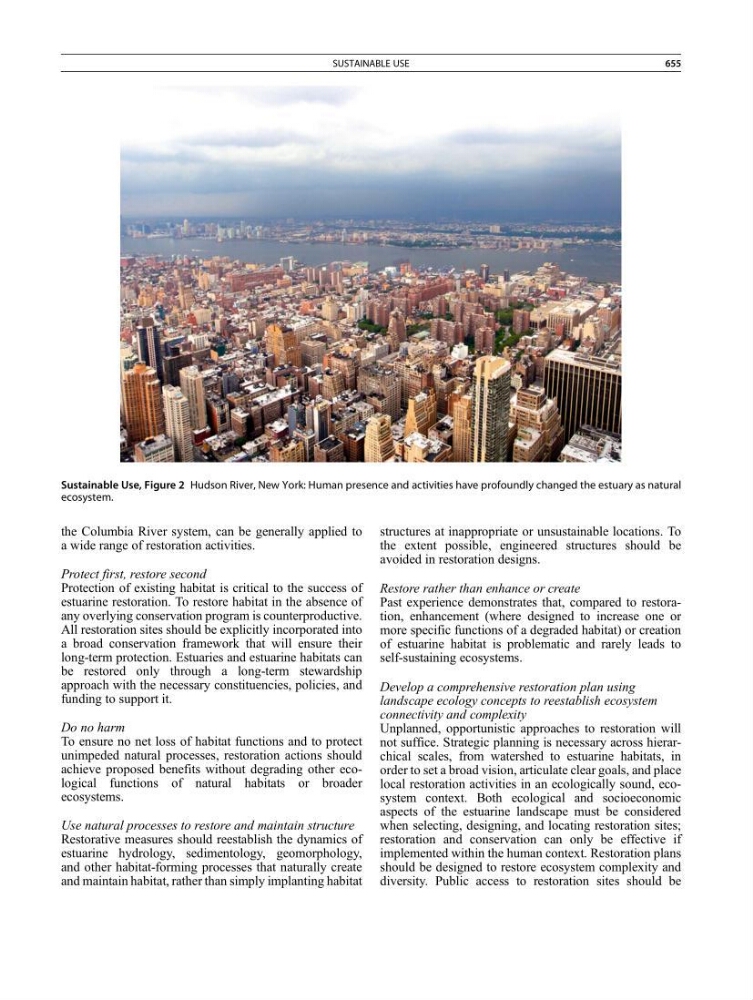
Sustainable Use, Figure 2 Hudson River, New York: Human presence and activities have profoundly changed the estuary as natural
ecosystem.
SUSTAINABLE USE
655