

Substrate
Substrate grain sizes have a major effect on biota occurrence, abundance, and functioning (McLachlan, 1996;
Semeniuk and Wurm, 2000; Unno and Semeniuk, 2009).
Mobile sand, for instance, agitated by current and waves
and devoid of interstitial mud and organic matter, is
a specific environment that only specialized fauna can
inhabit. Such environments are well oxygenated and
transmissive to pore waters and contain little or no organic
material interstitial to the sand particles. Faunas that
require a proportion of mud to line their burrow walls, or
substrates that are stable (non-mobile) to build burrow
structures, or feed on microbiota interstitial to sand grains
find mobile substrates unsuitable. Stable sand not mobilized by currents and waves and containing some interstitial mud and organic matter provides a specific
environment for specialized fauna; such environments
are not well oxygenated and less transmissive to pore
waters and contain organic material interstitial to the sand
particles. The Western Australian soldier crab, and its
associated invertebrate community, is an example of fauna
adapted to inhabiting a stable-sand substrate specifically
with medium/fine sand and <10 % mud (Unno and
Semeniuk, 2009). On the other hand, faunas that burrow
and forage through organic-rich mud and build permanent
burrows find mobile sand and even slightly muddy stable
sand unsuitable.
Inundation
The frequency of inundation has a large influence on the
occurrence and abundance of species across tidal flats
(Pennings and Callaway, 1992; Mitsch and Gosselink,
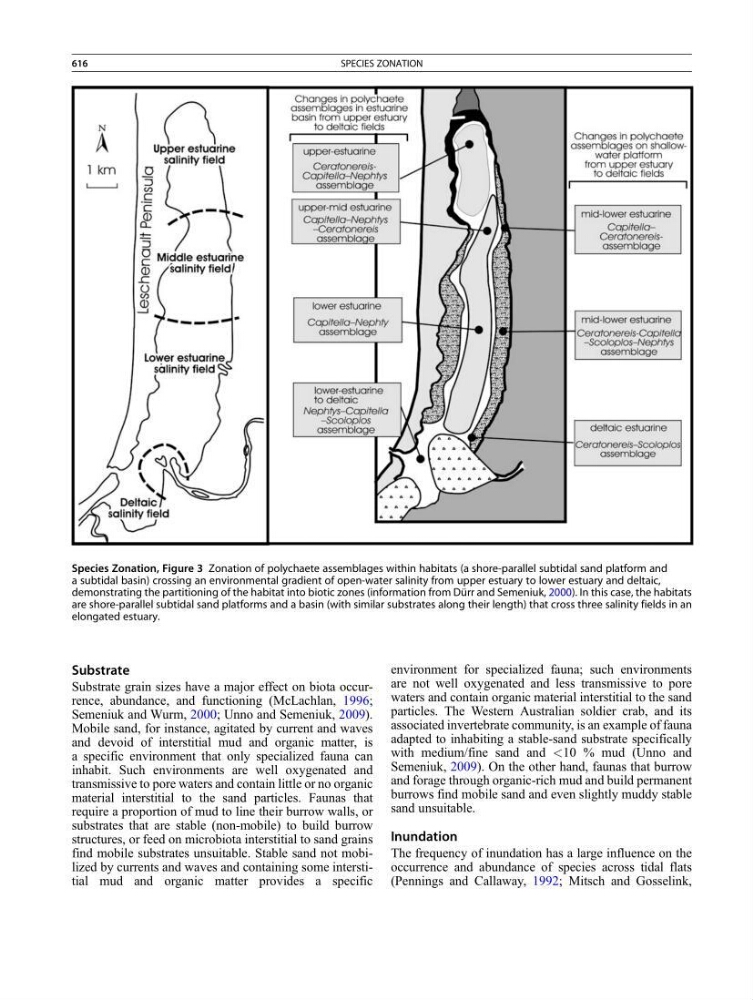
Species Zonation, Figure 3 Zonation of polychaete assemblages within habitats (a shore-parallel subtidal sand platform and
a subtidal basin) crossing an environmental gradient of open-water salinity from upper estuary to lower estuary and deltaic,
demonstrating the partitioning of the habitat into biotic zones (information from Du ¨ rr and Semeniuk, 2000). In this case, the habitats
are shore-parallel subtidal sand platforms and a basin (with similar substrates along their length) that cross three salinity fields in an
elongated estuary.
616
SPECIES ZONATION