

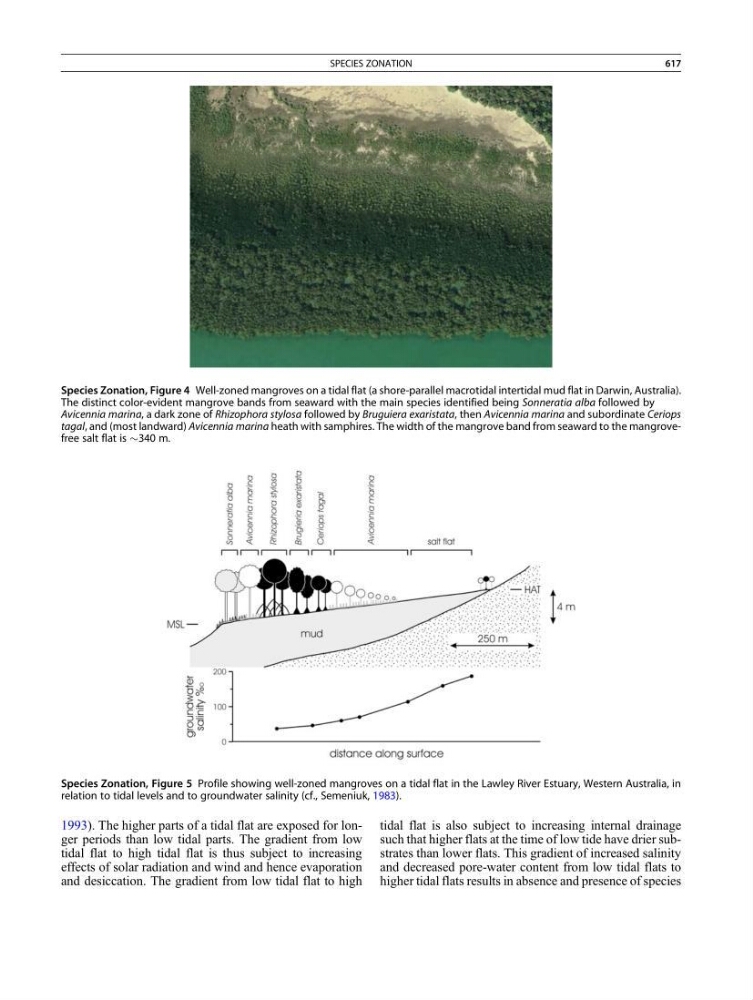
1993). The higher parts of a tidal flat are exposed for longer periods than low tidal parts. The gradient from low
tidal flat to high tidal flat is thus subject to increasing
effects of solar radiation and wind and hence evaporation
and desiccation. The gradient from low tidal flat to high
tidal flat is also subject to increasing internal drainage
such that higher flats at the time of low tide have drier substrates than lower flats. This gradient of increased salinity
and decreased pore-water content from low tidal flats to
higher tidal flats results in absence and presence of species
Species Zonation, Figure 4 Well-zoned mangroves on a tidal flat (a shore-parallel macrotidal intertidal mud flat in Darwin, Australia).
The distinct color-evident mangrove bands from seaward with the main species identified being Sonneratia alba followed by
Avicennia marina, a dark zone of Rhizophora stylosa followed by Bruguiera exaristata, then Avicennia marina and subordinate Ceriops
tagal, and (most landward) Avicennia marina heath with samphires. The width of the mangrove band from seaward to the mangrovefree salt flat is $340 m.
Species Zonation, Figure 5 Profile showing well-zoned mangroves on a tidal flat in the Lawley River Estuary, Western Australia, in
relation to tidal levels and to groundwater salinity (cf., Semeniuk, 1983).
SPECIES ZONATION
617