

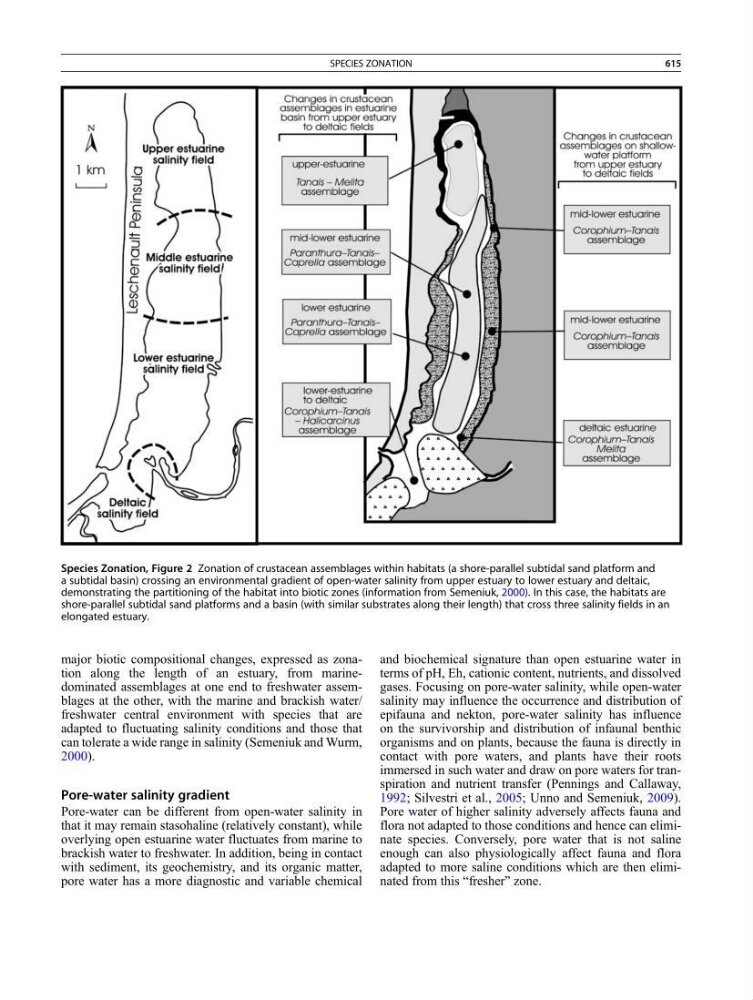
major biotic compositional changes, expressed as zonation along the length of an estuary, from marinedominated assemblages at one end to freshwater assemblages at the other, with the marine and brackish water/
freshwater central environment with species that are
adapted to fluctuating salinity conditions and those that
can tolerate a wide range in salinity (Semeniuk and Wurm,
2000).
Pore-water salinity gradient
Pore-water can be different from open-water salinity in
that it may remain stasohaline (relatively constant), while
overlying open estuarine water fluctuates from marine to
brackish water to freshwater. In addition, being in contact
with sediment, its geochemistry, and its organic matter,
pore water has a more diagnostic and variable chemical
and biochemical signature than open estuarine water in
terms of pH, Eh, cationic content, nutrients, and dissolved
gases. Focusing on pore-water salinity, while open-water
salinity may influence the occurrence and distribution of
epifauna and nekton, pore-water salinity has influence
on the survivorship and distribution of infaunal benthic
organisms and on plants, because the fauna is directly in
contact with pore waters, and plants have their roots
immersed in such water and draw on pore waters for transpiration and nutrient transfer (Pennings and Callaway,
1992; Silvestri et al., 2005; Unno and Semeniuk, 2009).
Pore water of higher salinity adversely affects fauna and
flora not adapted to those conditions and hence can eliminate species. Conversely, pore water that is not saline
enough can also physiologically affect fauna and flora
adapted to more saline conditions which are then eliminated from this “fresher” zone.
Species Zonation, Figure 2 Zonation of crustacean assemblages within habitats (a shore-parallel subtidal sand platform and
a subtidal basin) crossing an environmental gradient of open-water salinity from upper estuary to lower estuary and deltaic,
demonstrating the partitioning of the habitat into biotic zones (information from Semeniuk, 2000). In this case, the habitats are
shore-parallel subtidal sand platforms and a basin (with similar substrates along their length) that cross three salinity fields in an
elongated estuary.
SPECIES ZONATION
615