

estuary. The distribution of assemblages across and along
the estuary in these cases is not zoned; e.g., an estuary
comprised of deepwater mud basins, shallow-water
subtidal shore-parallel sandy platforms, tidal flats, and
hummocky tidally exposed shoals may have distinctive
fauna and flora in each of these habitats, but a transect
across the estuary will not illustrate species zonation nor
assemblage zonation but rather habitat-specific occurrences of assemblages. In contrast, species zonation, if
present in such estuaries, may be evident within a given
habitat that has environmental gradients within the habitat.
Some environmental determinants underpinning
zonation
The main environmental determinants for forcing species
zonation that are examined in this work are pore-water
salinity, open-water salinity, substrate type, and inundation. Each of these factors is discussed below in relation
to effects on species zonation. In the real world, it is the
combination of each of these physical environmental gradients, plus the interaction between species, that determines the final zonation of species. Other environmental
factors and gradients also influence zonation; these
include wave energy, tidal currents, extent of water turbidity, water depth, temperature, degree of light penetration,
pH, and nutrients. They influence the survivorship of
a given species, determine the suitability of a habitat for
an organism, and also affect the microbiota in the environment that then influence the occurrence of macrofauna and
macroflora.
Saline conditions can be lethal to biota adapted for
freshwater conditions, and freshwater can be lethal or
debilitating to biota adapted for saline conditions. So, the
salinity of open estuarine water or that of sediment pore
water (influencing those biotas residing in the substrate
or having their roots in the sediment) controls the occurrence and functioning of the various species in an estuary
and results in their occurrence or absence and in their differential abundance. In the case of substrates, some biotas
are adapted solely for inhabiting sandy substrates, and the
occurrence of mud interferes with their feeding or respiratory processes while, conversely, organisms adapted to
quiescent muddy conditions cannot tolerate mobile sandy
substrates. In the case of inundation, how frequently an
area in the tidal zone is inundated will influence the distribution of those biotas that require nearly continuous inundation for survival (Pennings et al., 2005). The gradient of
inundation affects the extent that tidal zones are exposed
to solar radiation, winds, evaporation, and groundwater
draining (which depletes sediment moisture content), all
of which influence the survivorship and population
dynamics of a given species.
Open-water salinity gradient
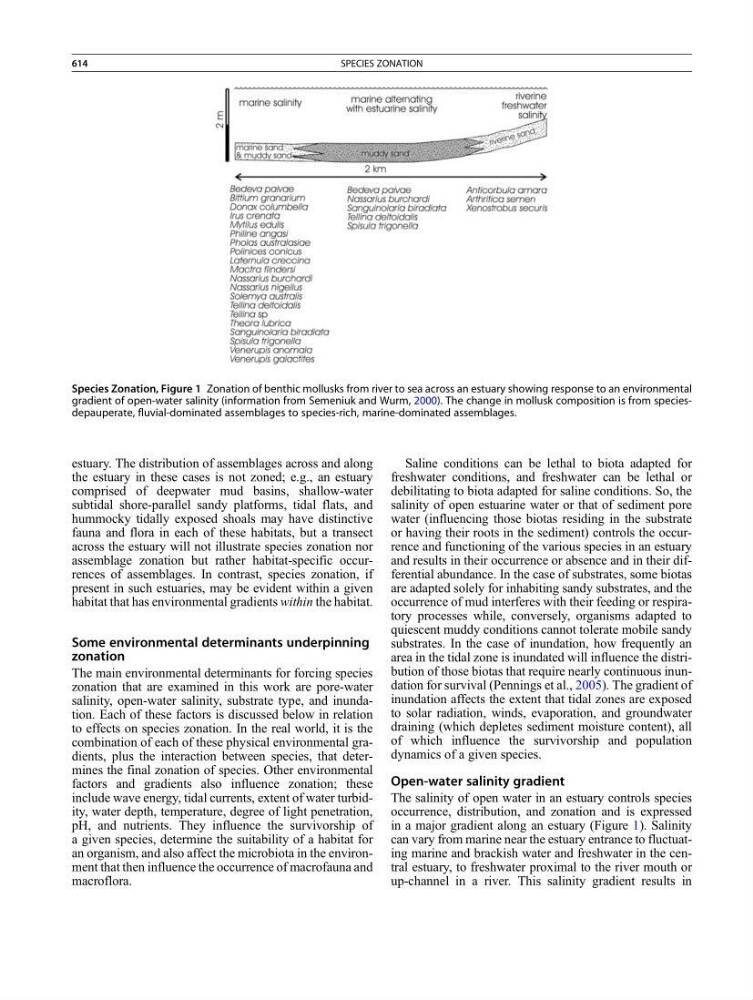
The salinity of open water in an estuary controls species
occurrence, distribution, and zonation and is expressed
in a major gradient along an estuary (Figure 1). Salinity
can vary from marine near the estuary entrance to fluctuating marine and brackish water and freshwater in the central estuary, to freshwater proximal to the river mouth or
up-channel in a river. This salinity gradient results in
Species Zonation, Figure 1 Zonation of benthic mollusks from river to sea across an estuary showing response to an environmental
gradient of open-water salinity (information from Semeniuk and Wurm, 2000). The change in mollusk composition is from speciesdepauperate, fluvial-dominated assemblages to species-rich, marine-dominated assemblages.
614
SPECIES ZONATION