

deliver larval recruits, is depauperate of mictyrid crabs.
The Murchison River estuary in Western Australia is such
an example – despite having suitable local sand shoals, it
is isolated by the Zuytdorp Cliffs and rocky coastline from
the nearest soldier crab population 200 km to the north at
Shark Bay (Unno and Semeniuk 2009). Of the various
types of estuaries, the ria or flooded river valley and the
bar-and-lagoon types (with an inlet opening to the ocean)
are most likely to host soldier crab populations as they
provide sheltered, low-wave energy environments.
There is a salinity gradient within an estuary from freshwater to brackish water near, at, or within the river mouth
to brackish water to marine water in the central estuarine
reaches, to marine (and seasonally brackish water) at or
near the estuary inlet. Soldier crabs inhabit estuaries from
the marine saline parts to the brackish water parts, occupying tidally exposed sandy substrates between the Mean
Low Water Neap (MLWN) and Mean High Water Spring
(MHWS) tidal levels.
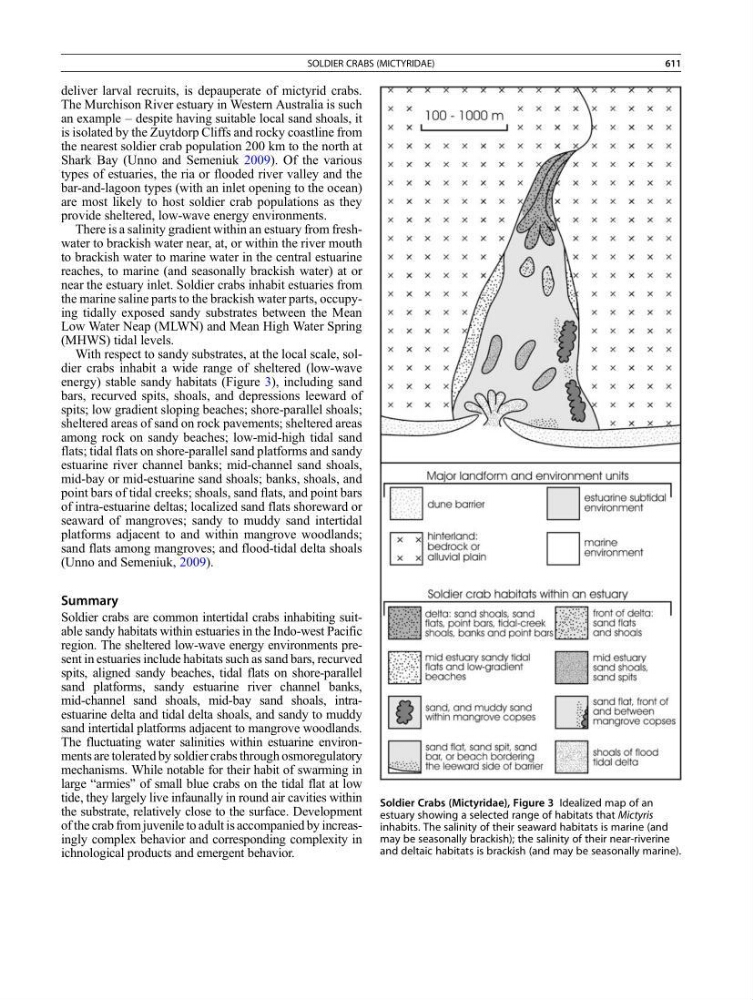
With respect to sandy substrates, at the local scale, soldier crabs inhabit a wide range of sheltered (low-wave
energy) stable sandy habitats (Figure 3), including sand
bars, recurved spits, shoals, and depressions leeward of
spits; low gradient sloping beaches; shore-parallel shoals;
sheltered areas of sand on rock pavements; sheltered areas
among rock on sandy beaches; low-mid-high tidal sand
flats; tidal flats on shore-parallel sand platforms and sandy
estuarine river channel banks; mid-channel sand shoals,
mid-bay or mid-estuarine sand shoals; banks, shoals, and
point bars of tidal creeks; shoals, sand flats, and point bars
of intra-estuarine deltas; localized sand flats shoreward or
seaward of mangroves; sandy to muddy sand intertidal
platforms adjacent to and within mangrove woodlands;
sand flats among mangroves; and flood-tidal delta shoals
(Unno and Semeniuk, 2009).
Summary
Soldier crabs are common intertidal crabs inhabiting suitable sandy habitats within estuaries in the Indo-west Pacific
region. The sheltered low-wave energy environments present in estuaries include habitats such as sand bars, recurved
spits, aligned sandy beaches, tidal flats on shore-parallel
sand platforms, sandy estuarine river channel banks,
mid-channel sand shoals, mid-bay sand shoals, intraestuarine delta and tidal delta shoals, and sandy to muddy
sand intertidal platforms adjacent to mangrove woodlands.
The fluctuating water salinities within estuarine environments are tolerated by soldier crabs through osmoregulatory
mechanisms. While notable for their habit of swarming in
large “armies” of small blue crabs on the tidal flat at low
tide, they largely live infaunally in round air cavities within
the substrate, relatively close to the surface. Development
of the crab from juvenile to adult is accompanied by increasingly complex behavior and corresponding complexity in
ichnological products and emergent behavior.
Soldier Crabs (Mictyridae), Figure 3 Idealized map of an
estuary showing a selected range of habitats that Mictyris
inhabits. The salinity of their seaward habitats is marine (and
may be seasonally brackish); the salinity of their near-riverine
and deltaic habitats is brackish (and may be seasonally marine).
SOLDIER CRABS (MICTYRIDAE)
611