

For the Australian species, a multitude of rivers
draining eastwards from the Great Dividing Range and
Blue Mountains provide many estuarine habitats for soldier crab species along the eastern coastline.
M. longicarpus has been well studied in the Brisbane
River and Pine River estuaries draining into Moreton
Bay, Queensland (Cameron, 1966; Dittmann, 1998) and
inhabits many estuarine environments from northern
Queensland to southern Victoria (Figure 1). M. livingstonei
occurs from northern Queensland to the Macleay River
estuarine complex in Trial Bay, New South Wales.
M. platycheles occurs along on the central and southern
mainland Australian coast, as well as in numerous estuaries along the northern, eastern, and southern coastlines of
Tasmania (Figure 1). In the Northern Territory and northern Western Australia, drainage from the highlands and
tectonic blocks result in extensive river outflow to the
coast forming estuaries wherein M. darwinensis resides
(e.g., Keep River estuary). M. occidentalis inhabiting the
northwest Western Australian coastline is an exception to
the soldier crab trend towards dominantly estuarine inhabitation. Within the crab’s biogeographic range, the climate
is arid to semiarid resulting in the development of few
large rivers and estuaries. Rivers are dominated by marine
salinities and only function intermittently as estuaries
every 5–10 years during times of flood; an example is
the Gascoyne River estuary where soldier crab
populations reside on deltaic (strand plain) shoals and
upstream on sandy creek banks and point bar shoals.
Range of habitats available in estuaries
Soldier crabs inhabit a wide variety of large-scale coastal
settings, including estuaries, barred lagoons, tidal creeks,
delta strand plains, tidal flats, beach/dune shores, and limestone barrier coasts. An estuary by definition is the area
where freshwater from rivers intermix with marine water
on a seasonal or intermittent basis resulting in a variation of
salinity ranging from marine to brackish to fresh depending
on the fluvial input. Factors influencing the development of
local habitats for soldier crabs within an estuary include the
large-scale geomorphology of the coast, coastal and marine
processes, and fluvial hydrology and sediment supply.
The presence of soldier crabs in an estuary depends on
climate setting and coastal setting of the estuary, the type
of estuary, as well the sedimentological and hydrological
regime prevalent in the estuary. An estuary may have
many local habitats suitable for soldier crabs but can be
situated in a region that due to remoteness from existing
soldier crab populations, or lack of regional currents to
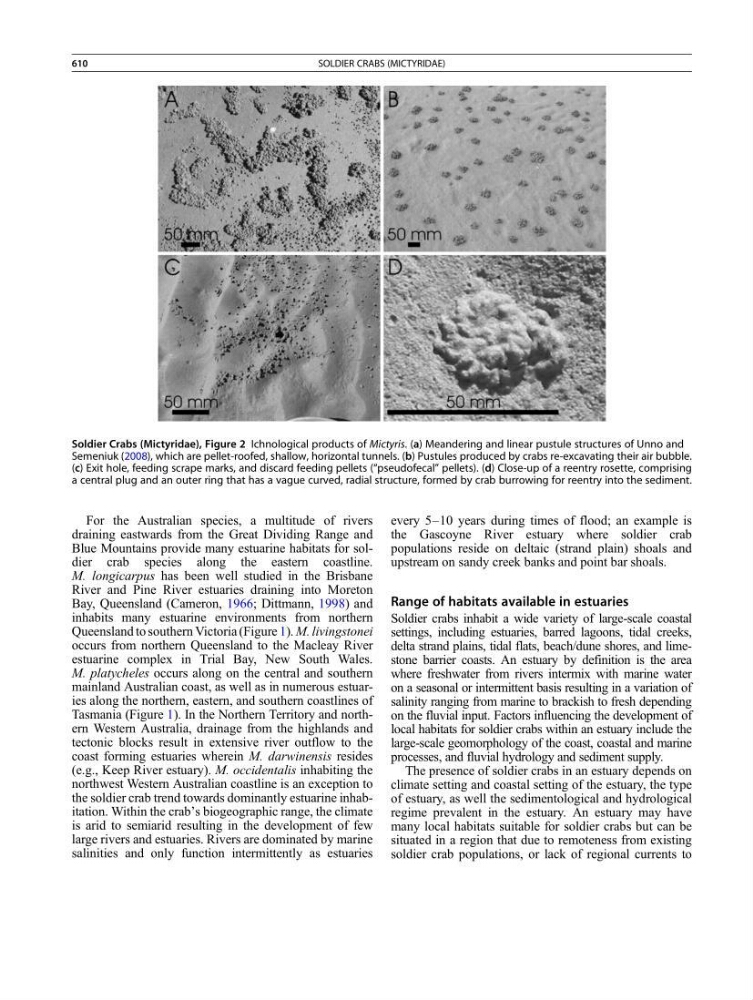
Soldier Crabs (Mictyridae), Figure 2 Ichnological products of Mictyris. (a) Meandering and linear pustule structures of Unno and
Semeniuk (2008), which are pellet-roofed, shallow, horizontal tunnels. (b) Pustules produced by crabs re-excavating their air bubble.
(c) Exit hole, feeding scrape marks, and discard feeding pellets (“pseudofecal” pellets). (d) Close-up of a reentry rosette, comprising
a central plug and an outer ring that has a vague curved, radial structure, formed by crab burrowing for reentry into the sediment.
610
SOLDIER CRABS (MICTYRIDAE)