

accretion or decelerated erosion results from greater sediment deposition, whereas decelerated accretion or accelerated erosion suggests greater sediment transport (Morton,
1979). Deposition and erosion of beach sediments depend
on shoreline configuration, source and sink of sediment,
and the hydrodynamics of the nearshore region. Although
the overall direction of sediment transport and its
mechanisms determine the areas of coastal erosion and
accumulation, factors such as intensity of monsoons influence the erosion and accretion patterns along the west
coast of India (Narayana et al., 2001). Therefore, it is
important to understand how sediments from various
sources on the beaches are reworked and redistributed by
the nearshore hydrodynamic processes.
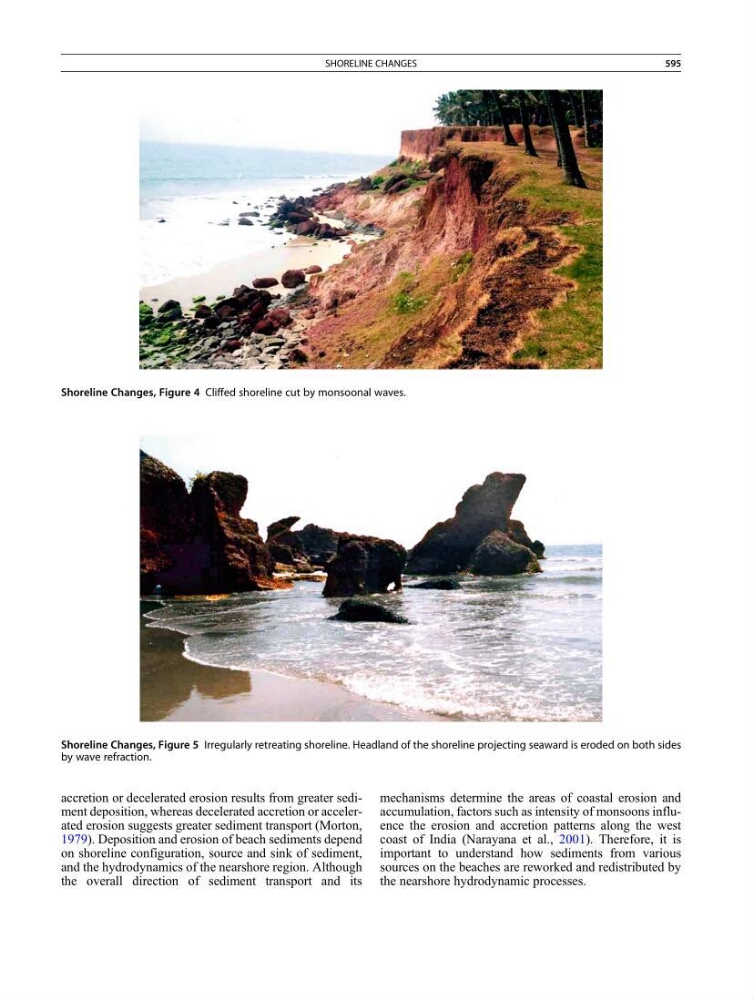
Shoreline Changes, Figure 4 Cliffed shoreline cut by monsoonal waves.
Shoreline Changes, Figure 5 Irregularly retreating shoreline. Headland of the shoreline projecting seaward is eroded on both sides
by wave refraction.
SHORELINE CHANGES
595