

A strong relationship was reported between the variability of rainfall and sediment transport, where high sediment discharges are recorded with high rainfall (Syvitski
and Morehead, 1999). Further, intensive monsoons make
the sea rough, with high wave activity, and erosion of
the sediment along the coast, resulting in change of the
shoreline configuration. In summary, intensive monsoon
rainfall and sediment derived from inland areas influence
the configuration and position of the shoreline. The oceanographic regime is dominated by meteorological forcing
rather than tidal forcing along the Asian coasts, where
tidal range is $1 m. If the accumulation of sediment at
the updrift arm completely balances the erosion at the
downdrift end, a “straight” inlet develops. A curved spit,
projecting toward the inlet, suggests that spits display
marked changes in form and alignment in response to relative sea-level variations, sediment supply, and wave climate (Firth et al., 1995).
Recession of cliffed coasts is the cumulative result of
a number of interacting forces and activities. It can be
measured or estimated from identified, common, or analogous cliff features and sequentially plotted over the longest possible time periods (Malcolm and Janet, 1997).
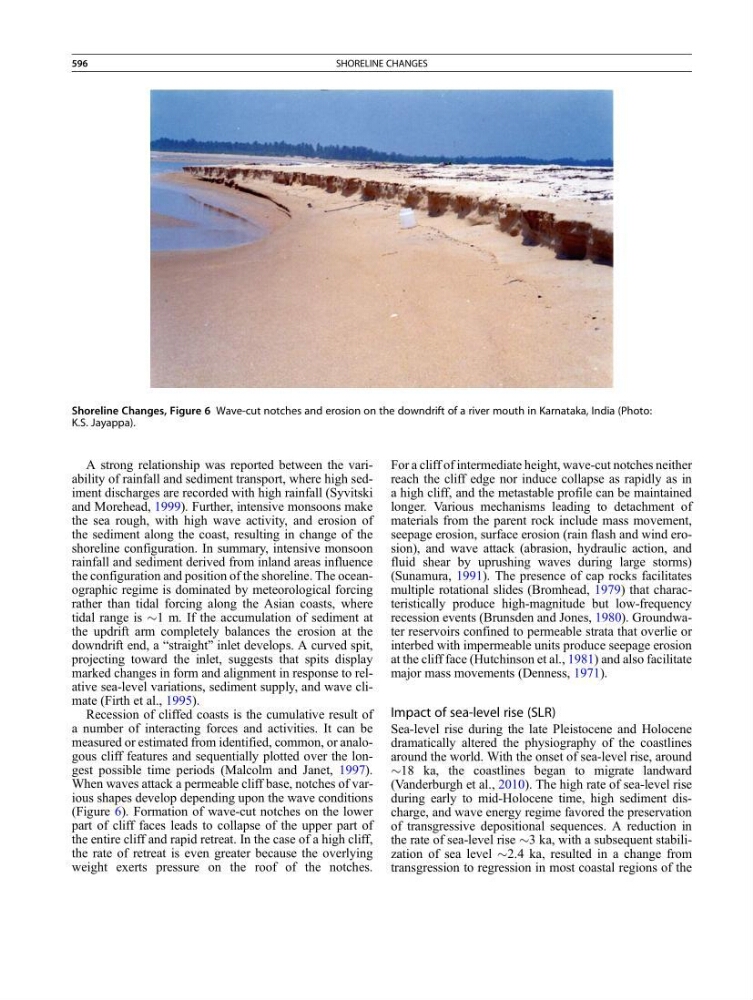
When waves attack a permeable cliff base, notches of various shapes develop depending upon the wave conditions
(Figure 6). Formation of wave-cut notches on the lower
part of cliff faces leads to collapse of the upper part of
the entire cliff and rapid retreat. In the case of a high cliff,
the rate of retreat is even greater because the overlying
weight exerts pressure on the roof of the notches.
For a cliff of intermediate height, wave-cut notches neither
reach the cliff edge nor induce collapse as rapidly as in
a high cliff, and the metastable profile can be maintained
longer. Various mechanisms leading to detachment of
materials from the parent rock include mass movement,
seepage erosion, surface erosion (rain flash and wind erosion), and wave attack (abrasion, hydraulic action, and
fluid shear by uprushing waves during large storms)
(Sunamura, 1991). The presence of cap rocks facilitates
multiple rotational slides (Bromhead, 1979) that characteristically produce high-magnitude but low-frequency
recession events (Brunsden and Jones, 1980). Groundwater reservoirs confined to permeable strata that overlie or
interbed with impermeable units produce seepage erosion
at the cliff face (Hutchinson et al., 1981) and also facilitate
major mass movements (Denness, 1971).
Impact of sea-level rise (SLR)
Sea-level rise during the late Pleistocene and Holocene
dramatically altered the physiography of the coastlines
around the world. With the onset of sea-level rise, around
$18 ka, the coastlines began to migrate landward
(Vanderburgh et al., 2010). The high rate of sea-level rise
during early to mid-Holocene time, high sediment discharge, and wave energy regime favored the preservation
of transgressive depositional sequences. A reduction in
the rate of sea-level rise $3 ka, with a subsequent stabilization of sea level $2.4 ka, resulted in a change from
transgression to regression in most coastal regions of the
Shoreline Changes, Figure 6 Wave-cut notches and erosion on the downdrift of a river mouth in Karnataka, India (Photo:
K.S. Jayappa).
596
SHORELINE CHANGES