

Shoreline erosion
Coastal erosion is generally related to wave energy, shoreline material, coastal topography, and the direction of the
approaching waves with respect to the shoreline direction.
The breaking waves and currents in the nearshore zone are
responsible for the transport of coastal sediments resulting
in shoreline change. The first effect of erosion on a newly
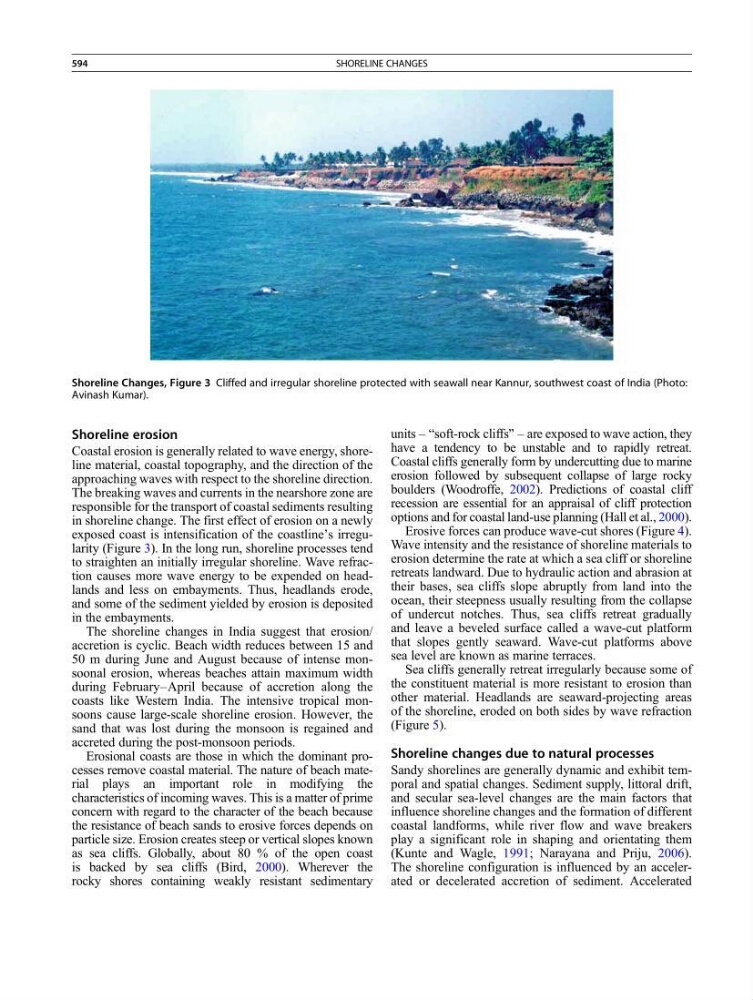
exposed coast is intensification of the coastline’s irregularity (Figure 3). In the long run, shoreline processes tend
to straighten an initially irregular shoreline. Wave refraction causes more wave energy to be expended on headlands and less on embayments. Thus, headlands erode,
and some of the sediment yielded by erosion is deposited
in the embayments.
The shoreline changes in India suggest that erosion/
accretion is cyclic. Beach width reduces between 15 and
50 m during June and August because of intense monsoonal erosion, whereas beaches attain maximum width
during February–April because of accretion along the
coasts like Western India. The intensive tropical monsoons cause large-scale shoreline erosion. However, the
sand that was lost during the monsoon is regained and
accreted during the post-monsoon periods.
Erosional coasts are those in which the dominant processes remove coastal material. The nature of beach material plays an important role in modifying the
characteristics of incoming waves. This is a matter of prime
concern with regard to the character of the beach because
the resistance of beach sands to erosive forces depends on
particle size. Erosion creates steep or vertical slopes known
as sea cliffs. Globally, about 80 % of the open coast
is backed by sea cliffs (Bird, 2000). Wherever the
rocky shores containing weakly resistant sedimentary
units – “soft-rock cliffs” – are exposed to wave action, they
have a tendency to be unstable and to rapidly retreat.
Coastal cliffs generally form by undercutting due to marine
erosion followed by subsequent collapse of large rocky
boulders (Woodroffe, 2002). Predictions of coastal cliff
recession are essential for an appraisal of cliff protection
options and for coastal land-use planning (Hall et al., 2000).
Erosive forces can produce wave-cut shores (Figure 4).
Wave intensity and the resistance of shoreline materials to
erosion determine the rate at which a sea cliff or shoreline
retreats landward. Due to hydraulic action and abrasion at
their bases, sea cliffs slope abruptly from land into the
ocean, their steepness usually resulting from the collapse
of undercut notches. Thus, sea cliffs retreat gradually
and leave a beveled surface called a wave-cut platform
that slopes gently seaward. Wave-cut platforms above
sea level are known as marine terraces.
Sea cliffs generally retreat irregularly because some of
the constituent material is more resistant to erosion than
other material. Headlands are seaward-projecting areas
of the shoreline, eroded on both sides by wave refraction
(Figure 5).
Shoreline changes due to natural processes
Sandy shorelines are generally dynamic and exhibit temporal and spatial changes. Sediment supply, littoral drift,
and secular sea-level changes are the main factors that
influence shoreline changes and the formation of different
coastal landforms, while river flow and wave breakers
play a significant role in shaping and orientating them
(Kunte and Wagle, 1991; Narayana and Priju, 2006).
The shoreline configuration is influenced by an accelerated or decelerated accretion of sediment. Accelerated
Shoreline Changes, Figure 3 Cliffed and irregular shoreline protected with seawall near Kannur, southwest coast of India (Photo:
Avinash Kumar).
594
SHORELINE CHANGES