

heads of rip currents. In the nearshore zone, where the
breaker zone and surf zone are located, the water from
breaking waves rushes forward and then flows seaward
as backwash. Longshore currents are one important aspect
of breaking waves, and these waves have the ability to
generate currents that flow parallel to the shoreline. They
occur because each wave thrusts the water forward when
it breaks. Longshore currents are long and narrow, and
they flow in the same general direction as the approaching
waves. Longshore currents are particularly important in
transporting and depositing sediment in the nearshore
zone. Rivers are one of the major sources of littoral drift
and the annual discharge of sediments to the seas. Along
the Indian coasts alone, the annual sediment discharge to
the ocean is about 1.2 billion tonnes, which accounts
roughly 10 % of the global sediment flux to the world
oceans (Subramanian, 1993).
Monsoons play an important role in shoreline changes
and configurations, particularly along Asia and Southeast
Asian seas. The Indian coast experiences two monsoons –
the southwest (summer) monsoon (June–September) and
the weaker northeast (winter) monsoon (October–December). During the southwest monsoon, the coastal current is
in a clockwise direction, while during the northeast monsoon, the current is in a counterclockwise direction. As
a result, the longshore current is stronger and toward the
south during the southwest monsoon (Narayana et al.,
2001). Natural processes such as waves, littoral currents,
offshore relief, rainfall, and sea-level changes are responsible for erosion/accretion of the coast and subsequent
shoreline changes. Surging, spilling, and plunging breakers with wave heights of 2–3 m occur along the
monsoon-dominated coasts. In the monsoon season, wind
energy is much greater, resulting in larger amplitude
waves and strong littoral currents. Infragravity and far
infragravity edge waves, coupled with strong reflections
and undertow, play an important role in the hydrodynamics of the coastline (Tatavarti et al., 1996). Sediments lying
on the nearshore bed are disturbed and eroded during the
monsoon season because of the larger and strong waves
and undertow. Therefore, sediments are mobilized into
suspension and transported. As the low-frequency
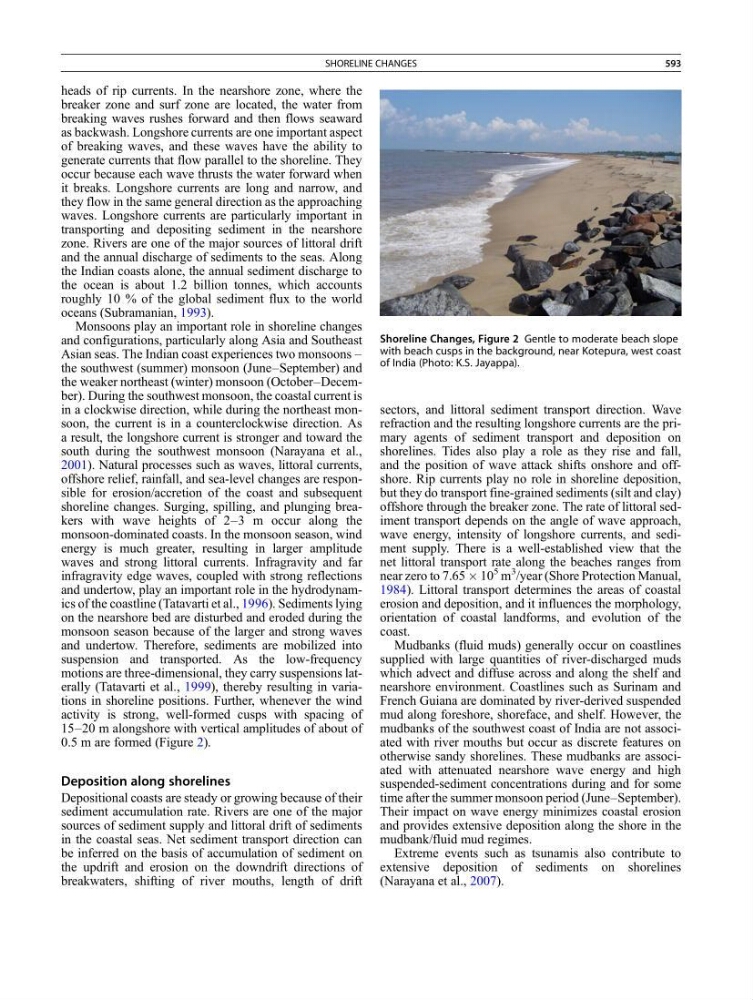
motions are three-dimensional, they carry suspensions laterally (Tatavarti et al., 1999), thereby resulting in variations in shoreline positions. Further, whenever the wind
activity is strong, well-formed cusps with spacing of
15–20 m alongshore with vertical amplitudes of about of
0.5 m are formed (Figure 2).
Deposition along shorelines
Depositional coasts are steady or growing because of their
sediment accumulation rate. Rivers are one of the major
sources of sediment supply and littoral drift of sediments
in the coastal seas. Net sediment transport direction can
be inferred on the basis of accumulation of sediment on
the updrift and erosion on the downdrift directions of
breakwaters, shifting of river mouths, length of drift
sectors, and littoral sediment transport direction. Wave
refraction and the resulting longshore currents are the primary agents of sediment transport and deposition on
shorelines. Tides also play a role as they rise and fall,
and the position of wave attack shifts onshore and offshore. Rip currents play no role in shoreline deposition,
but they do transport fine-grained sediments (silt and clay)
offshore through the breaker zone. The rate of littoral sediment transport depends on the angle of wave approach,
wave energy, intensity of longshore currents, and sediment supply. There is a well-established view that the
net littoral transport rate along the beaches ranges from
near zero to 7.65 Â 10
5 m
3
/year (Shore Protection Manual,
1984). Littoral transport determines the areas of coastal
erosion and deposition, and it influences the morphology,
orientation of coastal landforms, and evolution of the
coast.
Mudbanks (fluid muds) generally occur on coastlines
supplied with large quantities of river-discharged muds
which advect and diffuse across and along the shelf and
nearshore environment. Coastlines such as Surinam and
French Guiana are dominated by river-derived suspended
mud along foreshore, shoreface, and shelf. However, the
mudbanks of the southwest coast of India are not associated with river mouths but occur as discrete features on
otherwise sandy shorelines. These mudbanks are associated with attenuated nearshore wave energy and high
suspended-sediment concentrations during and for some
time after the summer monsoon period (June–September).
Their impact on wave energy minimizes coastal erosion
and provides extensive deposition along the shore in the
mudbank/fluid mud regimes.
Extreme events such as tsunamis also contribute to
extensive deposition of sediments on shorelines
(Narayana et al., 2007).
Shoreline Changes, Figure 2 Gentle to moderate beach slope
with beach cusps in the background, near Kotepura, west coast
of India (Photo: K.S. Jayappa).
SHORELINE CHANGES
593