

through all points of the compass during the tidal period.
This rotation, caused by the earth’s rotation and unless
modified by local conditions, is clockwise in the Northern
Hemisphere and counterclockwise in the Southern Hemisphere. In estuaries and/or straits, or where the direction of
flow is more or less restricted to certain channels, the tidal
current is reversing; that is, it flows alternately in approximately opposite directions with an instant or short period
of little or no current (called slack water) at each reversal
of the current. During the flow in each direction, the speed
varies from zero at the time of slack water to a maximum,
called strength of flood or ebb, about midway between the
slacks. Tidal currents generally have little modifying
effect on shorelines along straight coasts, except in narrow
passages where tidal current velocity is strong enough to
erode and transport sediment. It works as one of the
sediment-transporting agents and to prevent the blockage
of passageways created by sediment deposition via the
action of nearshore currents.
Several processes such as landslides, earthquakes, and
volcanic eruptions in the oceans generate large waves
and tsunamis that can devastate coastal areas, but most
natural process activities on shorelines are accomplished
by wind-generated waves, especially storm waves. Waves
are directly or indirectly responsible for most erosion, sediment transport, and deposition in coastal areas.
Shallow-water waves and breakers
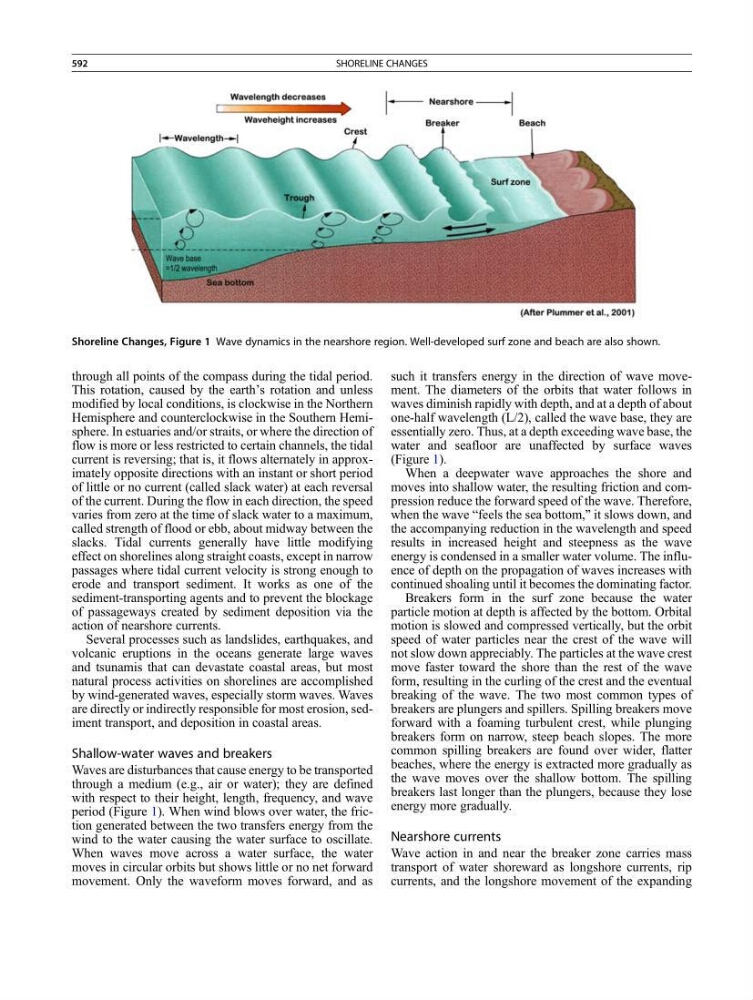
Waves are disturbances that cause energy to be transported
through a medium (e.g., air or water); they are defined
with respect to their height, length, frequency, and wave
period (Figure 1). When wind blows over water, the friction generated between the two transfers energy from the
wind to the water causing the water surface to oscillate.
When waves move across a water surface, the water
moves in circular orbits but shows little or no net forward
movement. Only the waveform moves forward, and as
such it transfers energy in the direction of wave movement. The diameters of the orbits that water follows in
waves diminish rapidly with depth, and at a depth of about
one-half wavelength (L/2), called the wave base, they are
essentially zero. Thus, at a depth exceeding wave base, the
water and seafloor are unaffected by surface waves
(Figure 1).
When a deepwater wave approaches the shore and
moves into shallow water, the resulting friction and compression reduce the forward speed of the wave. Therefore,
when the wave “feels the sea bottom,” it slows down, and
the accompanying reduction in the wavelength and speed
results in increased height and steepness as the wave
energy is condensed in a smaller water volume. The influence of depth on the propagation of waves increases with
continued shoaling until it becomes the dominating factor.
Breakers form in the surf zone because the water
particle motion at depth is affected by the bottom. Orbital
motion is slowed and compressed vertically, but the orbit
speed of water particles near the crest of the wave will
not slow down appreciably. The particles at the wave crest
move faster toward the shore than the rest of the wave
form, resulting in the curling of the crest and the eventual
breaking of the wave. The two most common types of
breakers are plungers and spillers. Spilling breakers move
forward with a foaming turbulent crest, while plunging
breakers form on narrow, steep beach slopes. The more
common spilling breakers are found over wider, flatter
beaches, where the energy is extracted more gradually as
the wave moves over the shallow bottom. The spilling
breakers last longer than the plungers, because they lose
energy more gradually.
Nearshore currents
Wave action in and near the breaker zone carries mass
transport of water shoreward as longshore currents, rip
currents, and the longshore movement of the expanding
Shoreline Changes, Figure 1 Wave dynamics in the nearshore region. Well-developed surf zone and beach are also shown.
592
SHORELINE CHANGES