

Worldwide, groins are a commonly used shore protection
method. Usually made of wood or rock, the installation of
more than one is often referred to as a groin field. Groin
length and spacing varies with site conditions. When there
is abundant sand moving alongshore, a groin field can be
an effective shore protection method (Figure 4). However,
in sand-poor systems, downdrift impacts can be significant. In fact, there is almost always an impact downdrift
which often leads to a “domino” effect with those properties affected adding more groins.
Offshore breakwaters have been used to provide
a stable protective beach in many areas around the world.
Along estuarine shorelines, they are either detached or
attached breakwaters. Attached breakwaters are often
called headland breakwaters. Breakwaters can be used
with or without sand nourishment. Though primarily used
along open ocean coasts, installations have become more
widespread in estuarine setting, particularly Chesapeake
Bay (Hardaway and Gunn, 2010, 2011).
Detached breakwater systems (Figure 5) operate on the
principal that by placing breakwaters offshore a certain
distance that alongshore transport in their lee can continue
and thus have minimal impact to the downdrift shoreline.
The degree of attachment (or detachment) is primarily
a function of breakwater length vs. distance offshore. If
the breakwater unit is shorter than its distance offshore,
a salient is likely to develop but if the breakwater unit is
equal to or closer that its distance offshore, a tombolo will
most likely develop (Chasten et al., 1993). Attached
breakwater systems (Figure 6) often have a series of
breakwater and pocket beaches and usually require sand
fill to complete the shore protection system. The sand
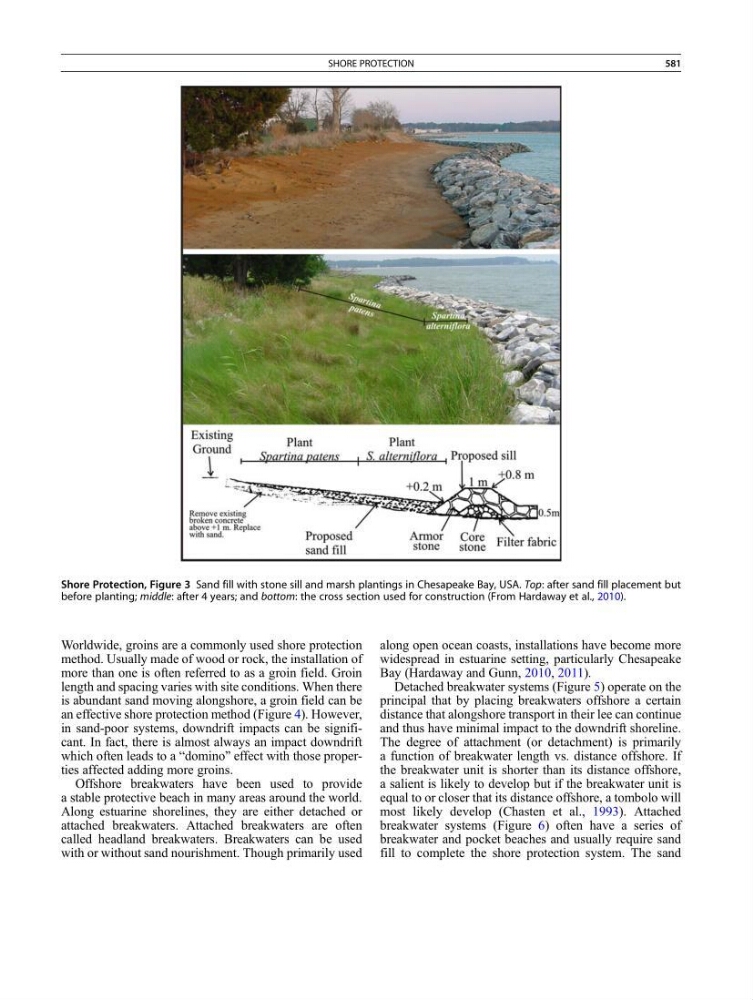
Shore Protection, Figure 3 Sand fill with stone sill and marsh plantings in Chesapeake Bay, USA. Top: after sand fill placement but
before planting; middle: after 4 years; and bottom: the cross section used for construction (From Hardaway et al., 2010).
SHORE PROTECTION
581