

Offensive
Offensive methods include those that extend beyond the
eroding bank slope to intercept the impinging wave climate well before impacting the bank. This often involves
creating marsh fringes and/or beaches, sometimes referred
to as living shorelines. Establishing a marsh fringe or
beach for shore protection either by planting the existing
substrate or by beach nourishment is considered
a nonstructural or “soft” approach. Establishing marsh
fringes on their own is limited to very fetch-limited shorelines of <1.6 km (Hardaway et al., 1985).
Marsh fringe establishment in higher fetch conditions
(up to 8 km) usually requires the addition of sand and
some type of sand containment structure. In the
Mid-Atlantic, the use of a sill system is widely used
(Figure 3). A sill system consists of sand fill to create stable beach and planting substrate. This is anchored by
a rock sill that runs along the nearshore parallel to the
coast, where it protects the sand fill from wave scour.
Marsh plants are established in the sand fill with intertidal
species planted from about mean tide level adjacent to the
back of the sill to about mean high water. The sand fill
might go up a couple of meters against the eroding bank
to a certain level of protection. Bank grading from that
point landward increases the stability of the system. The
combination of rock, sand, plants and possibly bank grading provides a coastal gradient for storm wave attenuation
and long-term sea-level rise (Hardaway et al., 2012).
Establishing a stable protective beach along estuarine
shorelines can be done with groins or breakwaters with
beach nourishment. Beach nourishment alone is usually
only placed on public beaches which seek to create recreational areas in addition to shore protection. When
beach nourishment is placed without a structure, ongoing
maintenance generally is necessary. Groins often are
used to capture littoral sands to create a wide beach.
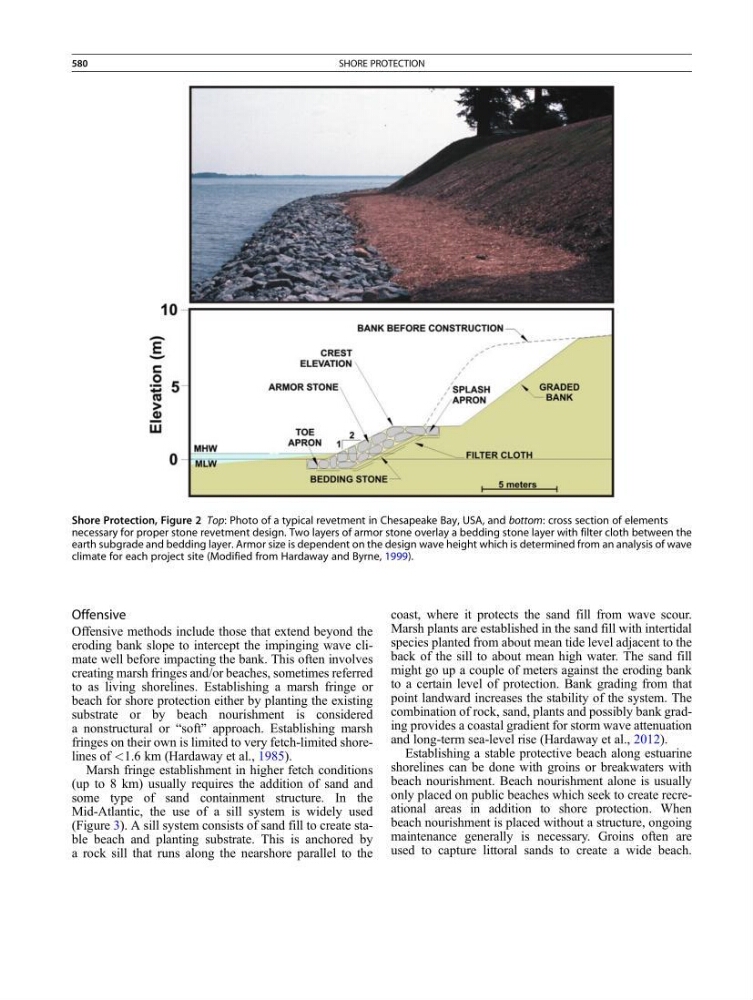
Shore Protection, Figure 2 Top: Photo of a typical revetment in Chesapeake Bay, USA, and bottom: cross section of elements
necessary for proper stone revetment design. Two layers of armor stone overlay a bedding stone layer with filter cloth between the
earth subgrade and bedding layer. Armor size is dependent on the design wave height which is determined from an analysis of wave
climate for each project site (Modified from Hardaway and Byrne, 1999).
580
SHORE PROTECTION