

can be both recreational and protective. Where possible,
the sand fill is sloped from the breakwaters to elevation
of the desired level of protection at the bank. This provides
a sloped area that can reduce the wave energy that impacts
the bank under high water conditions (Hardaway et al.,
2005).
Design elements
The design of shore protection along estuarine coasts often
is predicated on what has been done before and what is
locally permissible. In the context of designing an
engineered application, consideration of the hydrodynamic forces, usually waves, acting against the shore
should be evaluated. Site assessment should include
measuring several design parameters: fetch exposure,
storm surge frequency, shore orientation, nearshore
bathymetry, and bank height and composition. The project
wave climate will be affected by these parameters, and the
power and frequency storm waves that impact the shore
will determine basic components of a shore protection
structure such as structure height and rock size. Although
developed primarily for open ocean coasts, the Coastal
Engineering Manual (USACE, 2000) provides the theoretical basis for physics of shore protection.
The level of protection of a system describes the storm
conditions against which a shore protection system would
maintain its integrity. In most US localities, the Federal
Emergency Management Agency (FEMA) has created
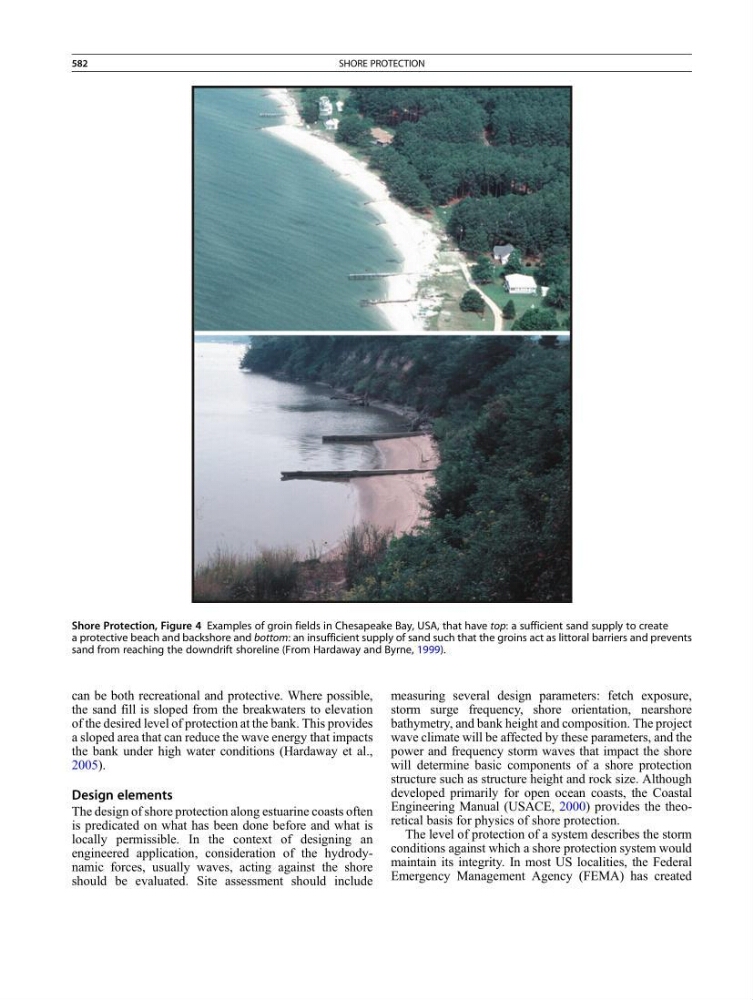
Shore Protection, Figure 4 Examples of groin fields in Chesapeake Bay, USA, that have top: a sufficient sand supply to create
a protective beach and backshore and bottom: an insufficient supply of sand such that the groins act as littoral barriers and prevents
sand from reaching the downdrift shoreline (From Hardaway and Byrne, 1999).
582
SHORE PROTECTION