

SEDIMENTARY STRUCTURES
Gautam Kumar Das
Department of Chemical Engineering, Jadavpur
University, Kolkata, West Bengal, India
Synonyms
Bedding; Bedforms
Definition
Sedimentary structures. Primary or mechanical structures
formed by physical processes in the sedimentary
environment.
Bedforms. Primary sedimentary structures formed by
the interactions between turbulence of flow and sediment
grains.
Antidunes. Large-scale structures looking like plane
beds formed after destruction of bedforms in the upper
part of the higher flow regime.
Megaripples. Large-scale sedimentary structures
formed in the upper part of the lower flow regime.
Ripples. Small-scale sedimentary structures formed in
the lower part of the lower flow regime.
Bedding planes. Surface sedimentary structures.
Bedding. Layering characteristics of the sequence.
Introduction
Sedimentary structures are surficial or internal, megascopic, three-dimensional features of sediments or sedimentary rocks (Pettijohn and Potter, 1964). These
structures have been called mechanical or primary structures (Potter and Pettijohn, 1977) due to their formation
by physical processes. In the modern environment, flow
regimes at varying speeds and velocities produce different
sedimentary structures that are called bedforms. Sands are
deposited in a diverse suite of ripples, megaripples, sand
waves, rill marks, rhomboid marks, backwash ripples,
swash marks, and current crescents in the central basin
and marginal areas of an estuary (Elliot, 1983). Ripple
bedforms have a tendency to occur in the intertidal areas
of mid-channel bars or point bars where tidal current
velocities are at a minimum, whereas megaripples and
sand waves are confined to the depressed zones of tidal
sand bars.
Small ripples are formed by an increase in flow velocity, and these migrate in the direction of flow. With
a continuous increase in flow velocity, the small ripples
may enlarge and change slope giving rise to megaripples.
Plane beds and antidunes gradually form as a result of the
destruction of megaripples at higher flow rates. Ripples
and megaripples are the most commonly observed
bedforms in the estuarine environment (Davis, 1983)
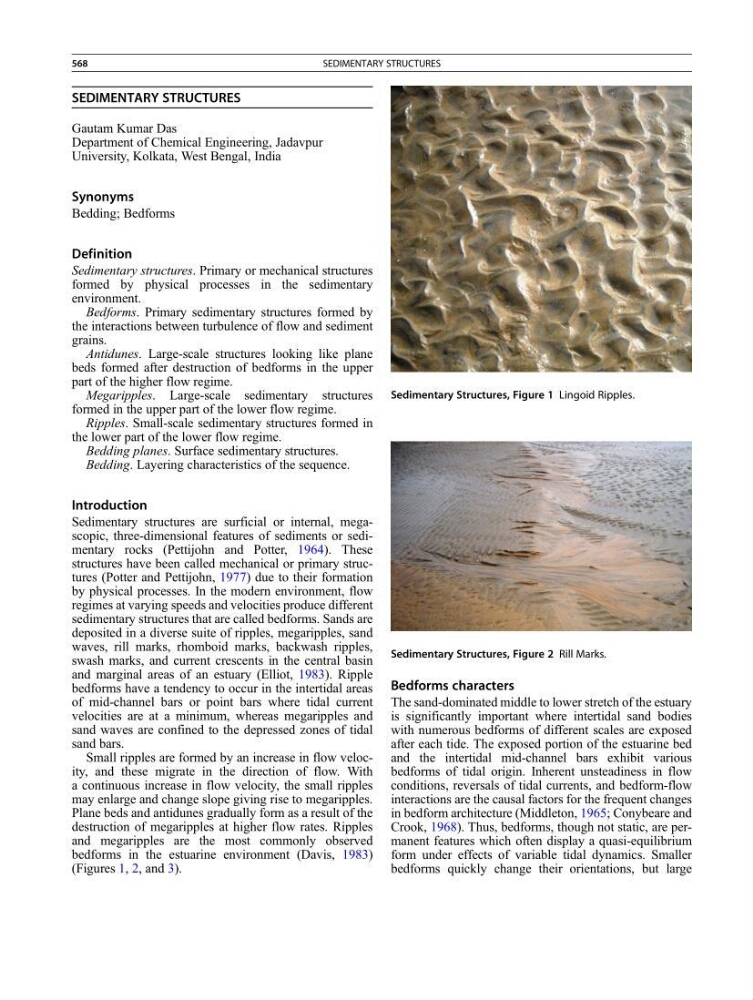
(Figures 1, 2, and 3).
Bedforms characters
The sand-dominated middle to lower stretch of the estuary
is significantly important where intertidal sand bodies
with numerous bedforms of different scales are exposed
after each tide. The exposed portion of the estuarine bed
and the intertidal mid-channel bars exhibit various
bedforms of tidal origin. Inherent unsteadiness in flow
conditions, reversals of tidal currents, and bedform-flow
interactions are the causal factors for the frequent changes
in bedform architecture (Middleton, 1965; Conybeare and
Crook, 1968). Thus, bedforms, though not static, are permanent features which often display a quasi-equilibrium
form under effects of variable tidal dynamics. Smaller
bedforms quickly change their orientations, but large
Sedimentary Structures, Figure 1 Lingoid Ripples.
Sedimentary Structures, Figure 2 Rill Marks.
568
SEDIMENTARY STRUCTURES