

sand waves do not, in response to changing flood-ebb
conditions (cf. Dalrymple et al., 1978; Collinson and
Thomson, 2006).
Types of bedforms
Three different scales of bedforms (i.e., small scale, intermediate scale, and large scale) are recognizable by different geomorphic units in mesotidal and macrotidal
estuaries. The small-scale bedforms include all varieties
of ripple marks. The intermediate-scale bedforms include
two different types of megaripples, and the large-scale
bedforms include sand waves.
Morphology of the bedforms
Large-scale bedforms
Sand waves
These features are the largest-scale bedforms observed on
the mid-channel bar surface. They are flood-oriented,
two-dimensional forms and appear mainly on the floor
of the flood-dominated portions of the bar surface. They
lack scour pits in their troughs and spurs on the slip faces.
Ripples superimposed on the sand waves have been partially planed off by the preceding ebb flow.
The intermediate-scale bedforms
Straight-crested megaripples
The mid-channel bar surface is extensively sculptured by
trains of straight-crested megaripples. They are parallel
to each other over considerable distances but exhibit
minor sinuosity. These megaripples have broadly
convex-up profiles, and their crestal heights remain more
or less constant without showing any well-developed
scour pits in the troughs. The troughs contain small ripples
with crestal orientations perpendicular to the megaripple
crests. This is because of the generation of secondary flow
along the troughs of megaripples during falling water
levels (Das and Bhattacharya, 2000).
Undulatory megaripples
Undulatory megaripples possess long wavy or undulating
crests and are devoid of well-developed scour pits in front
of their slip faces. In this respect, they differ from lunate
megaripples of Reineck and Singh (1980) or type II
megaripples of Dalrymple et al. (1978) in which the crest
line is broken and megaripples possess distinct scour pits
in front. Both in-phase and out-of-phase arrangements of
undulations are present in a single megaripples train. The
crests have forward tonguelike projections and steep profiles in contrast to those of the straight-crested
megaripples. The megaripples surface is ornamented by
linguoid ripples, which are produced by emergence.
Allen’s (1968) category of megaripples corresponds to
this type of bedform.
Small-scale bedforms
Ripples
These small-scale bedforms occur under the direct influence of both ebb and flood-tidal currents as well as under
the influence of any one of these currents where they originate along troughs of megaripples. The chief controlling
factors for their formation are the general slope of the
troughs, strength of tidal currents, and direction of wings.
The small-scale ripples are of various types as described
below.
Straight-crested ripples
These ripples have more or less straight crests and crestal
trains of successive ripples which run parallel for a few
meters. The surface undulation is very gentle because of
low ripple heights.
Linguoid ripples
These ripples exhibit a crescentic pattern in plan. The
crests are arcuate to tonguelike and have forward closures.
These ripples produce appreciable surface undulations.
The lee slopes can be easily measured in the field.
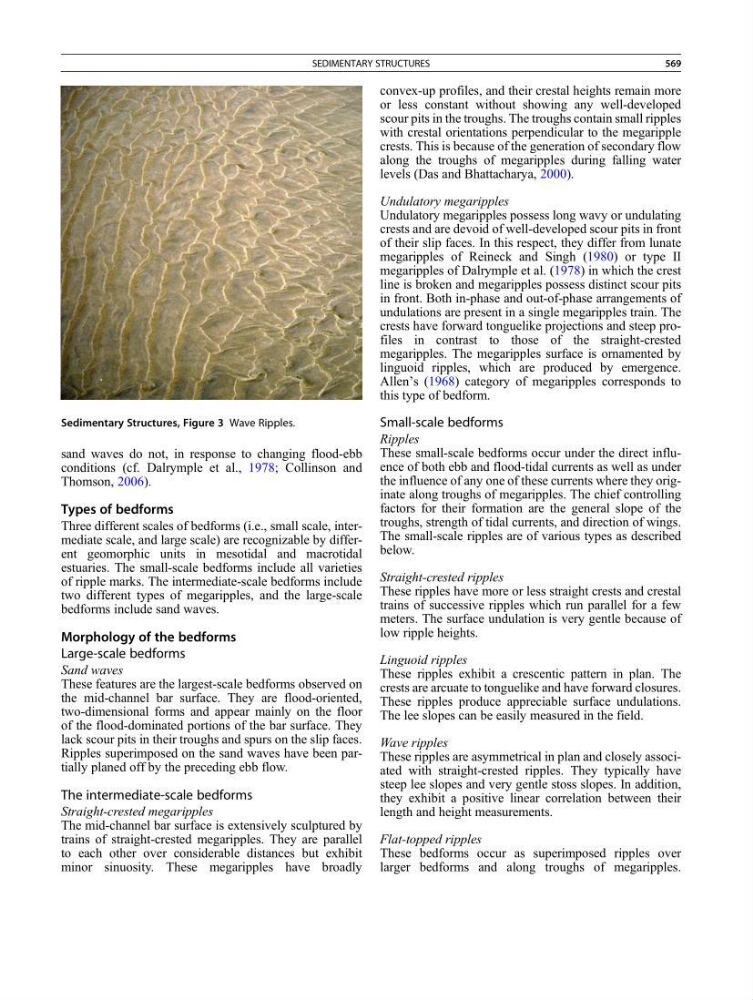
Wave ripples
These ripples are asymmetrical in plan and closely associated with straight-crested ripples. They typically have
steep lee slopes and very gentle stoss slopes. In addition,
they exhibit a positive linear correlation between their
length and height measurements.
Flat-topped ripples
These bedforms occur as superimposed ripples over
larger bedforms and along troughs of megaripples.
Sedimentary Structures, Figure 3 Wave Ripples.
SEDIMENTARY STRUCTURES
569