

The flows that are required to pick up grains of certain
sizes have been extensively studied empirically, and the
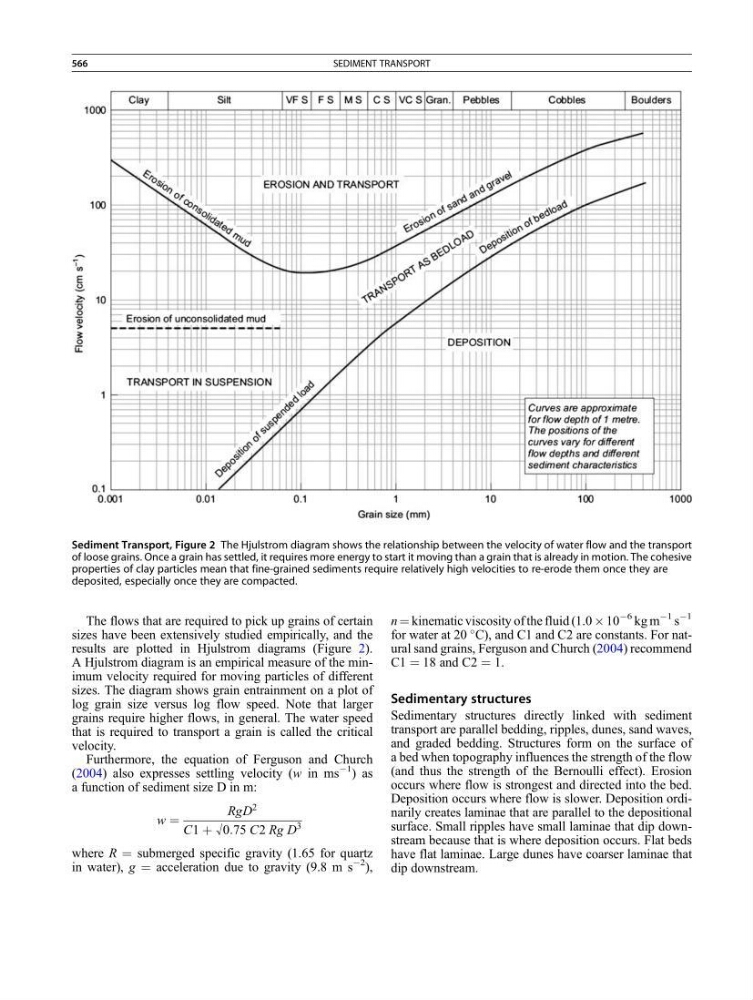
results are plotted in Hjulstrom diagrams (Figure 2).
A Hjulstrom diagram is an empirical measure of the minimum velocity required for moving particles of different
sizes. The diagram shows grain entrainment on a plot of
log grain size versus log flow speed. Note that larger
grains require higher flows, in general. The water speed
that is required to transport a grain is called the critical
velocity.
Furthermore, the equation of Ferguson and Church
(2004) also expresses settling velocity (w in ms
À1
) as
a function of sediment size D in m:
w ¼
RgD
2
C1 þ √0:75 C2 Rg D
3
where R ¼ submerged specific gravity (1.65 for quartz
in water), g ¼ acceleration due to gravity (9.8 m s
À2
),
n ¼ kinematic viscosity of the fluid (1.0 Â 10
À6 kg m
À1 s
À1
for water at 20
C), and C1 and C2 are constants. For natural sand grains, Ferguson and Church (2004) recommend
C1 ¼ 18 and C2 ¼ 1.
Sedimentary structures
Sedimentary structures directly linked with sediment
transport are parallel bedding, ripples, dunes, sand waves,
and graded bedding. Structures form on the surface of
a bed when topography influences the strength of the flow
(and thus the strength of the Bernoulli effect). Erosion
occurs where flow is strongest and directed into the bed.
Deposition occurs where flow is slower. Deposition ordinarily creates laminae that are parallel to the depositional
surface. Small ripples have small laminae that dip downstream because that is where deposition occurs. Flat beds
have flat laminae. Large dunes have coarser laminae that
dip downstream.
Sediment Transport, Figure 2 The Hjulstrom diagram shows the relationship between the velocity of water flow and the transport
of loose grains. Once a grain has settled, it requires more energy to start it moving than a grain that is already in motion. The cohesive
properties of clay particles mean that fine-grained sediments require relatively high velocities to re-erode them once they are
deposited, especially once they are compacted.
566
SEDIMENT TRANSPORT