

Yang (1972, 1973) approached the total transport from the
energy expenditure point of view and related the transport
rate to stream power. Shen and Hung (1971) derived
a regression equation based on laboratory data for the
sand-sized particles. Using the same concept, Ackers and
White (1973) defined sediment transport functions in
terms of three dimensionless groups, namely, size, mobility, and transport rate of sediments. Their functions are
based on flume data carried out with flow depths up to
0.4 m. One of the most extensive field and laboratory studies of sediment transport is that by Van Rijn (1984). He has
presented a method which enables the computation of the
bed-load transport as the product of the saltation height,
the particle velocity, and the bed-load concentration.
The theoretical equation for the distribution of
suspended sediment in turbulent flow has been given by
H. Rouse. Further useful information on the modification
of the theory can be found in Einstein and Chien (1955),
Vanoni (1984), Hassanzadeh (1985, 1979), and many
others (Graf, 1971; Graf and Altinakar, 1998; Raudkivi,
1976). Mei et al. (1994) also reported a study on the
hyperconcentrated fluid mud in rivers.
Several researchers have proposed formulas to estimate
the characteristics of the bed-load layer (Table 2).
Settling velocity
The settling velocity of sediment is one of the key
variables in the study of sediment transport. It hinges on
the type of flow (laminar, transitional, and turbulent) of
the fluid that transports the particle. Stokes’ settling theory
describes the velocity of a spherical particle settling
through a fluid – depending on a balance between the drag
force and the gravitational force. At the settling velocity,
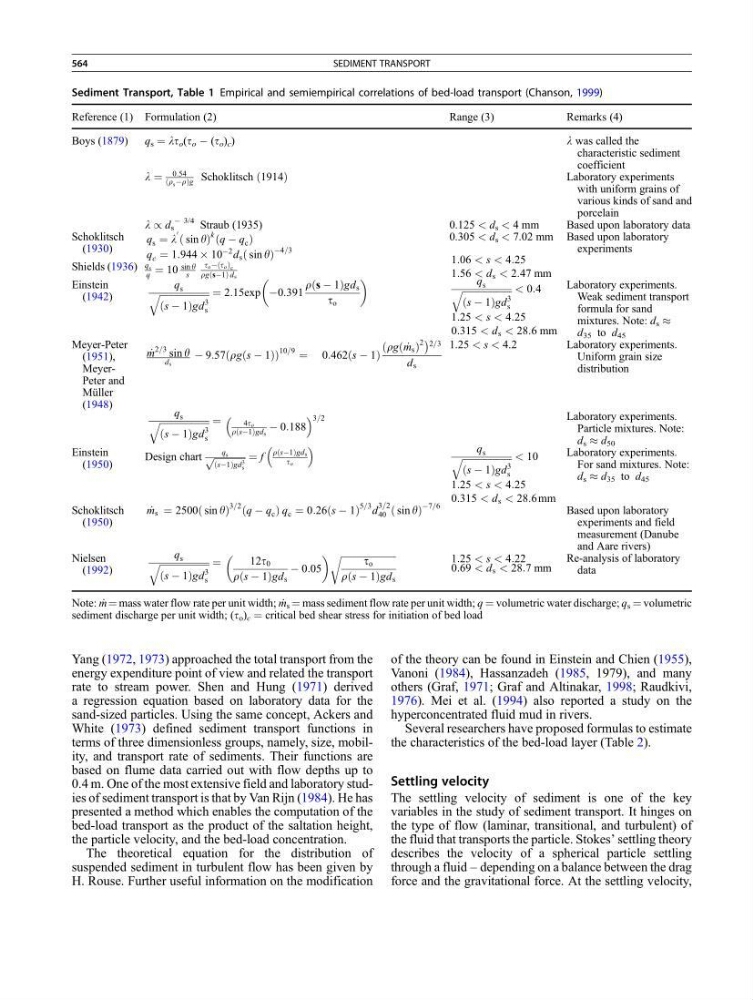
Sediment Transport, Table 1 Empirical and semiempirical correlations of bed-load transport (Chanson, 1999)
Reference (1) Formulation (2)
Range (3)
Remarks (4)
Boys (1879) q s ¼ lt o (t o À (t o ) c )
l was called the
characteristic sediment
coefficient
l ¼
0:54
r s Àr
ð
Þ g Schoklitsch 1914
ð
Þ
Laboratory experiments
with uniform grains of
various kinds of sand and
porcelain
l / d s
À 3/4 Straub (1935)
0.125 < d s < 4 mm
Based upon laboratory data
Schoklitsch
(1930)
q s ¼ l
0 sin y
ð
Þ
k q À q c
ð
Þ
q c ¼ 1:944 Â 10
À2 d s sin y
ð
Þ
À4=3
0.305 < d s < 7.02 mm Based upon laboratory
experiments
Shields (1936) q s
q ¼ 10
sin y
s
toÀ to
ð Þ c
rg sÀ1
ð
Þds
1:06 < s < 4:25
1:56 < d s < 2:47 mm
Einstein
(1942)
q s
ffiffiffiffiffiffiffiffiffiffiffiffiffiffiffiffiffiffiffiffiffi
s À 1
ð
Þgd
3
s
q
¼ 2:15exp À0:391
r s À 1
ð
Þgd s
t o
q s
ffiffiffiffiffiffiffiffiffiffiffiffiffiffiffiffiffiffiffiffiffi
s À 1
ð
Þgd
3
s
q
< 0:4
1:25 < s < 4:25
0:315 < d s < 28:6 mm
Laboratory experiments.
Weak sediment transport
formula for sand
mixtures. Note: d s %
d 35 to d 45
Meyer-Peter
(1951),
MeyerPeter and
Müller
(1948)
_
m
2=3 sin y
ds
À 9:57 rg s À 1
ð
Þ
ð
Þ
10=9 ¼ 0:462 s À 1
ð
Þ
ðrg _
m s
ð Þ
2 Á 2=3
d s
1.25 < s < 4.2
Laboratory experiments.
Uniform grain size
distribution
q s
ffiffiffiffiffiffiffiffiffiffiffiffiffiffiffiffiffiffiffiffiffi
s À 1
ð
Þgd
3
s
q
¼
4to
r sÀ1
ð
Þgds À 0:188
3=2
Laboratory experiments.
Particle mixtures. Note:
d s % d 50
Einstein
(1950)
Design chart
q s
ffiffiffiffiffiffiffiffiffiffiffiffiffi ffi
sÀ1
ð
Þgd
3
s
p
¼ f
r sÀ1
ð
Þgds
to
q s
ffiffiffiffiffiffiffiffiffiffiffiffiffiffiffiffiffiffiffiffiffi
s À 1
ð
Þgd
3
s
q
< 10
1:25 < s < 4:25
0:315 < d s < 28:6 mm
Laboratory experiments.
For sand mixtures. Note:
d s % d 35 to d 45
Schoklitsch
(1950)
_
m s ¼ 2500 sin y
ð
Þ
3=2 q À q c
ð
Þq c ¼ 0:26 s À 1
ð
Þ
5=3 d
3=2
40 sin y
ð
Þ
À7=6
Based upon laboratory
experiments and field
measurement (Danube
and Aare rivers)
Nielsen
(1992)
q s
ffiffiffiffiffiffiffiffiffiffiffiffiffiffiffiffiffiffiffiffiffi
s À 1
ð
Þgd
3
s
q
¼
12t 0
r s À 1
ð
Þgd s
À 0:05
ffiffiffiffiffiffiffiffiffiffiffiffiffiffiffiffiffiffiffiffiffiffiffi ffi
t o
r s À 1
ð
Þgd s
r
1:25 < s < 4:22
0:69 < d s < 28:7 mm
Re-analysis of laboratory
data
Note: _
m ¼ mass water flow rate per unit width; _
m s ¼ mass sediment flow rate per unit width; q ¼ volumetric water discharge; q s ¼ volumetric
sediment discharge per unit width; (t o ) c ¼ critical bed shear stress for initiation of bed load
564
SEDIMENT TRANSPORT