

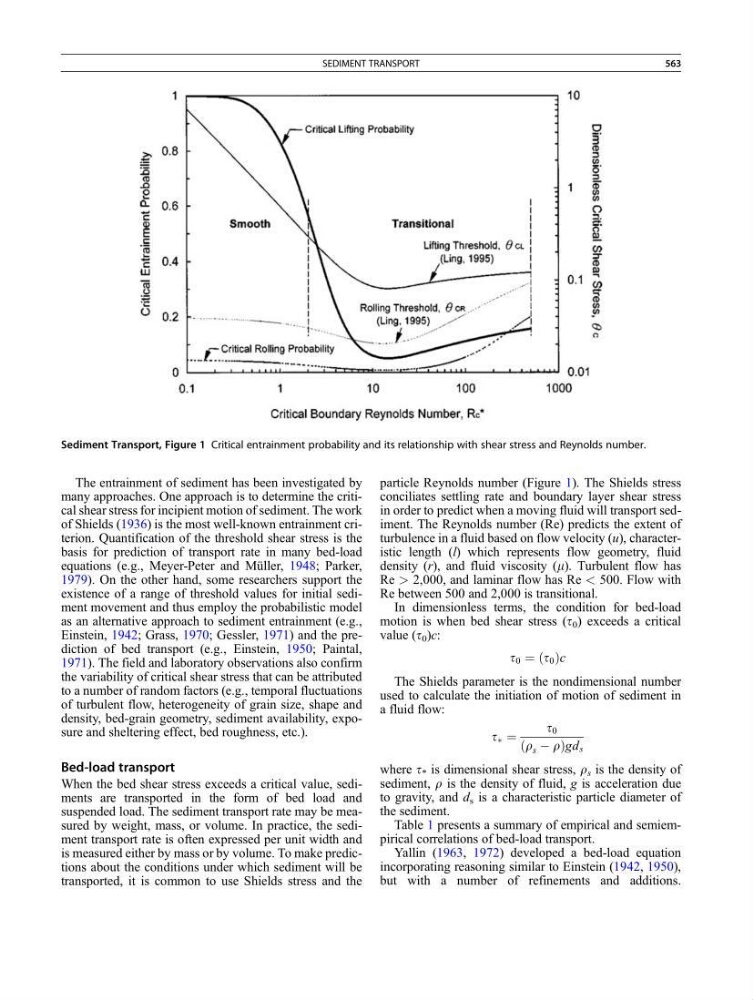
The entrainment of sediment has been investigated by
many approaches. One approach is to determine the critical shear stress for incipient motion of sediment. The work
of Shields (1936) is the most well-known entrainment criterion. Quantification of the threshold shear stress is the
basis for prediction of transport rate in many bed-load
equations (e.g., Meyer-Peter and Müller, 1948; Parker,
1979). On the other hand, some researchers support the
existence of a range of threshold values for initial sediment movement and thus employ the probabilistic model
as an alternative approach to sediment entrainment (e.g.,
Einstein, 1942; Grass, 1970; Gessler, 1971) and the prediction of bed transport (e.g., Einstein, 1950; Paintal,
1971). The field and laboratory observations also confirm
the variability of critical shear stress that can be attributed
to a number of random factors (e.g., temporal fluctuations
of turbulent flow, heterogeneity of grain size, shape and
density, bed-grain geometry, sediment availability, exposure and sheltering effect, bed roughness, etc.).
Bed-load transport
When the bed shear stress exceeds a critical value, sediments are transported in the form of bed load and
suspended load. The sediment transport rate may be measured by weight, mass, or volume. In practice, the sediment transport rate is often expressed per unit width and
is measured either by mass or by volume. To make predictions about the conditions under which sediment will be
transported, it is common to use Shields stress and the
particle Reynolds number (Figure 1). The Shields stress
conciliates settling rate and boundary layer shear stress
in order to predict when a moving fluid will transport sediment. The Reynolds number (Re) predicts the extent of
turbulence in a fluid based on flow velocity (u), characteristic length (l) which represents flow geometry, fluid
density (r), and fluid viscosity (m). Turbulent flow has
Re > 2,000, and laminar flow has Re < 500. Flow with
Re between 500 and 2,000 is transitional.
In dimensionless terms, the condition for bed-load
motion is when bed shear stress (t 0 ) exceeds a critical
value (t 0 )c:
t 0 ¼ t 0
ð Þc
The Shields parameter is the nondimensional number
used to calculate the initiation of motion of sediment in
a fluid flow:
t à ¼
t 0
r s À r
ð
Þgd s
where t * is dimensional shear stress, r s is the density of
sediment, r is the density of fluid, g is acceleration due
to gravity, and d s is a characteristic particle diameter of
the sediment.
Table 1 presents a summary of empirical and semiempirical correlations of bed-load transport.
Yallin (1963, 1972) developed a bed-load equation
incorporating reasoning similar to Einstein (1942, 1950),
but with a number of refinements and additions.
Sediment Transport, Figure 1 Critical entrainment probability and its relationship with shear stress and Reynolds number.
SEDIMENT TRANSPORT
563