

Small mammals, such as rabbits and hares, may be
obvious on some marshes. Other species such as voles
can be abundant but remain well hidden. North American
marshes are notable as habitat for a number of small rodent
taxa with limited geographic distributions which are now
regarded as threatened (Greenberg et al., 2006).
One group of mammals frequently ignored in assessments of saltmarshes is bats. Spencer et al. (2009) have
documented the utilization of saltmarshes by
Microchiroptera feeding on the abundance of flying
insects. As many bat species are of conservation concern,
this finding suggests that investigation of bats on
saltmarshes should be undertaken more widely.
Invasive species
Invasion of ecosystems by introduced species is one of the
factors seen as a major threat to biodiversity in most of the
world’s environments (see Introduced Species, Invasive
Species). In the marine environment, estuaries are recognized as being particularly exposed to invasion (Levin
and Crooks, 2011), and shipping is the major vector for
introductions, either through ballast (historically from
stone ballast, more recently in water ballast) or as fouling
organisms on ships’ hulls. An issue with detecting introductions is lack of reliable baseline data for many regions
and for many taxonomic groups. For example, it will be
difficult to determine whether many microalgae or microorganisms in estuaries are indigenous or introductions.
Increasing population numbers of a species might be suggestive of recent arrival, but recent arrival does not prove
introduction. Natural processes of dispersal and establishment did not end with the advent of humans. An increasing population could have been triggered in indigenous
species by changes in the environmental conditions. Modern molecular genetic techniques may assist in both
detecting and determining the status of introductions, but
their application requires adequate and appropriate sampling. There has been controversy over whether the gastropod Littorina littorea on the eastern American
seaboard was an introduction from Europe or whether
unique American haplotypes indicate native status. The
apparently unique American haplotypes are probably
a consequence of under sampling, and a number of lines
of evidence make a very strong case for introduction
(Chapman et al., 2008).
In the case of vascular plants, the very wide, unquestionably native, distribution of many species in saltmarsh and
mangroves might suggest that species had reached the
limits of distribution through natural means, with little
scope for further introduction. The deliberate introduction
and subsequent establishment of mangroves in Hawaii
and California disprove the hypothesis (Sauer, 1988). In
the case of saltmarshes, large numbers of introduced plants
have been recorded. Many of these are annual species,
recorded from upper saltmarshes, particularly in Mediterranean climate regions. Whether these species have major
biological impacts is uncertain. There is, however,
a smaller number of perennial species which undoubtedly
have major impacts. The two most important examples
are the genus Spartina and Phragmites australis.
Spartina is a genus of halophytic grasses which is most
diverse in the Americas. One species, S. maritima, is
apparently native in the Old World, occurring in both
Europe and Africa (Figure 8). Spartina species are now
found in temperate and subtropical saltmarshes worldwide
as a result of numerous documented deliberate introductions and natural spread from points of introduction
(Strong and Ayres, 2009). The introduced Spartina
spp. can occur lower on the shore than other species, so
one of the reasons for introduction was to stabilize mudflats. A consequence has been a loss of intertidal mudflats,
an important habitat in their own right.
One of the features of Spartina is the potential for interspecific hybridization. This is a chance event, with only
a low probability of occurrence. However, successful
hybridization between the American Spartina alterniflora
and the indigenous S. maritima occurred in Southampton
Water on the English Channel coast in the nineteenth century, initially producing the sterile S. x townsendii which
subsequently gave rise to the fertile S. anglica (Strong
and Ayres, 2009). S. anglica is now the low marsh dominant on much of the North European coast and also occurs
widely elsewhere as a result of deliberate introductions
(Ranwell, 1967). In the 1970s, the US Army Corps of
Engineers
introduced
the
eastern
American
S. alterniflora into California. Hybridization with the
West Coast native S. foliosa occurred; the hybrid is rapidly
spreading and through direct competition and continued
pollen flow threatens the survival of S. foliosa (Strong
and Ayres, 2009).
The common reed Phragmites australis has one of the
widest natural distributions of any vascular plant, occurring in all continents except Antarctica. A European strain
of P. australis was introduced into North America in the
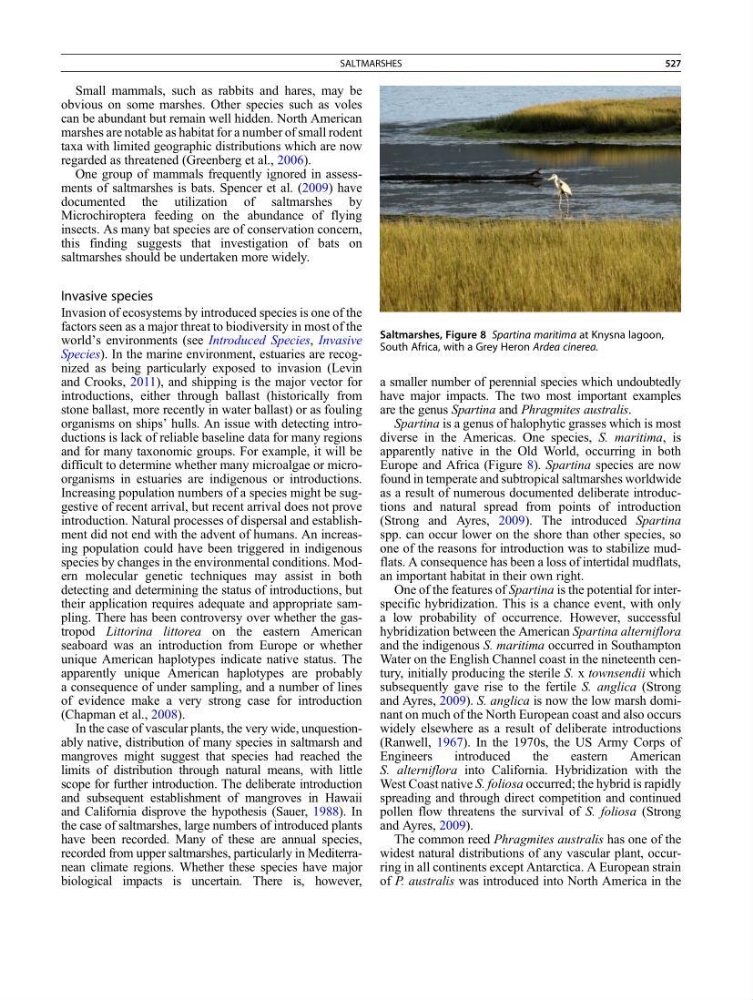
Saltmarshes, Figure 8 Spartina maritima at Knysna lagoon,
South Africa, with a Grey Heron Ardea cinerea.
SALTMARSHES
527
obvious on some marshes. Other species such as voles
can be abundant but remain well hidden. North American
marshes are notable as habitat for a number of small rodent
taxa with limited geographic distributions which are now
regarded as threatened (Greenberg et al., 2006).
One group of mammals frequently ignored in assessments of saltmarshes is bats. Spencer et al. (2009) have
documented the utilization of saltmarshes by
Microchiroptera feeding on the abundance of flying
insects. As many bat species are of conservation concern,
this finding suggests that investigation of bats on
saltmarshes should be undertaken more widely.
Invasive species
Invasion of ecosystems by introduced species is one of the
factors seen as a major threat to biodiversity in most of the
world’s environments (see Introduced Species, Invasive
Species). In the marine environment, estuaries are recognized as being particularly exposed to invasion (Levin
and Crooks, 2011), and shipping is the major vector for
introductions, either through ballast (historically from
stone ballast, more recently in water ballast) or as fouling
organisms on ships’ hulls. An issue with detecting introductions is lack of reliable baseline data for many regions
and for many taxonomic groups. For example, it will be
difficult to determine whether many microalgae or microorganisms in estuaries are indigenous or introductions.
Increasing population numbers of a species might be suggestive of recent arrival, but recent arrival does not prove
introduction. Natural processes of dispersal and establishment did not end with the advent of humans. An increasing population could have been triggered in indigenous
species by changes in the environmental conditions. Modern molecular genetic techniques may assist in both
detecting and determining the status of introductions, but
their application requires adequate and appropriate sampling. There has been controversy over whether the gastropod Littorina littorea on the eastern American
seaboard was an introduction from Europe or whether
unique American haplotypes indicate native status. The
apparently unique American haplotypes are probably
a consequence of under sampling, and a number of lines
of evidence make a very strong case for introduction
(Chapman et al., 2008).
In the case of vascular plants, the very wide, unquestionably native, distribution of many species in saltmarsh and
mangroves might suggest that species had reached the
limits of distribution through natural means, with little
scope for further introduction. The deliberate introduction
and subsequent establishment of mangroves in Hawaii
and California disprove the hypothesis (Sauer, 1988). In
the case of saltmarshes, large numbers of introduced plants
have been recorded. Many of these are annual species,
recorded from upper saltmarshes, particularly in Mediterranean climate regions. Whether these species have major
biological impacts is uncertain. There is, however,
a smaller number of perennial species which undoubtedly
have major impacts. The two most important examples
are the genus Spartina and Phragmites australis.
Spartina is a genus of halophytic grasses which is most
diverse in the Americas. One species, S. maritima, is
apparently native in the Old World, occurring in both
Europe and Africa (Figure 8). Spartina species are now
found in temperate and subtropical saltmarshes worldwide
as a result of numerous documented deliberate introductions and natural spread from points of introduction
(Strong and Ayres, 2009). The introduced Spartina
spp. can occur lower on the shore than other species, so
one of the reasons for introduction was to stabilize mudflats. A consequence has been a loss of intertidal mudflats,
an important habitat in their own right.
One of the features of Spartina is the potential for interspecific hybridization. This is a chance event, with only
a low probability of occurrence. However, successful
hybridization between the American Spartina alterniflora
and the indigenous S. maritima occurred in Southampton
Water on the English Channel coast in the nineteenth century, initially producing the sterile S. x townsendii which
subsequently gave rise to the fertile S. anglica (Strong
and Ayres, 2009). S. anglica is now the low marsh dominant on much of the North European coast and also occurs
widely elsewhere as a result of deliberate introductions
(Ranwell, 1967). In the 1970s, the US Army Corps of
Engineers
introduced
the
eastern
American
S. alterniflora into California. Hybridization with the
West Coast native S. foliosa occurred; the hybrid is rapidly
spreading and through direct competition and continued
pollen flow threatens the survival of S. foliosa (Strong
and Ayres, 2009).
The common reed Phragmites australis has one of the
widest natural distributions of any vascular plant, occurring in all continents except Antarctica. A European strain
of P. australis was introduced into North America in the
Saltmarshes, Figure 8 Spartina maritima at Knysna lagoon,
South Africa, with a Grey Heron Ardea cinerea.
SALTMARSHES
527