

There is a considerable diversity of spiders in saltmarshes,
and they are major predators in the ecosystem (Barnes, 1953;
Heydemann, 1979; Grimshaw, 1982; Petillon et al., 2007).
Some species escape flooding tides, but a number of species
can survive inundation (Petillon et al., 2009).
Terrestrial invertebrates on saltmarshes exhibit
a zonation comparable to that of plants (Heydemann,
1979). In some cases, this is due to a direct relationship
with particular plant species, while in other cases, it is
due to the animals responding to a similar environmental
gradient which determines plant distribution.
Terrestrial vertebrates
The most obvious vertebrates utilizing saltmarshes are
birds. Many species fly over saltmarshes or are occasional
visitors, but there are species which are particularly associated with saltmarshes.
In the northern hemisphere, large flocks of waterfowl –
ducks, geese, and swans – are a feature of many
saltmarshes for at least part of the year. Many of the species are migratory, breeding in the Arctic in summer and
overwintering farther south. The populations of
a number of these species, particularly geese, have
increased considerably in recent decades primarily in
response to changed agricultural practices which have
increased the availability of winter food, leading to higher
survival rates. In North America, the lesser snow goose
(Chen caerulescens caerulescens) population breeding
adjacent to Hudson Bay in northern Canada has caused
extensive damage to coastal marshes (Jefferies et al.,
2006), with loss of vegetation results from the grubbing
up of roots and rhizomes; the development of
hypersalinity in the newly bare areas and the compaction
of the soil through trampling by numerous geese prevent
recolonization (Jefferies et al., 2006; Henry and Jefferies,
2009). On the wintering grounds, grubbing by geese can
be a major but localized disturbance (Smith and Odum,
1981), but geese also utilize extensive areas of cropland,
so the damage to temperate marshes is far less than that
in the Arctic. In northern Europe, overwintering waterfowl help to maintain low grass vegetation on saltmarshes.
Whether impacts of increased breeding populations on
Eurasian Arctic marshes are as extensive as those in North
America is not reported in readily accessible literature.
The impact of geese is a very striking example of consumer pressure controlling ecosystem structure.
Shorebirds (which include wading birds) also include
many migratory species. The migratory paths of some species extend between hemispheres. Wading birds are
smaller than waterfowl but are the long-distance flight
record holders. Satellite telemetry has revealed that
bar-tailed godwits (Limosa lapponica) are capable of
making nonstop flights of over 10,000 km from breeding
territory in northern Alaska to New Zealand (Gill et al.,
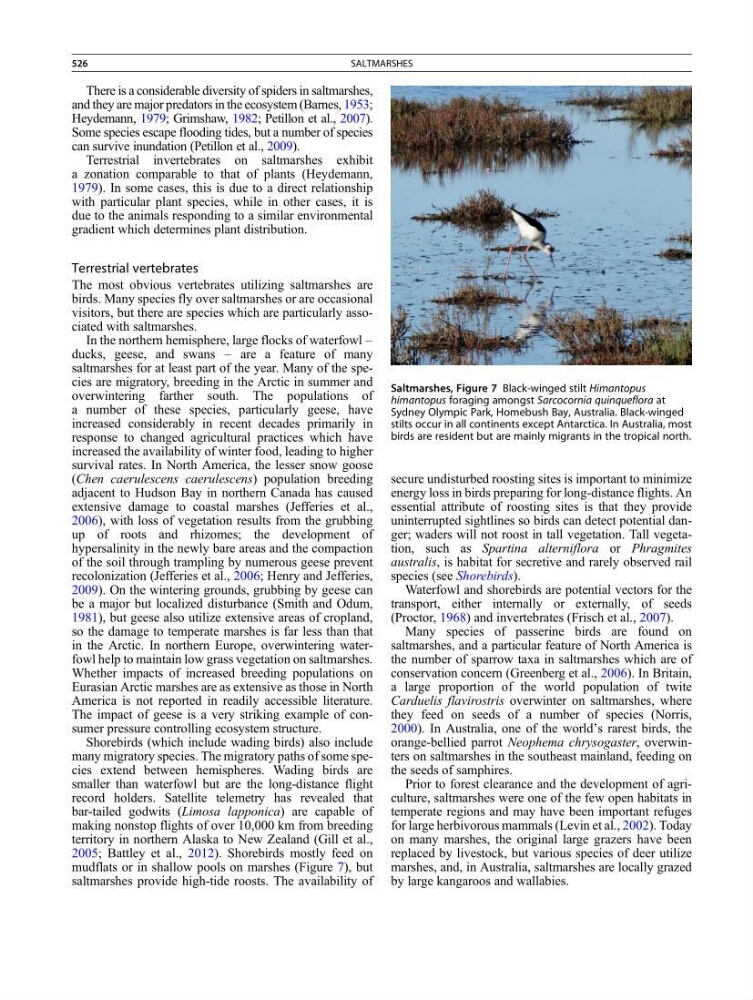
2005; Battley et al., 2012). Shorebirds mostly feed on
mudflats or in shallow pools on marshes (Figure 7), but
saltmarshes provide high-tide roosts. The availability of
secure undisturbed roosting sites is important to minimize
energy loss in birds preparing for long-distance flights. An
essential attribute of roosting sites is that they provide
uninterrupted sightlines so birds can detect potential danger; waders will not roost in tall vegetation. Tall vegetation, such as Spartina alterniflora or Phragmites
australis, is habitat for secretive and rarely observed rail
species (see Shorebirds).
Waterfowl and shorebirds are potential vectors for the
transport, either internally or externally, of seeds
(Proctor, 1968) and invertebrates (Frisch et al., 2007).
Many species of passerine birds are found on
saltmarshes, and a particular feature of North America is
the number of sparrow taxa in saltmarshes which are of
conservation concern (Greenberg et al., 2006). In Britain,
a large proportion of the world population of twite
Carduelis flavirostris overwinter on saltmarshes, where
they feed on seeds of a number of species (Norris,
2000). In Australia, one of the world’s rarest birds, the
orange-bellied parrot Neophema chrysogaster, overwinters on saltmarshes in the southeast mainland, feeding on
the seeds of samphires.
Prior to forest clearance and the development of agriculture, saltmarshes were one of the few open habitats in
temperate regions and may have been important refuges
for large herbivorous mammals (Levin et al., 2002). Today
on many marshes, the original large grazers have been
replaced by livestock, but various species of deer utilize
marshes, and, in Australia, saltmarshes are locally grazed
by large kangaroos and wallabies.
Saltmarshes, Figure 7 Black-winged stilt Himantopus
himantopus foraging amongst Sarcocornia quinqueflora at
Sydney Olympic Park, Homebush Bay, Australia. Black-winged
stilts occur in all continents except Antarctica. In Australia, most
birds are resident but are mainly migrants in the tropical north.
526
SALTMARSHES
and they are major predators in the ecosystem (Barnes, 1953;
Heydemann, 1979; Grimshaw, 1982; Petillon et al., 2007).
Some species escape flooding tides, but a number of species
can survive inundation (Petillon et al., 2009).
Terrestrial invertebrates on saltmarshes exhibit
a zonation comparable to that of plants (Heydemann,
1979). In some cases, this is due to a direct relationship
with particular plant species, while in other cases, it is
due to the animals responding to a similar environmental
gradient which determines plant distribution.
Terrestrial vertebrates
The most obvious vertebrates utilizing saltmarshes are
birds. Many species fly over saltmarshes or are occasional
visitors, but there are species which are particularly associated with saltmarshes.
In the northern hemisphere, large flocks of waterfowl –
ducks, geese, and swans – are a feature of many
saltmarshes for at least part of the year. Many of the species are migratory, breeding in the Arctic in summer and
overwintering farther south. The populations of
a number of these species, particularly geese, have
increased considerably in recent decades primarily in
response to changed agricultural practices which have
increased the availability of winter food, leading to higher
survival rates. In North America, the lesser snow goose
(Chen caerulescens caerulescens) population breeding
adjacent to Hudson Bay in northern Canada has caused
extensive damage to coastal marshes (Jefferies et al.,
2006), with loss of vegetation results from the grubbing
up of roots and rhizomes; the development of
hypersalinity in the newly bare areas and the compaction
of the soil through trampling by numerous geese prevent
recolonization (Jefferies et al., 2006; Henry and Jefferies,
2009). On the wintering grounds, grubbing by geese can
be a major but localized disturbance (Smith and Odum,
1981), but geese also utilize extensive areas of cropland,
so the damage to temperate marshes is far less than that
in the Arctic. In northern Europe, overwintering waterfowl help to maintain low grass vegetation on saltmarshes.
Whether impacts of increased breeding populations on
Eurasian Arctic marshes are as extensive as those in North
America is not reported in readily accessible literature.
The impact of geese is a very striking example of consumer pressure controlling ecosystem structure.
Shorebirds (which include wading birds) also include
many migratory species. The migratory paths of some species extend between hemispheres. Wading birds are
smaller than waterfowl but are the long-distance flight
record holders. Satellite telemetry has revealed that
bar-tailed godwits (Limosa lapponica) are capable of
making nonstop flights of over 10,000 km from breeding
territory in northern Alaska to New Zealand (Gill et al.,
2005; Battley et al., 2012). Shorebirds mostly feed on
mudflats or in shallow pools on marshes (Figure 7), but
saltmarshes provide high-tide roosts. The availability of
secure undisturbed roosting sites is important to minimize
energy loss in birds preparing for long-distance flights. An
essential attribute of roosting sites is that they provide
uninterrupted sightlines so birds can detect potential danger; waders will not roost in tall vegetation. Tall vegetation, such as Spartina alterniflora or Phragmites
australis, is habitat for secretive and rarely observed rail
species (see Shorebirds).
Waterfowl and shorebirds are potential vectors for the
transport, either internally or externally, of seeds
(Proctor, 1968) and invertebrates (Frisch et al., 2007).
Many species of passerine birds are found on
saltmarshes, and a particular feature of North America is
the number of sparrow taxa in saltmarshes which are of
conservation concern (Greenberg et al., 2006). In Britain,
a large proportion of the world population of twite
Carduelis flavirostris overwinter on saltmarshes, where
they feed on seeds of a number of species (Norris,
2000). In Australia, one of the world’s rarest birds, the
orange-bellied parrot Neophema chrysogaster, overwinters on saltmarshes in the southeast mainland, feeding on
the seeds of samphires.
Prior to forest clearance and the development of agriculture, saltmarshes were one of the few open habitats in
temperate regions and may have been important refuges
for large herbivorous mammals (Levin et al., 2002). Today
on many marshes, the original large grazers have been
replaced by livestock, but various species of deer utilize
marshes, and, in Australia, saltmarshes are locally grazed
by large kangaroos and wallabies.
Saltmarshes, Figure 7 Black-winged stilt Himantopus
himantopus foraging amongst Sarcocornia quinqueflora at
Sydney Olympic Park, Homebush Bay, Australia. Black-winged
stilts occur in all continents except Antarctica. In Australia, most
birds are resident but are mainly migrants in the tropical north.
526
SALTMARSHES