

in determining the species composition of vegetation has
long been recognized in Europe (Adam, 1978). However,
until recently, the importance of invertebrates and the
effects of human activities in estuarine ecosystems were
not fully appreciated (Silliman et al., 2009a). In the United
States, there have now been several convincing demonstrations that key consumers can alter vegetation, for
example, following increases in populations of snails
(Silliman et al., 2009a) and crabs (Holdredge et al.,
2008; Altieri et al., 2012). The increases in grazers were
most probably initiated by reduction of predator numbers
as a result of harvesting by both professional and recreational fishers.
Dieback
In the 1950s, extensive areas of Spartina anglica marshes
in southern England exhibited dieback (Goodman
et al., 1959), although despite considerable investigation,
no single causal factor was isolated. In the early twentyfirst century, dieback of thousands of hectares of Spartina-dominated marshes on the Gulf and Atlantic coasts
of the United States also occurred (Alber et al., 2008;
Osgood and Silliman, 2009). A single causative factor is
unlikely and Osgood and Silliman (2009) suggest that
interactions between several factors are involved: (1) climate, with severe drought being a trigger; (2) drought,
which could be responsible for changes in soils, including
increased salinity, acidity, and bioavailability of metals,
the stresses either directly killing Spartina rendering it
more susceptible to pathogens; and (3) populations of
grazers which have been increased by reduction in predator pressure. Osgood and Silliman (2009) discount eutrophication as a major factor in dieback, although
acknowledging that it contributes to the general stresses
on marshes.
Eutrophication is widespread in estuarine and coastal
waters in the United States (Scavia and Bricker, 2006)
and elsewhere in the world. Deegan et al., (2012) propose
that eutrophication is a driver of saltmarsh loss. The
mechanism suggested is that nutrient enrichment promotes increased aboveground productivity and reduction
(or maintenance of) below ground biomass so that
there is a reduction in the binding of sediment, leading
to collapse of creek sides and erosion of the lower
marsh zone.
The mechanisms suggested as contributing to both dieback and losses from eutrophication are not unique to
North America. Why have similar phenomena not been
reported from saltmarshes in other continents? Are there
features of Spartina marshes which render them particularly vulnerable?
Biota
The biota of saltmarshes can be categorized in a number of
different ways – by conventional taxonomy, by whether
species are of marine or terrestrial origin, and by pattern
of occupancy of saltmarsh habitats (permanent residence,
residence for particular stages of life cycle, migrant, or
opportunistic).
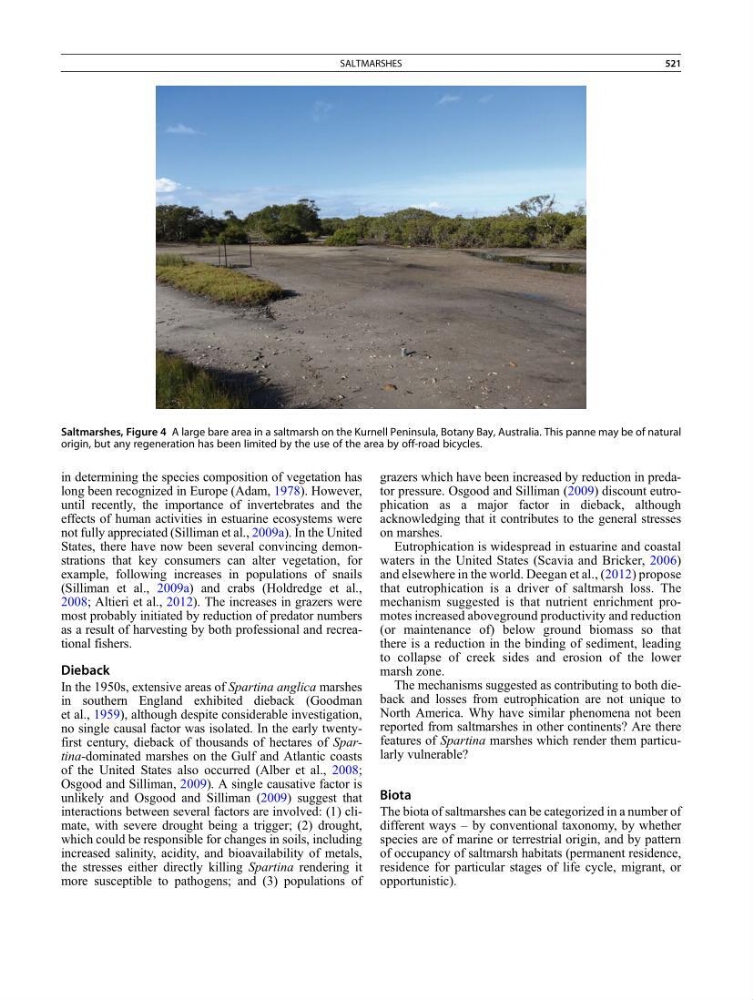
Saltmarshes, Figure 4 A large bare area in a saltmarsh on the Kurnell Peninsula, Botany Bay, Australia. This panne may be of natural
origin, but any regeneration has been limited by the use of the area by off-road bicycles.
SALTMARSHES
521
long been recognized in Europe (Adam, 1978). However,
until recently, the importance of invertebrates and the
effects of human activities in estuarine ecosystems were
not fully appreciated (Silliman et al., 2009a). In the United
States, there have now been several convincing demonstrations that key consumers can alter vegetation, for
example, following increases in populations of snails
(Silliman et al., 2009a) and crabs (Holdredge et al.,
2008; Altieri et al., 2012). The increases in grazers were
most probably initiated by reduction of predator numbers
as a result of harvesting by both professional and recreational fishers.
Dieback
In the 1950s, extensive areas of Spartina anglica marshes
in southern England exhibited dieback (Goodman
et al., 1959), although despite considerable investigation,
no single causal factor was isolated. In the early twentyfirst century, dieback of thousands of hectares of Spartina-dominated marshes on the Gulf and Atlantic coasts
of the United States also occurred (Alber et al., 2008;
Osgood and Silliman, 2009). A single causative factor is
unlikely and Osgood and Silliman (2009) suggest that
interactions between several factors are involved: (1) climate, with severe drought being a trigger; (2) drought,
which could be responsible for changes in soils, including
increased salinity, acidity, and bioavailability of metals,
the stresses either directly killing Spartina rendering it
more susceptible to pathogens; and (3) populations of
grazers which have been increased by reduction in predator pressure. Osgood and Silliman (2009) discount eutrophication as a major factor in dieback, although
acknowledging that it contributes to the general stresses
on marshes.
Eutrophication is widespread in estuarine and coastal
waters in the United States (Scavia and Bricker, 2006)
and elsewhere in the world. Deegan et al., (2012) propose
that eutrophication is a driver of saltmarsh loss. The
mechanism suggested is that nutrient enrichment promotes increased aboveground productivity and reduction
(or maintenance of) below ground biomass so that
there is a reduction in the binding of sediment, leading
to collapse of creek sides and erosion of the lower
marsh zone.
The mechanisms suggested as contributing to both dieback and losses from eutrophication are not unique to
North America. Why have similar phenomena not been
reported from saltmarshes in other continents? Are there
features of Spartina marshes which render them particularly vulnerable?
Biota
The biota of saltmarshes can be categorized in a number of
different ways – by conventional taxonomy, by whether
species are of marine or terrestrial origin, and by pattern
of occupancy of saltmarsh habitats (permanent residence,
residence for particular stages of life cycle, migrant, or
opportunistic).
Saltmarshes, Figure 4 A large bare area in a saltmarsh on the Kurnell Peninsula, Botany Bay, Australia. This panne may be of natural
origin, but any regeneration has been limited by the use of the area by off-road bicycles.
SALTMARSHES
521