

be reached by nearly every tide (although where mangroves are found as a seaward zone even the lowest levels
of marsh may be flooded by relatively few tides). The
upper levels of marsh are reached by spring tides, at
the highest levels possibly only once or twice a year. In
the lower marsh, with frequent flooding, soil salinity and
soil aeration are reasonably constant; at higher elevations,
there is greater variability. Conditions are strongly
influenced by climate. Rainfall can lower soil salinity,
and dry periods can result in hypersalinity. The tidal range
will determine the depth to which the lower marshes flood
and importantly, the velocity of the tidal current. The
speed of the current can influence the success of seedling
establishment, newly germinated seedlings being vulnerable to uprooting. The timing of tides and of rainfall
(germination of many halophytes is promoted by salinity
reduction) means opportunities for seedling establishment
are limited.
Explanations of the patterns of species and community
distributions within saltmarshes have traditionally emphasized the importance of physical factors and assigned
a limited role to biotic interactions, an example being the
description of the holocoenotic complex by Clarke and
Hannon (1969). Nevertheless, the role of plants was recognized very early in scientific investigations of saltmarsh
geomorphology. Similarly, the role of grazing by livestock
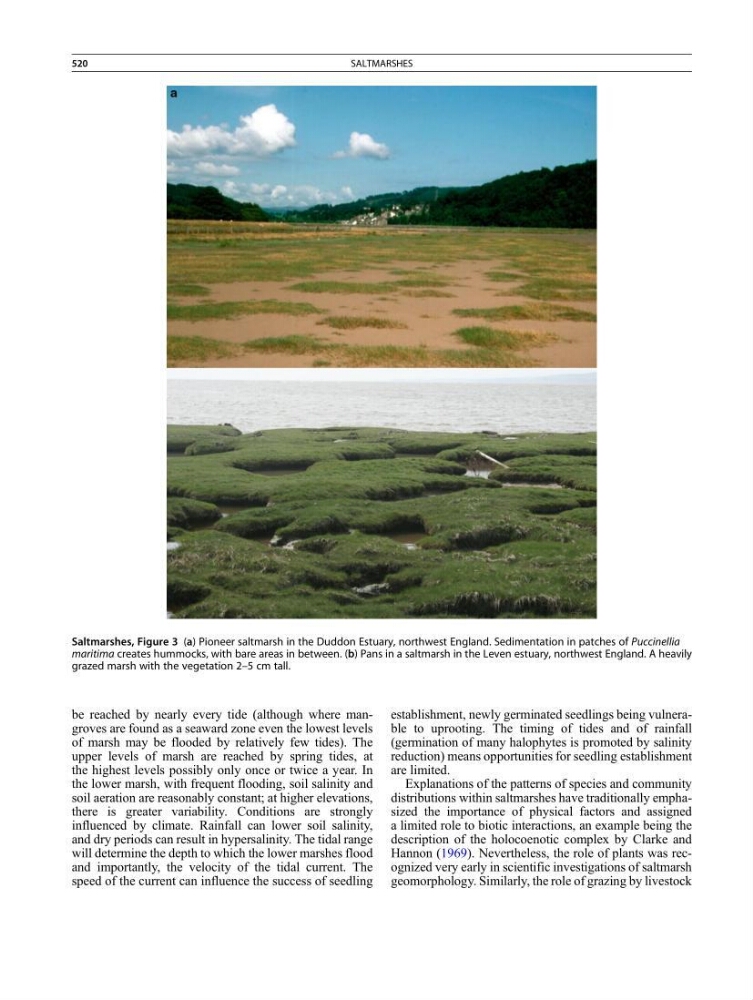
Saltmarshes, Figure 3 (a) Pioneer saltmarsh in the Duddon Estuary, northwest England. Sedimentation in patches of Puccinellia
maritima creates hummocks, with bare areas in between. (b) Pans in a saltmarsh in the Leven estuary, northwest England. A heavily
grazed marsh with the vegetation 2–5 cm tall.
520
SALTMARSHES
of marsh may be flooded by relatively few tides). The
upper levels of marsh are reached by spring tides, at
the highest levels possibly only once or twice a year. In
the lower marsh, with frequent flooding, soil salinity and
soil aeration are reasonably constant; at higher elevations,
there is greater variability. Conditions are strongly
influenced by climate. Rainfall can lower soil salinity,
and dry periods can result in hypersalinity. The tidal range
will determine the depth to which the lower marshes flood
and importantly, the velocity of the tidal current. The
speed of the current can influence the success of seedling
establishment, newly germinated seedlings being vulnerable to uprooting. The timing of tides and of rainfall
(germination of many halophytes is promoted by salinity
reduction) means opportunities for seedling establishment
are limited.
Explanations of the patterns of species and community
distributions within saltmarshes have traditionally emphasized the importance of physical factors and assigned
a limited role to biotic interactions, an example being the
description of the holocoenotic complex by Clarke and
Hannon (1969). Nevertheless, the role of plants was recognized very early in scientific investigations of saltmarsh
geomorphology. Similarly, the role of grazing by livestock
Saltmarshes, Figure 3 (a) Pioneer saltmarsh in the Duddon Estuary, northwest England. Sedimentation in patches of Puccinellia
maritima creates hummocks, with bare areas in between. (b) Pans in a saltmarsh in the Leven estuary, northwest England. A heavily
grazed marsh with the vegetation 2–5 cm tall.
520
SALTMARSHES