

Vascular plants
The vascular plants growing in the intertidal zone face two
particular challenges: salinity and the consequences of
inundation. Of these, salinity has been the most studied,
and there is now a detailed understanding of the mechanisms conferring salt tolerance (Flowers et al., 1977;
Flowers et al., 1986; Flowers and Colmer, 2008; Flowers
et al., 2010; Munns and Tester, 2008). Plants which tolerate
saline conditions are referred to as halophytes, in contrast to
non-salt-tolerant species, the glycophytes. Halophytes are
found not only in intertidal saltmarshes but in a range of
other salt-affected habitats. As yet there is not a complete
list of halophytes, in part because there are parts of the
world where saline habitats have not been fully investigated
but also because of lack of agreement on the definition of
halophyte. There is a continuum of salinity conditions and
where within the transition from brackish to freshwater conditions a limit is drawn between the habitats of halophytes
and glycophytes is arbitrary. Adopting the definition of
ability to complete the life cycle in at least 200 mM salt
(Flowers and Colmer, 2008; Flowers et al., 2010), the number of halophytes is probably between 500 and 1,000. In
some cases, an entire taxon might be described as halophytic, but there are a number of widespread species where
only some genotypes exhibit halophytic traits (Adam,
1990). Some of the species-rich upper saltmarsh communities in northwest Europe (Adam, 1981) may be composed,
at the species level, of species also found in a range of
nonsaline habitats. Nevertheless, the saltmarsh forms of
the species are adapted to tolerate and thrive under moderately saline conditions and can thus be regarded as halophytic genotypes. This emphasizes the point made by
Flowers et al. (2010) that halophytes are not unique; all
plants possess the same features, but the pattern and degree
of expression of particular traits are different in halophytes
from those in glycophytes.
Halophytes include species from a number of different
families and orders; the ability to tolerate saline conditions
appears to have evolved independently on a number of
occasions (Flowers et al., 2010). Viewed in isolation, there
are no features which immediately identify a plant as
being a saltmarsh species. This differs from the much
smaller pool of species which constitute mangroves,
where features such as possession of aerial roots or
production of viviparous seedlings are characteristic.
A feature shown by many saltmarsh species is succulence,
but this is also displayed by species in a number of other
habitats and on its own would not be sufficient to identify
species as being from saltmarsh. One feature that might
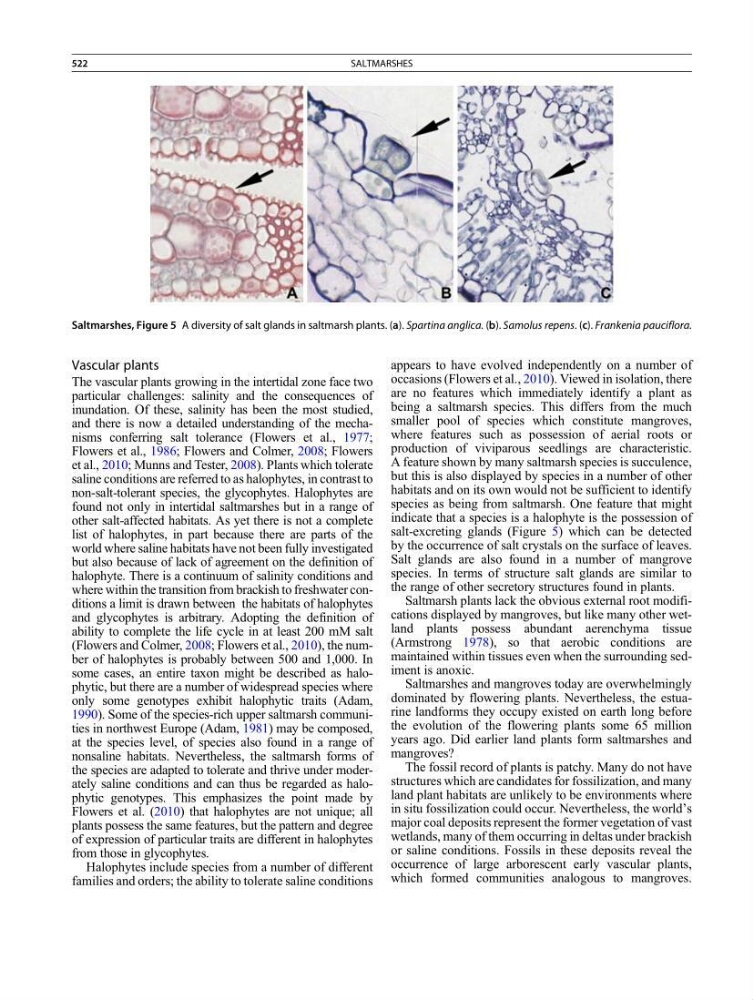
indicate that a species is a halophyte is the possession of
salt-excreting glands (Figure 5) which can be detected
by the occurrence of salt crystals on the surface of leaves.
Salt glands are also found in a number of mangrove
species. In terms of structure salt glands are similar to
the range of other secretory structures found in plants.
Saltmarsh plants lack the obvious external root modifications displayed by mangroves, but like many other wetland plants possess abundant aerenchyma tissue
(Armstrong 1978), so that aerobic conditions are
maintained within tissues even when the surrounding sediment is anoxic.
Saltmarshes and mangroves today are overwhelmingly
dominated by flowering plants. Nevertheless, the estuarine landforms they occupy existed on earth long before
the evolution of the flowering plants some 65 million
years ago. Did earlier land plants form saltmarshes and
mangroves?
The fossil record of plants is patchy. Many do not have
structures which are candidates for fossilization, and many
land plant habitats are unlikely to be environments where
in situ fossilization could occur. Nevertheless, the world’s
major coal deposits represent the former vegetation of vast
wetlands, many of them occurring in deltas under brackish
or saline conditions. Fossils in these deposits reveal the
occurrence of large arborescent early vascular plants,
which formed communities analogous to mangroves.
Saltmarshes, Figure 5 A diversity of salt glands in saltmarsh plants. (a). Spartina anglica. (b). Samolus repens. (c). Frankenia pauciflora.
522
SALTMARSHES
The vascular plants growing in the intertidal zone face two
particular challenges: salinity and the consequences of
inundation. Of these, salinity has been the most studied,
and there is now a detailed understanding of the mechanisms conferring salt tolerance (Flowers et al., 1977;
Flowers et al., 1986; Flowers and Colmer, 2008; Flowers
et al., 2010; Munns and Tester, 2008). Plants which tolerate
saline conditions are referred to as halophytes, in contrast to
non-salt-tolerant species, the glycophytes. Halophytes are
found not only in intertidal saltmarshes but in a range of
other salt-affected habitats. As yet there is not a complete
list of halophytes, in part because there are parts of the
world where saline habitats have not been fully investigated
but also because of lack of agreement on the definition of
halophyte. There is a continuum of salinity conditions and
where within the transition from brackish to freshwater conditions a limit is drawn between the habitats of halophytes
and glycophytes is arbitrary. Adopting the definition of
ability to complete the life cycle in at least 200 mM salt
(Flowers and Colmer, 2008; Flowers et al., 2010), the number of halophytes is probably between 500 and 1,000. In
some cases, an entire taxon might be described as halophytic, but there are a number of widespread species where
only some genotypes exhibit halophytic traits (Adam,
1990). Some of the species-rich upper saltmarsh communities in northwest Europe (Adam, 1981) may be composed,
at the species level, of species also found in a range of
nonsaline habitats. Nevertheless, the saltmarsh forms of
the species are adapted to tolerate and thrive under moderately saline conditions and can thus be regarded as halophytic genotypes. This emphasizes the point made by
Flowers et al. (2010) that halophytes are not unique; all
plants possess the same features, but the pattern and degree
of expression of particular traits are different in halophytes
from those in glycophytes.
Halophytes include species from a number of different
families and orders; the ability to tolerate saline conditions
appears to have evolved independently on a number of
occasions (Flowers et al., 2010). Viewed in isolation, there
are no features which immediately identify a plant as
being a saltmarsh species. This differs from the much
smaller pool of species which constitute mangroves,
where features such as possession of aerial roots or
production of viviparous seedlings are characteristic.
A feature shown by many saltmarsh species is succulence,
but this is also displayed by species in a number of other
habitats and on its own would not be sufficient to identify
species as being from saltmarsh. One feature that might
indicate that a species is a halophyte is the possession of
salt-excreting glands (Figure 5) which can be detected
by the occurrence of salt crystals on the surface of leaves.
Salt glands are also found in a number of mangrove
species. In terms of structure salt glands are similar to
the range of other secretory structures found in plants.
Saltmarsh plants lack the obvious external root modifications displayed by mangroves, but like many other wetland plants possess abundant aerenchyma tissue
(Armstrong 1978), so that aerobic conditions are
maintained within tissues even when the surrounding sediment is anoxic.
Saltmarshes and mangroves today are overwhelmingly
dominated by flowering plants. Nevertheless, the estuarine landforms they occupy existed on earth long before
the evolution of the flowering plants some 65 million
years ago. Did earlier land plants form saltmarshes and
mangroves?
The fossil record of plants is patchy. Many do not have
structures which are candidates for fossilization, and many
land plant habitats are unlikely to be environments where
in situ fossilization could occur. Nevertheless, the world’s
major coal deposits represent the former vegetation of vast
wetlands, many of them occurring in deltas under brackish
or saline conditions. Fossils in these deposits reveal the
occurrence of large arborescent early vascular plants,
which formed communities analogous to mangroves.
Saltmarshes, Figure 5 A diversity of salt glands in saltmarsh plants. (a). Spartina anglica. (b). Samolus repens. (c). Frankenia pauciflora.
522
SALTMARSHES