

Formation was incised (Piper, 2010; Troiani et al., 2011).
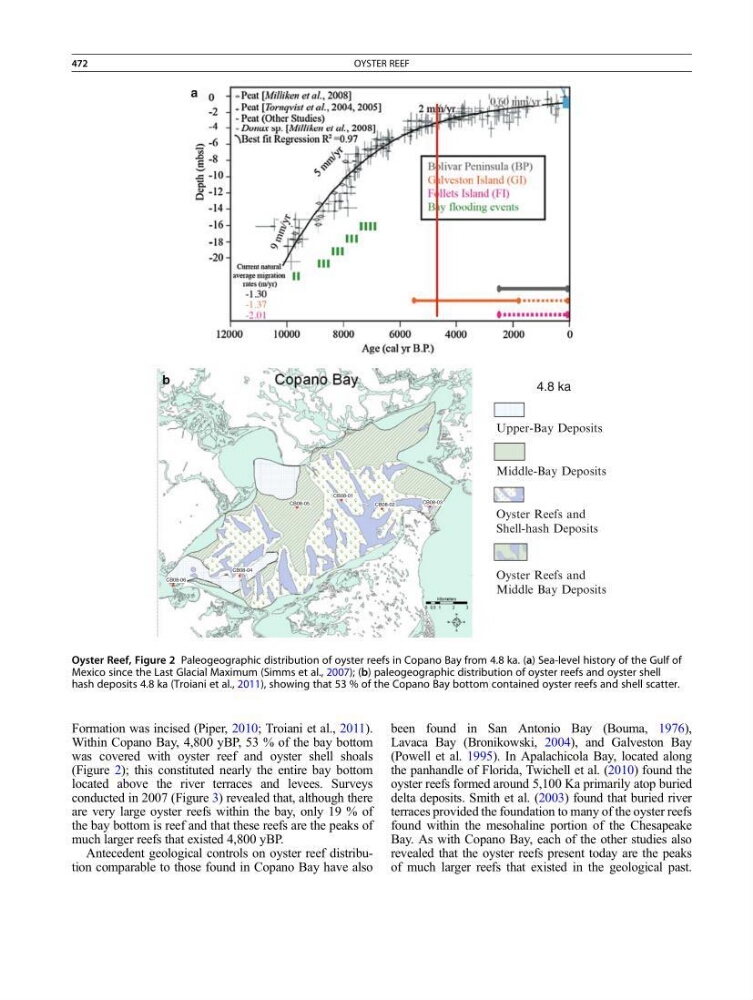
Within Copano Bay, 4,800 yBP, 53 % of the bay bottom
was covered with oyster reef and oyster shell shoals
(Figure 2); this constituted nearly the entire bay bottom
located above the river terraces and levees. Surveys
conducted in 2007 (Figure 3) revealed that, although there
are very large oyster reefs within the bay, only 19 % of
the bay bottom is reef and that these reefs are the peaks of
much larger reefs that existed 4,800 yBP.
Antecedent geological controls on oyster reef distribution comparable to those found in Copano Bay have also
been found in San Antonio Bay (Bouma, 1976),
Lavaca Bay (Bronikowski, 2004), and Galveston Bay
(Powell et al. 1995). In Apalachicola Bay, located along
the panhandle of Florida, Twichell et al. (2010) found the
oyster reefs formed around 5,100 Ka primarily atop buried
delta deposits. Smith et al. (2003) found that buried river
terraces provided the foundation to many of the oyster reefs
found within the mesohaline portion of the Chesapeake
Bay. As with Copano Bay, each of the other studies also
revealed that the oyster reefs present today are the peaks
of much larger reefs that existed in the geological past.
4.8 ka
CB08-02
CB08-03
CB08-04
CB08-05
CB08-01
CB08-06
Upper-Bay Deposits
Middle-Bay Deposits
Oyster Reefs and
Shell-hash Deposits
Oyster Reefs and
Middle Bay Deposits
b
a
Oyster Reef, Figure 2 Paleogeographic distribution of oyster reefs in Copano Bay from 4.8 ka. (a) Sea-level history of the Gulf of
Mexico since the Last Glacial Maximum (Simms et al., 2007); (b) paleogeographic distribution of oyster reefs and oyster shell
hash deposits 4.8 ka (Troiani et al., 2011), showing that 53 % of the Copano Bay bottom contained oyster reefs and shell scatter.
472
OYSTER REEF
Within Copano Bay, 4,800 yBP, 53 % of the bay bottom
was covered with oyster reef and oyster shell shoals
(Figure 2); this constituted nearly the entire bay bottom
located above the river terraces and levees. Surveys
conducted in 2007 (Figure 3) revealed that, although there
are very large oyster reefs within the bay, only 19 % of
the bay bottom is reef and that these reefs are the peaks of
much larger reefs that existed 4,800 yBP.
Antecedent geological controls on oyster reef distribution comparable to those found in Copano Bay have also
been found in San Antonio Bay (Bouma, 1976),
Lavaca Bay (Bronikowski, 2004), and Galveston Bay
(Powell et al. 1995). In Apalachicola Bay, located along
the panhandle of Florida, Twichell et al. (2010) found the
oyster reefs formed around 5,100 Ka primarily atop buried
delta deposits. Smith et al. (2003) found that buried river
terraces provided the foundation to many of the oyster reefs
found within the mesohaline portion of the Chesapeake
Bay. As with Copano Bay, each of the other studies also
revealed that the oyster reefs present today are the peaks
of much larger reefs that existed in the geological past.
4.8 ka
CB08-02
CB08-03
CB08-04
CB08-05
CB08-01
CB08-06
Upper-Bay Deposits
Middle-Bay Deposits
Oyster Reefs and
Shell-hash Deposits
Oyster Reefs and
Middle Bay Deposits
b
a
Oyster Reef, Figure 2 Paleogeographic distribution of oyster reefs in Copano Bay from 4.8 ka. (a) Sea-level history of the Gulf of
Mexico since the Last Glacial Maximum (Simms et al., 2007); (b) paleogeographic distribution of oyster reefs and oyster shell
hash deposits 4.8 ka (Troiani et al., 2011), showing that 53 % of the Copano Bay bottom contained oyster reefs and shell scatter.
472
OYSTER REEF