

In each case, antecedent geology, in the form of river terraces along the margins of incised fluvial valleys, tidal or
bayhead deltas, or other large sand shoals provided a highcompressive-strength foundation for these reefs to form.
Because coastal plain estuaries exist within partially
filled incised valleys, the portions of the bay bayward of
river terraces, tidal deltas, and bayhead deltas tend to be
areas where there are often 10–30 m-thick sequences of
relatively soft, unconsolidated, bay fill muds. These
areas are generally not capable of supporting oyster reefs.
Oyster reef restoration projects often do not consider the
geology when siting artificial reefs, and many restoration
projects have failed because the shell sinks into deep
bay fill deposits with no antecedent geologic foundation.
Historical oyster reefs exist within the bay because
there is a foundation for them. For oyster reef restoration
projects to succeed, they need to site the reefs on
areas where there is an antecedent geological foundation
capable of supporting the reef.
Summary
Oysters need to accumulate on a stable substrate that keeps
them elevated above the muddy bay bottom. Over time,
for oyster reefs to survive, they need to form atop
a substrate capable of supporting the weight of the reef.
Oyster reef restoration projects often do not consider the
geology when siting artificial reefs, and many restoration
projects have failed because the shell sinks into deep bay
fill deposits with no antecedent geologic foundation.
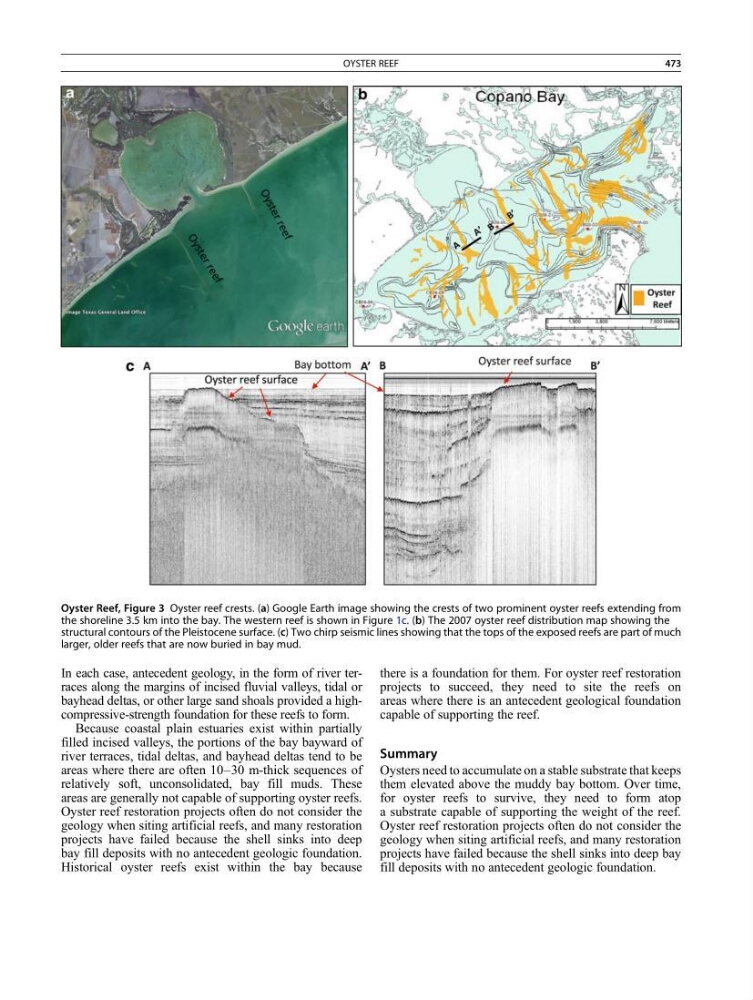
Oyster Reef, Figure 3 Oyster reef crests. (a) Google Earth image showing the crests of two prominent oyster reefs extending from
the shoreline 3.5 km into the bay. The western reef is shown in Figure 1c. (b) The 2007 oyster reef distribution map showing the
structural contours of the Pleistocene surface. (c) Two chirp seismic lines showing that the tops of the exposed reefs are part of much
larger, older reefs that are now buried in bay mud.
OYSTER REEF
473
bayhead deltas, or other large sand shoals provided a highcompressive-strength foundation for these reefs to form.
Because coastal plain estuaries exist within partially
filled incised valleys, the portions of the bay bayward of
river terraces, tidal deltas, and bayhead deltas tend to be
areas where there are often 10–30 m-thick sequences of
relatively soft, unconsolidated, bay fill muds. These
areas are generally not capable of supporting oyster reefs.
Oyster reef restoration projects often do not consider the
geology when siting artificial reefs, and many restoration
projects have failed because the shell sinks into deep
bay fill deposits with no antecedent geologic foundation.
Historical oyster reefs exist within the bay because
there is a foundation for them. For oyster reef restoration
projects to succeed, they need to site the reefs on
areas where there is an antecedent geological foundation
capable of supporting the reef.
Summary
Oysters need to accumulate on a stable substrate that keeps
them elevated above the muddy bay bottom. Over time,
for oyster reefs to survive, they need to form atop
a substrate capable of supporting the weight of the reef.
Oyster reef restoration projects often do not consider the
geology when siting artificial reefs, and many restoration
projects have failed because the shell sinks into deep bay
fill deposits with no antecedent geologic foundation.
Oyster Reef, Figure 3 Oyster reef crests. (a) Google Earth image showing the crests of two prominent oyster reefs extending from
the shoreline 3.5 km into the bay. The western reef is shown in Figure 1c. (b) The 2007 oyster reef distribution map showing the
structural contours of the Pleistocene surface. (c) Two chirp seismic lines showing that the tops of the exposed reefs are part of much
larger, older reefs that are now buried in bay mud.
OYSTER REEF
473